
Small goals
Too many goals? How to pick the one that matters right now
The short answer
When you have too many goals, pick the one you’d be most glad to see moving this month, and park the rest with a return date. Give the one you kept a small step, like a 20-minute walk. Do it at a time you already stop, such as after dinner. Keep it that small for a week.
In 30 seconds
- Pick one goal with three quick questions.
- Park the others with a date, so they can wait.
- Merge goals that are the same wish written twice.
- Add a second goal only when the first feels dull.
Picture the Notes app on your phone. There’s a list called “2026 Goals” with 17 items, and item 4 is “stop making lists”.
It’s October. Nothing on it has a tick.
The list isn’t lazy, and neither are you. It’s 17 goals all asking for the same Tuesday evening, so each one gets about four minutes and a guilty look.

Reading XP0 XP
Too many goals at once, and why they all stall
Every goal on that list wants a slice of the same few free hours, the ones between getting home and falling asleep.
Seventeen slices is a lot.
Each one ends up too thin to start anything, so nothing gets a first step. And the list grows by one item every time a new idea turns up.
What one study found
There’s a study that fits this. Amy Dalton and Stephen Spiller gave people a to-do list with either one good task or six, to finish over five days.
Some of them also planned exactly how, when and where they’d do each task.
Planning helped the people with one task (opens in a new tab), but not the people with six.
Their guess: planning six things makes you notice every clash between them, like two goals that both need the hour after work, until the whole plan looks impossible.
So you stop.
But the shape matches the Notes list. One goal with a plan beats six with six plans.
That’s also why our guide to setting small goals opens with the same word: one.
How to prioritize goals in three moves
Sorting takes ten minutes, and you can do it in bed. So which goal gets tonight?
Merge the repeats.
Put goals that are the same wish together under one name.
Pick one.
Use the three questions below if it’s close.
Park the rest.
Write a return date next to each one.
Here’s a made-up list of six, sorted. Yours will look different.
| On the list | Verdict | Why |
|---|---|---|
| “Walk 20 minutes after dinner” | Pick | It has a size and a time, and it fits tonight |
| “Get fit” | Merge into the walk | Same wish, with no number in it |
| “Read 20 books” | Park until 1 December | The books will still be on the shelf |
| “Learn Spanish” | Park until 1 February | It needs a daily slot you don’t have right now |
| “Drink more water” | Park until the walk feels dull | A good second goal, later |
| “Stop making lists” | Merge into this page | This is the last list for a while |
Merging does more work than it looks.
“Get fit”, “move more” and “walk after dinner” are often one goal, written down on three different days in three different moods.
Put them together and the list shrinks before you’ve chosen anything.
Three questions to pick the one
If two or three goals still look equally important, ask these. Give each goal a mark for every yes.
Which goal gets picked
Ticks stay in this browser. Nothing is sent.
The goal with the most marks wins. If it’s a tie, pick the smaller step.
A step you can start tonight beats one you’ll start when things calm down. Things rarely calm down.
The laundry doesn’t know you have goals.
Focus on one goal at a time without losing the rest
Parking feels risky. What if the Spanish gets forgotten for good?
It won’t, as long as it’s written down with a date.
There’s research on why the date helps. In a set of studies, E. J. Masicampo and Roy Baumeister found that unfinished goals kept coming to mind while people did an unrelated reading task.
When people wrote a specific plan for the unfinished goal (opens in a new tab), that effect went away.
Those were short lab tasks, and your Spanish is a bigger thing than an anagram puzzle. But a parked goal with a date is a small plan too.
Every parked goal gets a date, or it isn’t parked.
For the one goal you kept, cut it to a size that fits today. Our list of daily goals has 50 ideas, each with a busy-day version.
One goal at a time, in our app
We make an app built around one goal at a time, so weigh the next part with that in mind. A sticky note on the fridge does the same job.
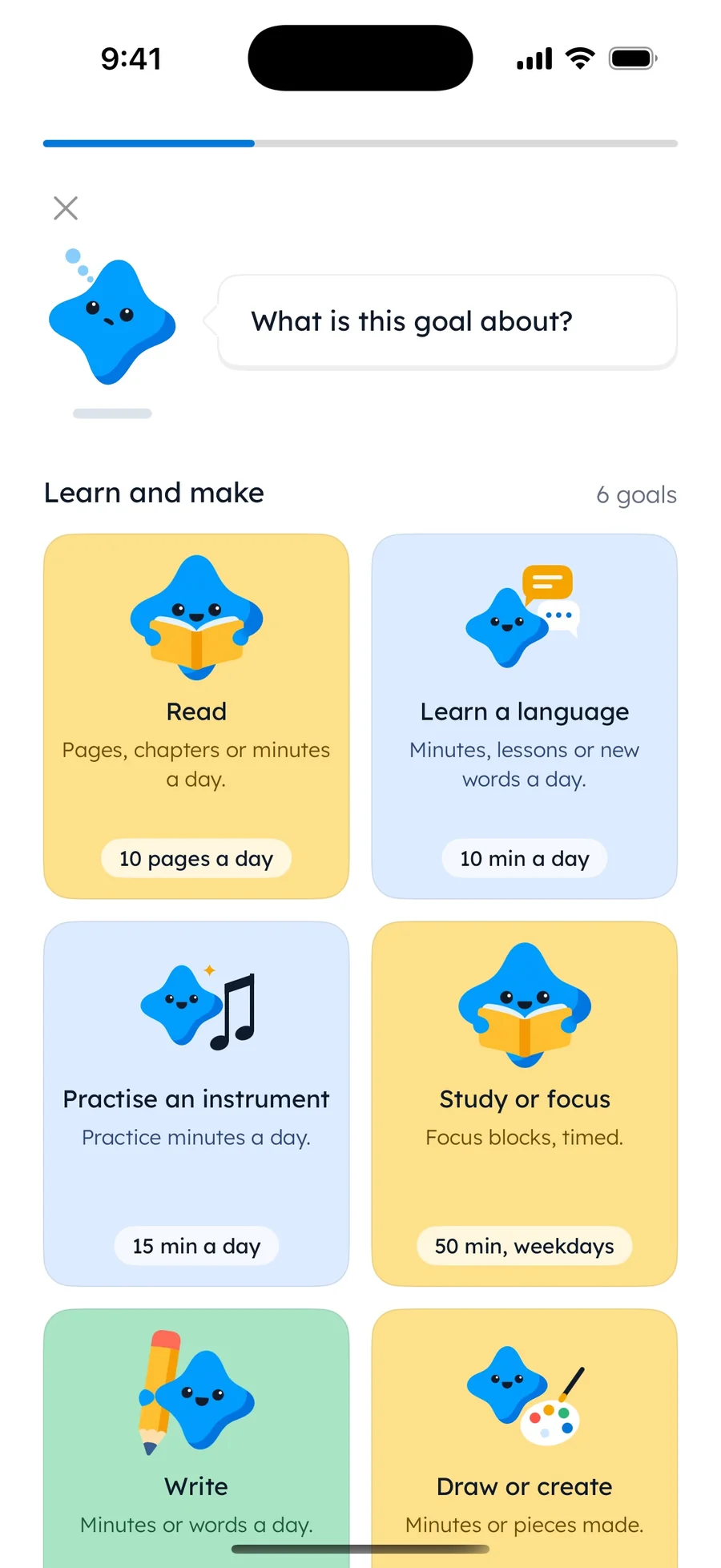
In Yumemira, the small-steps goal journal for iPhone, Free keeps one goal at a time. Paused and finished goals don’t count toward that one, so you can pause a goal and run another.
You can pick from 26 ready goals or tap Make your own.
If you’d rather run several goals side by side, that’s part of Pro.
So many goals but can’t stay consistent?
Sometimes the list isn’t long, but you still can’t keep any goal going.
Each goal gets its own excited week, with new shoes or a new notebook or a new app, and then the next shiny one arrives and takes its place.
The goals take turns. None gets enough of them.
The fix is the same: one goal, every day, small.
A long Thursday
Say you picked the walk. Then Thursday turns into a late meeting, a long queue at the pharmacy counter and dinner eaten while answering three messages from the family group.
Without a smaller version, the walk loses.
With a busy-day step of 5 minutes, it’s still alive tomorrow.
If you keep starting and stopping, our piece on why you keep giving up looks at that pattern. And how to stay consistent covers the day after a miss.
When to add a second goal
Add a second goal when the first one gets dull and easy.
Dull means it runs without a fight. We haven’t found a magic week number in any study, so three or four weeks is a fair time to check whether the goal still needs a push.
| Week | Goals | A line from that week |
|---|---|---|
| 1 | Walk 20 minutes | “Walked to the bakery. Closed. Walked back anyway.” |
| 2 | Walk 20 minutes | “Rain. Did the 5-minute version, under an umbrella.” |
| 3 | Walk 20 minutes | “Didn’t think about it. Just went out after dinner.” |
| 4 | Walk, plus read 10 pages | “Walk was easy. Page 10 came fast too.” |
Week 3 is the signal, and it’s a boring one. “Didn’t think about it” is the line you’re waiting for.
The second goal comes from the parked list, the one with the dates on it, and not from a new idea that turned up on the bus home.
That keeps the list from growing back.
Keep one line about the one goal
Writing about one goal is easier than writing about 17. Much easier.
And a line each day is how you’ll notice the goal turning dull and easy. So do one small thing, then write a line about it: what you did, and how it went.
- “Walked 20 minutes. The neighbor’s dog has a new jacket.”
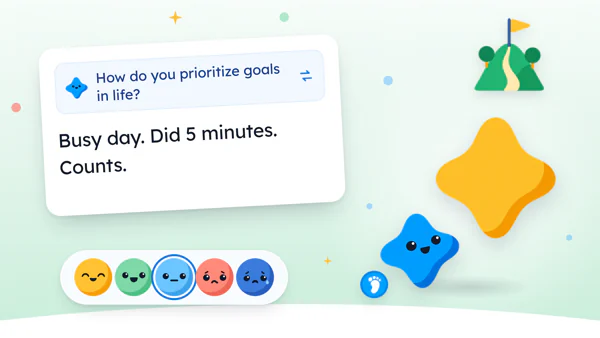
- “Busy day. Did 5 minutes. Counts.”
- “Walked the long way, past the closed bakery again.”
A month of lines like these is a small goal journal. It shows which days worked, and when the goal stopped needing a push.
In our app, you tap Mark done and Mira cheers.
Then a button says Say how it went, so the line gets written while the walk is still fresh. On paper, it’s a short list down the page, one line per day.
The parked Spanish is in there too, waiting for February.
Pick yours before bed
Tonight, open that Notes list. Merge what repeats, then pick one goal and write today’s date next to it.
Give every other goal a return date, even a rough one.
Then cross off item 4, the first goal you’ve finished this year.
Questions people ask
How many goals should you have at once?
Start with one. Add a second once the first feels dull and easy, which often takes a few weeks. Park the rest on a list with a date next to each, so they’re waiting and not forgotten.
How do you prioritize goals in life?
Merge goals that are the same wish, then pick the one you’d be most glad to see moving this month. Park the rest with a return date. If two goals tie, pick the one with the smaller first step.
Should you focus on one goal at a time?
For most goals that need a daily step, yes. One goal gets enough of your free time to start, and a second can join once the first runs without effort. Goals that need no daily time can wait on the parked list.
What do you do with too many goals at once?
Sort them into pick, park and merge. Keep one goal active with a small daily step. Write a return date next to each parked goal, and when that date comes, pick it, move the date or cross it off.
Sources
- Too Much of a Good Thing: The Benefits of Implementation Intentions Depend on the Number of Goals (opens in a new tab)
- When does planning interfere with achieving our goals? (opens in a new tab)
- Consider it done! Plan making can eliminate the cognitive effects of unfulfilled goals (opens in a new tab)
TopicSmall goals

You earned the Small Step badge
You read the whole guide. Now pick one goal and give the rest a date.
0 XP

Yumemira is an iPhone app (iOS 18 or later).
How Yumemira worksYumemira is free to start. iPhone, iOS 18 or later.