
Staying consistent
Why do I give up so easily? (And how to make one thing stick)

The short answer
If you give up so easily, the plan was usually too big to do on a bad day, too many things at once, or all-or-nothing. That’s a plan problem, not a you problem. Pick one thing, shrink it to a 2-minute version, and do it at a time you already stop. Keep it that small for a week.
In 30 seconds
- Plans written on a good day break on the first bad one.
- One thing at a time beats four things in January.
- A skipped day is one day. Never miss two in a row.
- Decide the busy-day version before the busy day arrives.
Guitar, Spanish, sourdough, running, a journal. The graveyard of hobbies has a lovely view.
Each one had a great first week. The guitar now holds a scarf, and the sourdough starter is still in the fridge, being patient.
We make an iPhone app built on small daily steps, so we’re biased. A notebook works just as well.

Reading XP0 XP
Why do you give up so easily? Five reasons
Quitting rarely arrives as a big decision. It shows up as one short sentence you say to yourself on a tired evening, and at the time it sounds completely reasonable.
Find yours in the middle column, then read across.
| Reason | What it sounds like | The small fix |
|---|---|---|
| Too big | “Starting Monday: an hour of guitar every day.” | 2 minutes, one chord |
| Too many at once | “Running, Spanish, journal and no sugar. All in January.” | Keep 1 thing for now |
| All-or-nothing | “Missed Wednesday. The week’s ruined anyway.” | Never miss two days |
| Waiting for the mood | “I’ll practise when I actually feel like it.” | Tie it to something you already do |
| No bad-day plan | “Long shift. No way I’m baking tonight.” | Write a busy-day version now |
Every sentence in that middle column was written for your best day. Then a normal day showed up.
The guide to staying consistent covers the long game. This page is about the minute right before you stop.
What each reason looks like up close
Each reason has its own small fix, and you only need the one that matches your sentence.
Too big for a normal week
An hour of guitar fits an empty Saturday, but not a weeknight with laundry on the chair, rice on the stove and a charger that only works at one angle.
The plan breaks on day four.
And you blame yourself instead of the hour.
Too many things at once
Four new things means four chances to miss one, and once one slips, the other three start to wobble too, like chairs around a table with one short leg.
Pick one thing. The others can wait their turn, probably right where you left them.
One bad day ends it
This is all-or-nothing thinking. One skipped day turns into proof that you “can’t stick to anything”, and the whole plan goes in the bin.
But a skipped day is just a day. James Clear’s rule is to avoid the second mistake (opens in a new tab): miss once if you must, then don’t miss again.
Waiting to feel like it
BJ Fogg’s behavior model (opens in a new tab) says a behavior happens when motivation, ability and a prompt meet at the same moment.
Motivation comes and goes. So change the other two: make it easier, and give it a fixed moment in your day.
On low days, shrink the task, then start.
No plan for the bad day
Without a smaller version written down, a long day leaves two choices: the full hour, or nothing.
Nothing wins that argument every time.
A one-step plan to make one thing stick
This plan works on paper. It takes about five minutes and the back of an envelope.
Pick one thing.
Choose one from your pile. The others wait for now.
Shrink it to 2 minutes.
One chord, one Spanish word, two pages. Small on purpose.
Write a busy-day version.
Even smaller: tune one string, read one sentence.
Decide what a skip means.
One skipped day is fine. The next day, do the busy-day version.
Then add one tiny habit on top: do the step, then write one line about it.
It’s hard to have nothing to say about something you did five minutes ago.
That’s the idea behind Yumemira, the small-steps journal for iPhone. You choose a goal, and each day the Today screen shows one step sized for today, with Mark done right under it.
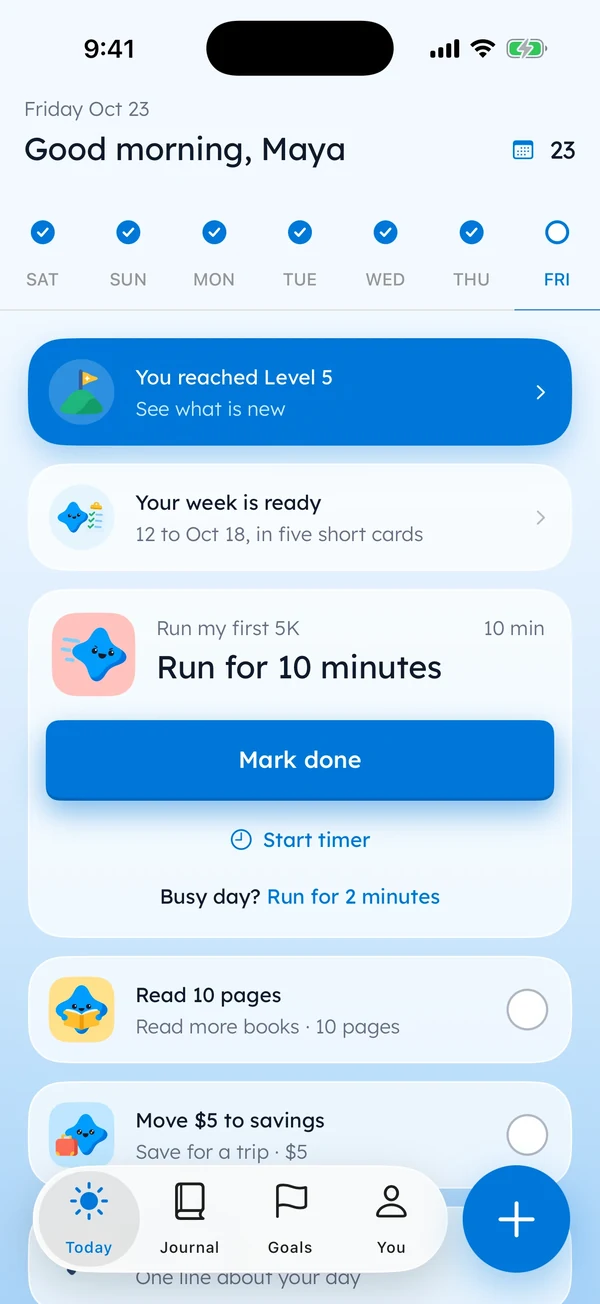
Step 3 of the plan is already on the screen: a busy-day step. On a long day you tap that one instead, and it counts in full.
On paper, write both versions at the top of a page and tick one of them each night. The envelope won’t cheer, but it will remember.
Why do I give up when things get hard?
The first week is new, and new things are easy to notice. Every day brings something you couldn’t do yesterday.
Then week three arrives, the chord still buzzes, the Spanish words slip away halfway through a sentence, and the run is the same loop past the same bus stop.
Nothing seems to move, and if your guitar is anything to go by, that’s where it stopped.
Progress at this stage is real, but slow. So the job changes: make the progress visible. Say it’s day 19:
- “Played the C chord. Buzzes less, maybe.”
- “Ran the same loop. Didn’t stop at the bus stop.”
- “Learned ‘umbrella’ in Spanish. Mine still doesn’t open.”
Write down what you did, so slow weeks still show.
Each line is proof you were there.
Why do I quit everything I start?
There’s a loop behind this one. You start big, miss a day, feel bad and stop.
Then, weeks later, you start again with an even bigger plan to make up for the gap, even though your evenings are exactly the same size they were before.
So it breaks sooner.
Restart with the small version, never the catch-up version.
For ideas sized for a tired evening, try these micro habits. And when you’re ready for the first week, here’s how to build a good habit.
Every hobby in the pile is something you once cared about enough to try. That part still stands.
Tonight, pick one from the pile
You don’t need the most important one. Choose the one that’s easiest to shrink.
Say it’s Spanish. Tonight’s version is one word, said out loud in bed, after the charger finds its one good angle and before the light goes off.
Tomorrow, maybe two.
One word tonight. The guitar can keep holding the scarf.
Questions people ask
Why do I give up so easily?
Usually because the plan was built for a good day. It was too big, or it changed too much at once, so one bad day ended it. Shrink one thing to 2 minutes and plan a busy-day version.
Why do I quit everything I start?
Often it’s a loop: start big, miss a day, stop, then restart with an even bigger plan. Break it by restarting with the small version. Do one thing for a week before adding another.
Why do I give up when things get hard?
After the first exciting week, progress gets slow and hard to see, so it can feel like nothing is working. Keep the step small and write one line about what you did, so the progress stays visible.
How do I stop giving up on my goals?
Pick one goal, shrink the daily step until you could do it on your worst day, and write a smaller busy-day version. After a skipped day, do the small version the next day.
Sources
TopicStaying consistent

You earned the Curious Reader badge
You read to the end. Now pick one thing and shrink it to 2 minutes.
0 XP

Yumemira is an iPhone app (iOS 18 or later).
How Yumemira worksYumemira is free to start. iPhone, iOS 18 or later.