
Staying consistent
How to stay consistent learning a language: 10 minutes a day

The short answer
To stay consistent learning a language, pick a daily floor of 10 minutes, with a 2-minute version for busy days, and hang it on something that already happens every evening, like clearing the dinner plates. Finish by writing one line about the word you learned. Give that size seven days before you make it bigger.
In 30 seconds
- Pick a daily floor: 10 minutes, or 2 on a busy day.
- Tie practice to something you already do every day.
- Review first, learn one new thing, then say it out loud.
- After a gap, restart with the 2-minute version.
- Write one line about what you learned after each session.
The U.S. State Department plans about 30 weeks of full-time class for diplomats learning Spanish. You have the 10 minutes after dinner.
So far, your app has given you “la manzana” and a fear of verb endings.
Quick disclosure: we make Yumemira, an iPhone app for small daily steps, so read the app parts with that in mind. A notebook and a kitchen timer will carry this plan just fine.

Reading XP0 XP
Why language learning drops off after a few weeks
The first week is the fun part.
Every new sound feels like a small win, the notebook still smells new, and by Friday you can read the sign on the bakery door without moving your lips.
Then week three arrives. Say you started at 30 minutes a day. By now:
- The lessons want past tenses.
- The review pile has 80 cards in it.
- One late night at work turned into six days off.
- The bakery sign is still the only one you can read.
So the trouble started on the first tired Thursday. Thirty minutes was the only size the plan came in.
A plan needs a size that fits your worst day.
It’s the same idea behind how to stay consistent with anything. The daily amount has to survive the week you’d rather forget.
If week three feels slow, nothing is wrong with you. A language is a very long road.
And 10 minutes is a small, real piece of it.
How many minutes a day? Pick your floor
Your floor is what you do on a bad day. A good day can go bigger, and nobody will stop you.
The right row is the one that fits a normal weekday. The last column is the same row on a busy one.
| Minutes a day | What to do | Busy-day version |
|---|---|---|
| 2 minutes | Review 5 words | Say one word out loud |
| 10 minutes | Review, then one new lesson | 2 minutes of review |
| 20 minutes | A lesson, plus some listening | 5 minutes of listening |
| 30 minutes | A lesson, then speaking practice | 10 minutes of either |
It’s worth starting one row lower than feels serious.
The 30-minute row looks great in week one, when the evenings are free and the verbs are easy, and it’s the first row a long day breaks.
As far as we can tell, 10 minutes is a good middle. It’s long enough for one new thing and short enough to fit between dinner and the dishes.
In Yumemira, the small-steps journal for iPhone, the ready-made Learn a language goal starts at 10 minutes a day. Its busy-day step is “Practise for 2 minutes”, and you can count lessons or new words instead of minutes.
On paper, the same floor works. A page with “10 / 2” at the top and a tick each night does the job.
A 10-minute session that works
Ten minutes goes fast. So give each part a job, and use any timer you like, even the one on the stove.
Review, 2 min.
Yesterday’s words first. Say each one before you check the answer.
One new thing, 6 min.
One short lesson or five new words, and no more.
Out loud, 2 min.
Use one new word in a sentence about your own day.
The third step feels silly the first few times. You’re talking to an empty kitchen in a language the kitchen doesn’t speak, with the rice cooker clicking away and nobody around to hear the verb go wrong.
But it’s the step that turns a word on a screen into a word you can use.
Stop at 10 minutes, even on a good night.
Even when you’re on a roll? Yes, even then.
Here’s why: a session that ends while it’s still easy is easier to start again tomorrow.
How to stay consistent learning a language on busy days
On a busy day, the 2-minute version is the whole session. Five old words while the kettle boils keeps the habit in place for tomorrow.
That’s the 2-minute rule applied to a language. Most micro habits work the same way, because the small version is the one you can still do when the day goes wrong.
Gaps are harder. Say you were away for a wedding, then busy at work, and three weeks went by.
Now your course shows 300 cards to review. That number alone can close the app again.
After a gap, restart at the busy-day size.
Grow it again after a week, one row at a time.
What to write after each session
Why write anything at all? Because a word you just fought with is the easiest thing in the world to describe, and four minutes later it’s still fresh.
So after each session, write one line about what you learned. The new word will do, or the mistake, or the sentence you said to an empty room.
| If today you… | Write… |
|---|---|
| Learned a phrase | “Learned ‘la cuenta, por favor’. Asked the dog for the bill.” |
| Found something odd | “Hindi ‘kal’ means yesterday. Also tomorrow. Bold choice.” |
| Got stuck | “Past tense again. Still lost. Did 10 minutes anyway.” |
| Only had 2 minutes | “Two minutes on my lunch break. Five old words, all there.” |
| Had a long day | “Long day. Said ‘buenas noches’ and stopped.” |
Little by little, the lines become a record of what you know.
Read last month’s now and then, on a slow Sunday with the coffee still too hot, and you’ll find words you use without checking, next to the day you first got them wrong.
In the app, the line comes right after the step. Tap Mark done and Mira cheers, then a button says “Say how it went”. That’s where the word of the day goes.
On paper, keep the line next to the tick. Same job, smaller notebook.
The same plan for studying
How to build a study habit works the same way, with focus blocks in place of minutes. You pick a floor and a busy-day size, then write one line when you stop.
For study, a floor of one 25-minute block fits a lot of evenings, with 10 minutes as the busy-day version. The line can be plain: “Chapter 4, two pages of notes. Still don’t get enzymes.”
Yumemira’s Study or focus goal starts at 50 minutes on weekdays, with “Focus for 10 minutes” as the busy-day step. Start opens a focus timer.
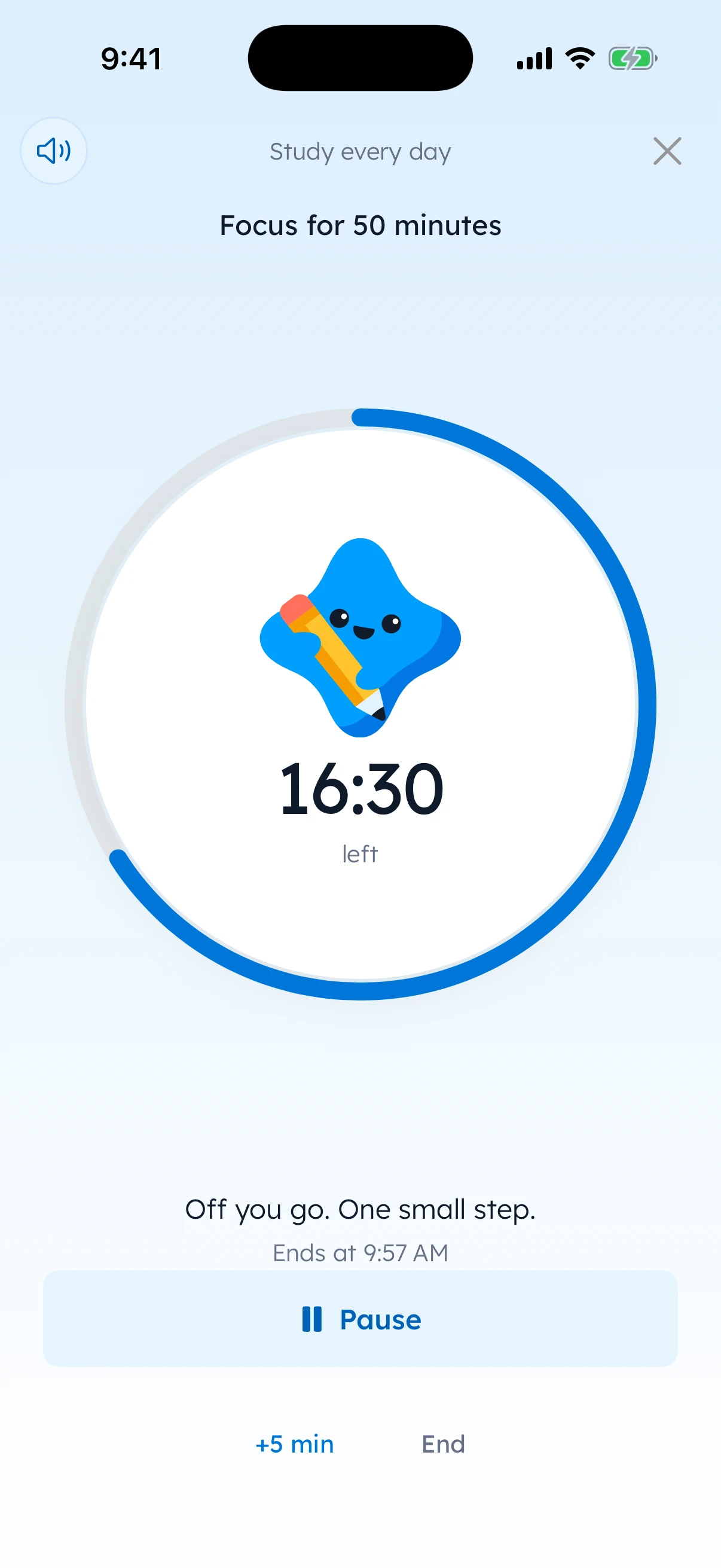
You can set 5, 10, 15 or 25 minutes, or your own length. But a desk timer works the same way, minus the star.
Start with la manzana. It’s been waiting since week one.
Questions people ask
How many minutes a day should I study a language?
Pick a daily floor you can keep on a bad day, like 10 minutes, with a 2-minute version for busy days. Ten minutes is enough for a short review and one new thing. Grow it only after a week of keeping it.
How do I stay motivated learning a language?
Lean less on motivation and more on size. Keep the daily amount small, tie it to something you already do, like dinner, and end with one sentence about your own day. Writing one line about what you learned also shows your progress over weeks.
How do I get back into learning a language after a break?
Restart at the busy-day size, about 2 minutes a day, and skip clearing every old review card. Review a few words you liked, say one sentence out loud, then stop. After a week, move up to 10 minutes.
How do I build a study habit?
Pick one focus block, like 25 minutes, at the same time each day, with a 10-minute version for busy days. When you stop, write one line about what you covered and what’s still unclear. Hold it at that size for seven days before adding more.
Sources
TopicStaying consistent

You earned the First Word badge
You read the whole thing. Now say one word out loud before bed.
0 XP

Yumemira is an iPhone app (iOS 18 or later).
How Yumemira worksYumemira is free to start. iPhone, iOS 18 or later.