
Staying consistent
How to stop procrastinating on the one thing you keep avoiding
The short answer
To stop procrastinating on one thing, name it, then shrink the first step until it takes about two minutes. Do that step at a time you already stop, like after lunch or when you get home, and set a timer. Keep it that small for a week. Doing more is allowed.
In 30 seconds
- Pick the one thing you keep avoiding, not the whole list.
- Cut the first step until it sounds a little silly.
- Tie that step to a moment you already have.
- Two minutes counts. Stopping there is allowed.
The form has been open in a tab for eleven days. You’ve closed every other tab around it, carefully, like stepping over a cat on the stairs.
Most of the form is your name and address. That’s what makes it so annoying.

Reading XP0 XP
Why we put off the things we care about
Usually the thing is bigger or vaguer than its name. “Do the form” sounds like one job, but there are five inside:
- Find the login you made three years ago
- Find the reference number on a letter somewhere
- Find the document they want a copy of
- Answer the one question you don’t understand
- Press submit and hope
Your head sees all five at once. So you answer an email instead, and wash a mug that was already clean.
The things we care about can be worse. A call you need to make or a book you want to start carries weight, so the first move feels like it has to be a good one.
If you can’t picture the first move, it’s too big.
The fix below works for any goal you’ve been putting off. It’s also the first move in staying consistent with anything.
How to stop procrastinating on one thing
Four steps, and the whole method fits on a sticky note. Step two does the heavy lifting.
Name it.
One thing, in plain words. “Renew the passport,” not “sort out my life admin.”
Shrink it.
Cut the first step until it takes about two minutes and sounds a bit silly. Open the form and type your name.
Pick the moment.
Tie the step to something that already happens, like finishing lunch or taking your shoes off at home.
Start for 2 minutes.
Set a timer. When it rings, you can stop. The step still counts.
Step three has research behind it. In a 1999 paper (opens in a new tab), psychologist Peter Gollwitzer wrote about “when X happens” plans.
The full shape is “when X happens, I’ll do Y.” He lists failing to get started among the usual ways good intentions stall.
So “sometime this week” becomes “right after lunch.” A moment you’ll meet anyway beats a time you have to remember.
The two-minute part
Why two minutes? Because two minutes is small enough to say yes to on a bad day. The idea comes from the 2-minute rule, which has its own page.
And if you’d like a timer that keeps going past the two minutes,  try a focus session.
Silly-small first steps for things people avoid
The left column is the thing that sits on the list for weeks. The rest shows how small a first move gets, and the line you might write once it’s done.
| You’re avoiding | Silly-small first step | When | A line afterwards |
|---|---|---|---|
| A form | Type your name only | Right after lunch | “Name’s in. Address tomorrow.” |
| A phone call | Find the number and save it | While your tea cools | “Number saved. Calling Thursday.” |
| A workout | Put your shoes on | When you get home | “Shoes on. Walked to the corner.” |
| Saving money | Move $1 to savings | On payday morning | “Moved $1. It’s a start.” |
| A book you meant to start | Read one page | Before you open social media | “One page. Chapter one is long.” |
| A messy room | Clear one chair | During one song | “One chair. You can sit on it now.” |
The last column matters most.
Every step leaves you with something true to write, even in a week when the rest of the list sat exactly where it was, and the laundry pile grew a second floor.
If even the small step won’t happen
Then it’s still too big. So cut it again.
“Read one page” becomes “open the book.” “Type your name” becomes “open the tab,” which, to be fair, is already open.
Write down the step, not the task.
Do the step, then write one line
A step you did minutes ago is easy to write about. That’s why our app puts the step first, and the line second.
We make that app, so we’re not neutral here. A pen works too.
In Yumemira, the small-steps journal for iPhone, you pick a goal and get a daily step small enough for today. There’s also a smaller busy-day step that counts in full.
For a goal like Study or focus, tapping Start opens a focus timer: 5, 10, 15 or 25 minutes, or your own. It keeps going if you leave the app.
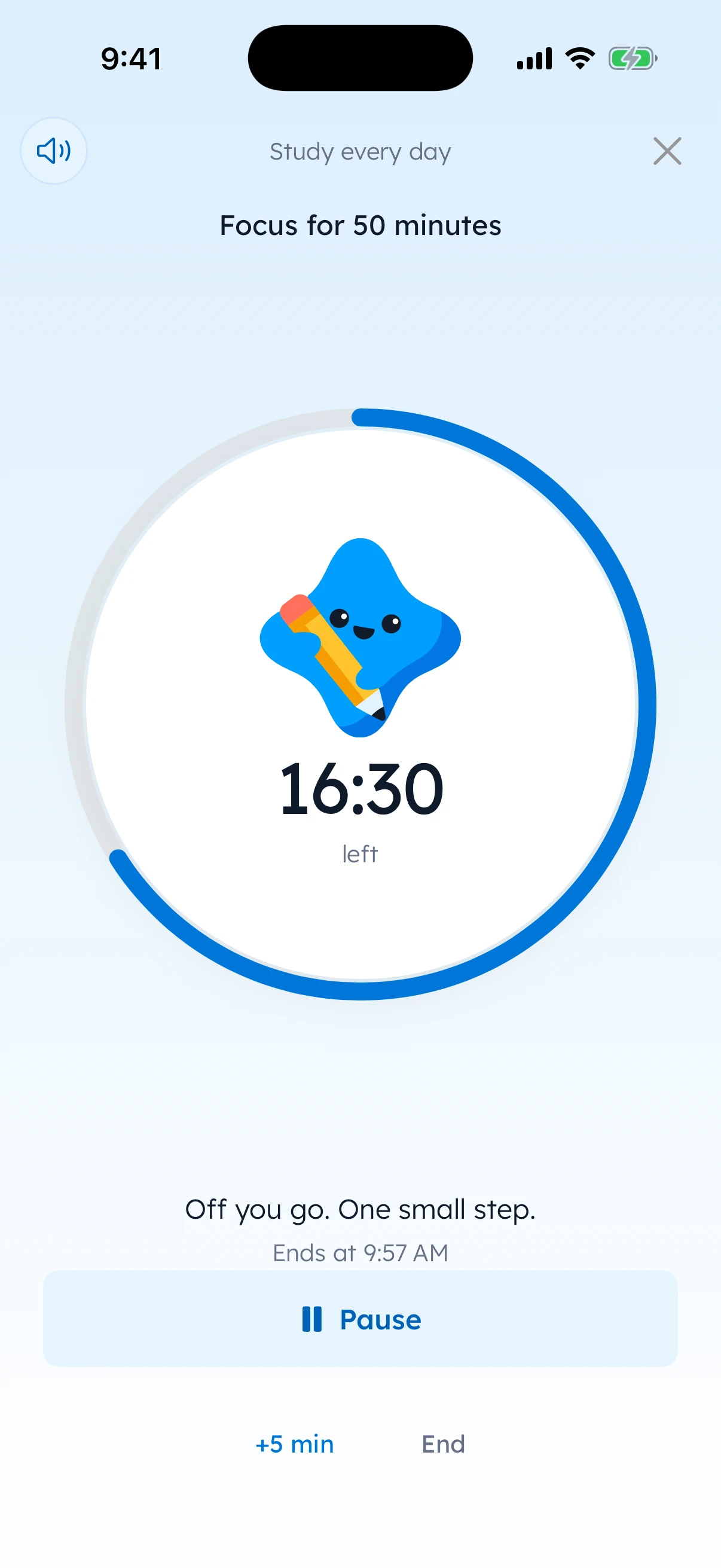
When the step is done, you tap Mark done and Mira cheers. Then Say how it went asks one question: “How did it go?”
On paper, it’s the same trick: the sticky note, a tick, and one line underneath it.
When you start and stop again
Say you do the step four days in a row.
Then a busy week arrives with a birthday, a late shift and a sink full of dishes, and the sticky note curls up at one corner.
It happens.
The next move is the same small step, at the same moment, today. Nobody has to do eight minutes of form-filling to make up for four missed days.
If you keep stopping at the same point, why you give up so easily looks at the usual reasons plans fall apart.
But once the small step starts to feel boring, that’s a good sign.
It can grow a little, the way small habits do. One page becomes two. The shoes become a walk to the corner.
Grow the step only when it feels boring.
Tonight’s two minutes
You don’t need a free afternoon or a new notebook for this, only the thing you keep avoiding and a step so small it’s slightly embarrassing.
Tonight, before the phone goes on its charger, open that tab and type your name. Then close it.
Eleven days was long enough. Day twelve has your name in it.
Questions people ask
Why do I procrastinate on things I want to do?
Often the thing is big or vague, so the first move isn’t clear. Caring about it can make the first move feel heavier. Name one physical action, make it take two minutes, and tie it to a moment you already have.
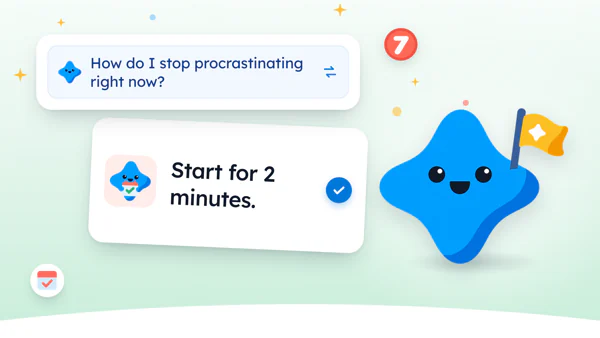
How do I stop procrastinating right now?
Choose the one thing. Then write down the smallest first action you can picture, like opening the file or finding the phone number. A two-minute timer helps. When it rings, you’re allowed to stop.
What is the 2-minute rule?
It means starting a habit with a version that takes two minutes or less, like reading one page instead of a chapter. The small version counts in full, and doing more is allowed.
Is procrastination laziness?
Calling it laziness doesn’t give you a next step. Avoiding one specific thing while staying busy with everything else usually points to a task that feels too big or unclear. The first step can shrink before you judge yourself.
Sources
TopicStaying consistent

You earned the Small Step badge
You read to the end. Now type your name into the thing you’ve been avoiding.
0 XP

Yumemira is an iPhone app (iOS 18 or later).
How Yumemira worksYumemira is free to start. iPhone, iOS 18 or later.