
Small habits
Micro habits: 40 habits so small you can’t skip them
The short answer
Micro habits are tiny versions of a habit, small enough to do on your worst day: two pages, one glass of water, three slow breaths. Pick one and do it right after something you already do, at a time you already stop. Plan a busy-day size too. Keep it that small for a week.
In 30 seconds
- It’s the smallest version of a habit you’d still count.
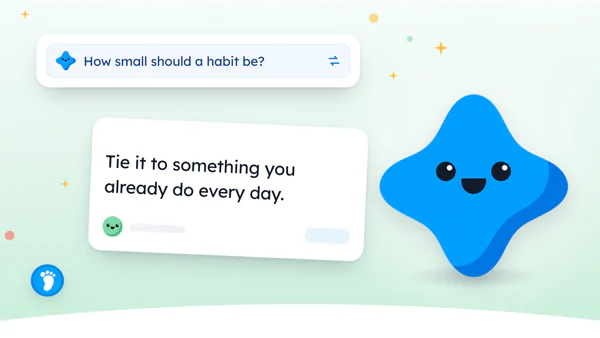
- Tie it to something you already do every day.
- Give every habit a busy-day size before you need one.
- Grow it only when the small size feels boring.
Flossing one tooth sounds like a joke, until you notice you flossed them all.
The example belongs to behavior scientist BJ Fogg, from an NPR piece on his research (opens in a new tab). The bar is set so low it feels a bit goofy, and that’s on purpose.
Below are 40 habits cut to that size, sorted by where they fit in a day.

Reading XP0 XP
What are micro habits?
Think of one as the smallest version of a habit you’d still be willing to call done.
One page instead of a chapter. One tug of the cover instead of a hotel-perfect bed (the pillows have never once complained).
Fogg wrote a whole book on this, called Tiny Habits (opens in a new tab). In the NPR piece, the advice is to keep the bar really low.
So how small is small enough? Think of your worst day this month, the one where the bus was late and the whole evening went to a problem that wasn’t yours.
Would the habit survive that day? If not, it’s too big.
Shrink it until skipping feels sillier than doing it.
Size is half of how to stay consistent. The other half is deciding what happens on the bad days before they turn up.
Ten habits with a ready goal and a busy-day size
Every habit below has two sizes: the normal one and a busy-day one.
The busy-day size is the one worth planning first, because a habit rarely breaks on a calm Sunday with nothing on and plenty of time to spare.
It breaks on the busy day.
The goal names and sizes are the starting lines of real goals, so you can copy the whole row.
| Habit | Ready goal | Busy-day size |
|---|---|---|
| Loosen up after you get out of bed | Stretch or yoga, 10 min a day | Stretch for 2 minutes |
| Sit still before you open messages | Meditate, 5 min a day | Meditate for 2 minutes |
| Read before the light goes off | Read, 10 pages a day | Read 2 pages |
| Play one scale after you eat | Practise an instrument, 15 min a day | Practise for 5 minutes |
| Clear one surface before bed | Tidy up, 10 min a day | Tidy for 2 minutes |
| Phone in a drawer after you eat | Less phone time, 30 min a day | Put the phone away for 10 minutes |
| Three slow breaths before a call | Take breathers, 3 a day | Take 1 breather |
| One good thing before sleep | Gratitude, 3 good things a day | Write down 1 good thing |
| A lap of the block | Walk, 20 min a day | Walk for 5 minutes |
| Move spare change to savings | Save money, $10 a week | Put aside $1 |
Across each row, the busy-day size looks almost rude. Two pages. One breath.
But a busy-day step is a full day’s step. Two pages on a terrible Tuesday keeps the habit going, and on that Tuesday, going is the whole job.
In Yumemira, the small-steps journal for iPhone, each of 26 goals that start small comes with its starting line and busy-day step filled in. We built it, so we’re biased. A sticky note on the fridge does the same thing.
40 small habits, sorted by where they fit
The idea is to pick one from one group. Forty is a menu, and nobody orders the whole menu.
Each one is already at its busy-day size, so there’s nothing to shrink.
Morning
- Pull the cover straight on the bed
- Open the curtains before you open your phone
- Drink one glass of water
- Get up on the first alarm
- Write today’s one task on a sticky note
- Step outside the front door for one minute
- Read one paragraph with your first drink of the day
Body
- Stretch for 2 minutes
- Walk for 5 minutes
- Work out for 5 minutes
- Do two squats while the microwave runs
- Take the stairs for one floor
- Eat one piece of fruit with a meal
- Swap one sweet thing for something else
Mind
- Take 1 breather: three slow breaths
- Meditate for 2 minutes
- Write down 1 good thing from today
- Put the phone away for 10 minutes
- Go outside for 5 minutes
- Write one line about today
- Name today’s feeling in one word
Learning
- Read 2 pages
- Practise a language for 2 minutes
- Learn one new word
- Practise an instrument for 5 minutes
- Focus for 10 minutes on one task
- Write for 5 minutes
- Draw one small sketch
Money
- Put aside $1
- Skip one small buy
- Put $1 in a trip fund
- Write down one thing you bought today
- Unsubscribe from one shop email
- Check your balance once, and that’s all
Home and people
- Tidy for 2 minutes
- Wash the one cup you’ll use tomorrow
- Put one thing back where it lives
- Water one plant
- Make a simple snack at home
- Send a short hello to someone you miss
The cup is a good place to start. The rest of the sink can stay in a mood about it.
If you can’t choose, this sheet picks by the time you have.
| If you have… | Try something like… |
|---|---|
| 30 seconds | “Three slow breaths before I stand up.” |
| 1 minute | “Washed the one cup for the morning.” |
| 2 minutes | “Read 2 pages in bed.” |
| 5 minutes | “Walked to the corner and back.” |
| 10 minutes | “Phone in the drawer while dinner cooked.” |
How to grow micro habits once they stick
Grow a habit only once it’s boring, when you do it without thinking.
A habit that still takes effort isn’t ready, and another week at the small size costs you nothing.
After that, the next size up is the smallest one you can name: 2 pages becomes 5, then 10. The busy-day size stays where it was, so the bad days stay easy.
Fogg’s rule for the days you feel like more is short.
“But if you want to do more, you do more.”
So the small size is a floor, never a ceiling. You can read a whole chapter tonight, and tomorrow’s target is still 2 pages.
Grow the normal day. Keep the busy day tiny.
On paper, this is a line in a notebook with the date and how the step went.
In the app, the goal screen shows today’s step, a Mark done button and a smaller choice under it.
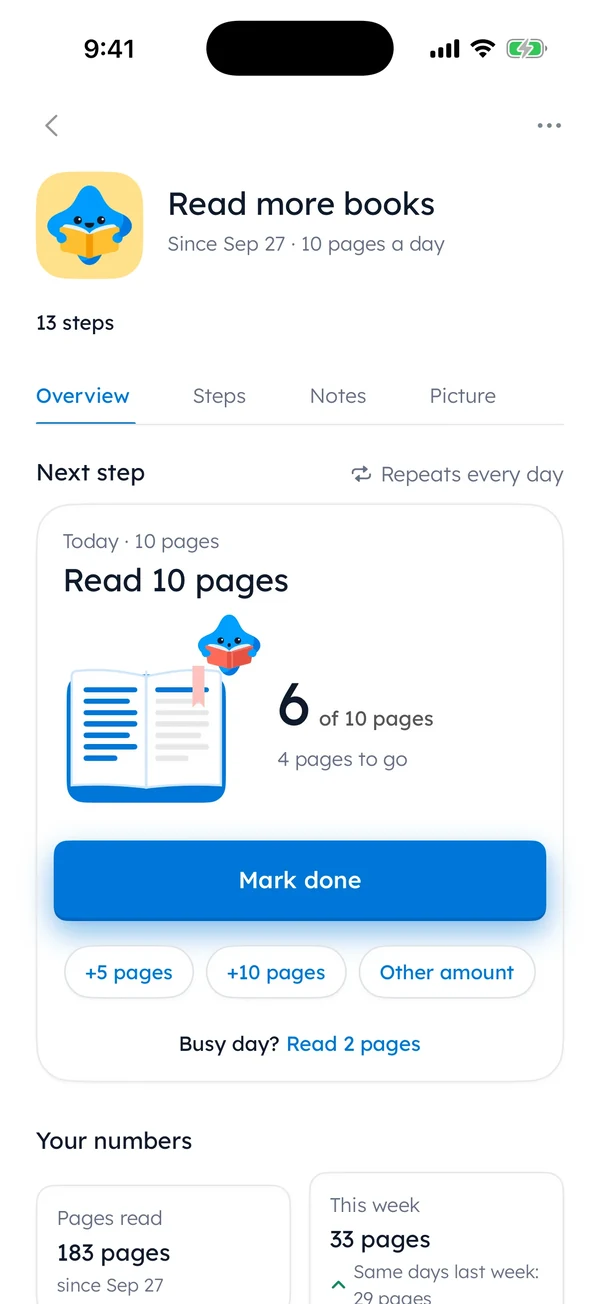
Tap Busy day? and the 2-page step becomes the day’s step. If you’d like both sizes kept for you,  try it in Yumemira.
After a step, the Say how it went button opens one line to write about it.
Small habits, big changes?
Small habits can add up to something you notice, like a finished book or a tidier kitchen. But nobody can promise a size or a date, and this page won’t try.
What a tiny daily habit does is easier to count. Two pages a day is 730 pages a year, if you keep going.
That’s arithmetic. No study needed.
The rest depends on things neither of us controls. So judge it by one thing: whether you did it today.
For the full method, from the first step to the day after a miss, read how to build a good habit.
And when a habit grows into something with a finish line, it becomes one of your small goals.
Tonight, pick the smallest habit in the table and do it once. Two pages will do.
Then stop. One tooth was always allowed to be enough.
Questions people ask
What are micro habits?
They’re very small versions of a habit, like reading 2 pages or taking three slow breaths. They’re sized for your worst day, so there’s always time. You tie each one to something you already do every day.
What are examples of small habits?
Drink one glass of water, read 2 pages, stretch for 2 minutes, put aside $1, tidy for 2 minutes, write down one good thing, or send a short hello to someone. Pick one, not all of them.
How do small habits lead to big changes?
They can add up, like pages turning into a finished book, but no size or date is promised. The useful part is that a small habit is easy to repeat on hard days, and repeating it is what adds up.
How small should a habit be?
Small enough that you’d do it on your worst day. If you can picture a day when you’d skip it, shrink it again. Two minutes, two pages or one glass of water is a good starting size.
Sources
TopicStaying consistent
You earned the Tiny Step badge
You read the whole list. Now do the smallest one once, tonight.
0 XP

Yumemira is an iPhone app (iOS 18 or later).
How Yumemira worksYumemira is free to start. iPhone, iOS 18 or later.