
Staying consistent
How to stay consistent when motivation runs out

The short answer
To stay consistent, make the step small enough for your worst day, and decide now what the step looks like on a busy day. Then never miss twice: after one missed day, do the small version the next day. Tie the step to something you already do, and keep it that small for a week.
In 30 seconds
- A good step fits your worst day, not your best one.
- The busy-day version gets written down before the busy day.
- One miss is fine. The next day gets the small version.
- Days you showed up add up. Gaps don’t subtract.
- A single goal does the job until it feels boring.
On Monday you’re a new person. By Thursday you’re the old person, with a new water bottle.
The bottle is still on the desk. What went missing was a plan for the days you don’t feel like it.
We make an iPhone app built on small daily steps, so we’re not neutral here. A sticky note works just as well.

Reading XP0 XP
Why is it so hard to stay consistent?
Most plans are written on a good day.
So the plan assumes energy that a Wednesday after a long shift doesn’t have.
And the first bad day breaks the plan. The broken plan then feels like proof about you.
It isn’t proof of anything. Look at the reasons in the left column below and you’ll probably find yours, along with a smaller fix that fits a bad week.
| Why it breaks | The small fix | A line it might get this week |
|---|---|---|
| The step is too big for a bad day | Set a worst-day size today | “Busy day. Read 2 pages on the bus.” |
| One miss feels like the end | Never miss twice | “Skipped Tuesday. Did 5 minutes today.” |
| Waiting to feel like it | Make it too small to argue with | “Didn’t feel like it. Ran 2 minutes anyway.” |
| Too many goals at once | Keep 1 goal for now | “Just the reading this month.” |
| No set time | Tie it to something you already do | “Dishes done, then 10 pages.” |
| A busy week arrives | Switch to the busy-day version | “Long week. Walked 5 minutes each night.” |
Every line in the third column is short and a little dull.
That’s on purpose.
If you’re still choosing what to work on, start with small goals you could begin today. And if you have no idea where to start, a list of goal ideas makes picking one quicker.
What causes a lack of consistency?
Usually one of three things: a step sized for your best day, no plan for the busy day, or seeing one miss as a reason to stop.
Size and timing can both be changed tonight.
How to stay consistent without motivation
Make the step so easy that motivation stops being the deciding vote.
BJ Fogg, who runs the Behavior Design Lab at Stanford, sums up his Fogg Behavior Model (opens in a new tab) as B=MAP. Behavior happens when motivation, ability and a prompt meet at the same moment.
In plain words, low motivation can be covered by high ability. If the step is tiny, you can do it on a day when you care about it very little.
So shrink the step until it fits that day:
- Gym: shoes on and one set, instead of the full hour
- Reading: 2 pages instead of a chapter
- Running: 2 minutes out the door instead of 5 kilometers
- Journaling: one line instead of a page
- Water: 4 glasses on a busy day instead of 8
Each of these feels a bit silly.
That’s a good sign. A silly-small step is one you won’t argue with at 10 pm.
Make the step small enough for your worst day.
Then give it a prompt that shows up every day without your help, like brushing your teeth or putting the phone on its charger. The step rides along with something that already happens.
Do you need discipline to be consistent?
A little, as far as we can tell, and less than a big plan needs. A small step tied to a fixed moment leaves very little to decide.
When motivation fades after a few days
If it fades after a few days, that’s normal. Plan for the fade the way you’d plan for rain.
The first days run on novelty, like new shoes and that first satisfying tick. Then a normal day arrives, with laundry on the chair and an inbox that refilled itself overnight, and the novelty has nothing left to give.
That’s the day the plan has to carry you.
We haven’t measured how many days motivation lasts, and we haven’t found a source that has, so we won’t put a number on it. What matters is what you do on the first flat day.
Say it’s day four of a reading goal. The book is fine and you’d still rather scroll.
So you read 2 pages instead of 10 and go to bed.
Day four, done.
How to be consistent when you’re bored
Boredom is often the sign that the step has become automatic. Keep the step, and change one small thing around it, like a different chair or a new route for the walk.
Plan the busy day before it happens
Busy days aren’t a surprise. You already know roughly which days will be full, like the late shift, the school run or the evening when relatives visit and the kitchen turns into a small restaurant.
So decide the small version now, while you’re calm.
Name the full step.
The normal amount on a normal day, like 10 pages or 20 minutes.
Name the busy-day step.
About a fifth of it, or less, like 2 pages or 5 minutes.
Write both down.
On the sticky note, the calendar, or wherever the step happens.
Decide the busy-day version before the busy day.
This is the part we built the app around. In Yumemira, the small-steps journal for iPhone, every goal comes with a busy-day step next to the normal one.
Read 10 pages has a busy-day size of 2 pages. Walk 20 minutes has 5. On a full day you tap the busy-day step instead, and the day is a whole day.
On paper, the same idea is two lines on the sticky note: the full step on top, the busy-day step underneath.
You cross out whichever one you did, and the note stays on the fridge or the mirror until the week is over.
Staying consistent with goals in busy weeks
Think of the busy-day step as the real plan for the hardest weeks.
The full step is the bonus. And a hard month is still a month of showing up.
Never miss twice, then start again
You’ll miss a day. Plan for it like you planned for the busy day.
The rule is short: after a miss, go small.
James Clear calls this avoiding the second mistake, and he puts it in two short sentences.
“One mistake is just an outlier. Two mistakes is the beginning of a pattern.”
There’s research on the first half of that. In a 2010 study of habit forming led by Phillippa Lally at University College London, missing one opportunity (opens in a new tab) “did not materially affect the habit formation process” (as summarized by James Clear (opens in a new tab)).
That’s one study, about single misses, so read it as a small comfort rather than a promise. It does fit what the rule asks of you: one miss is normal, so skip the catching up and do today’s step.
Catching up is the trap. Doing Monday’s 10 pages and Tuesday’s 10 pages on Wednesday turns one gap into homework, and homework is easy to skip again.
What if you missed more than one day?
Say the miss turns into two weeks, because a work deadline ate every evening and a family visit filled the weekend. The rule doesn’t change.
Tonight gets the small step, with no catching up.
And if you start again every Monday, that’s worth noticing too. You don’t need a Monday. Thursday works fine, and it’s closer.
Count the days you showed up
A days-in-a-row count has a harsh rule. Miss one Sunday and it drops to zero, which is a strange reward for showing up eleven times.
Count the other number instead: total days you showed up. It can only go up.
On paper, that’s a tally on the inside cover. One mark for each day you did the step, at either size. Missed days get no mark, so there’s nothing to cross out.
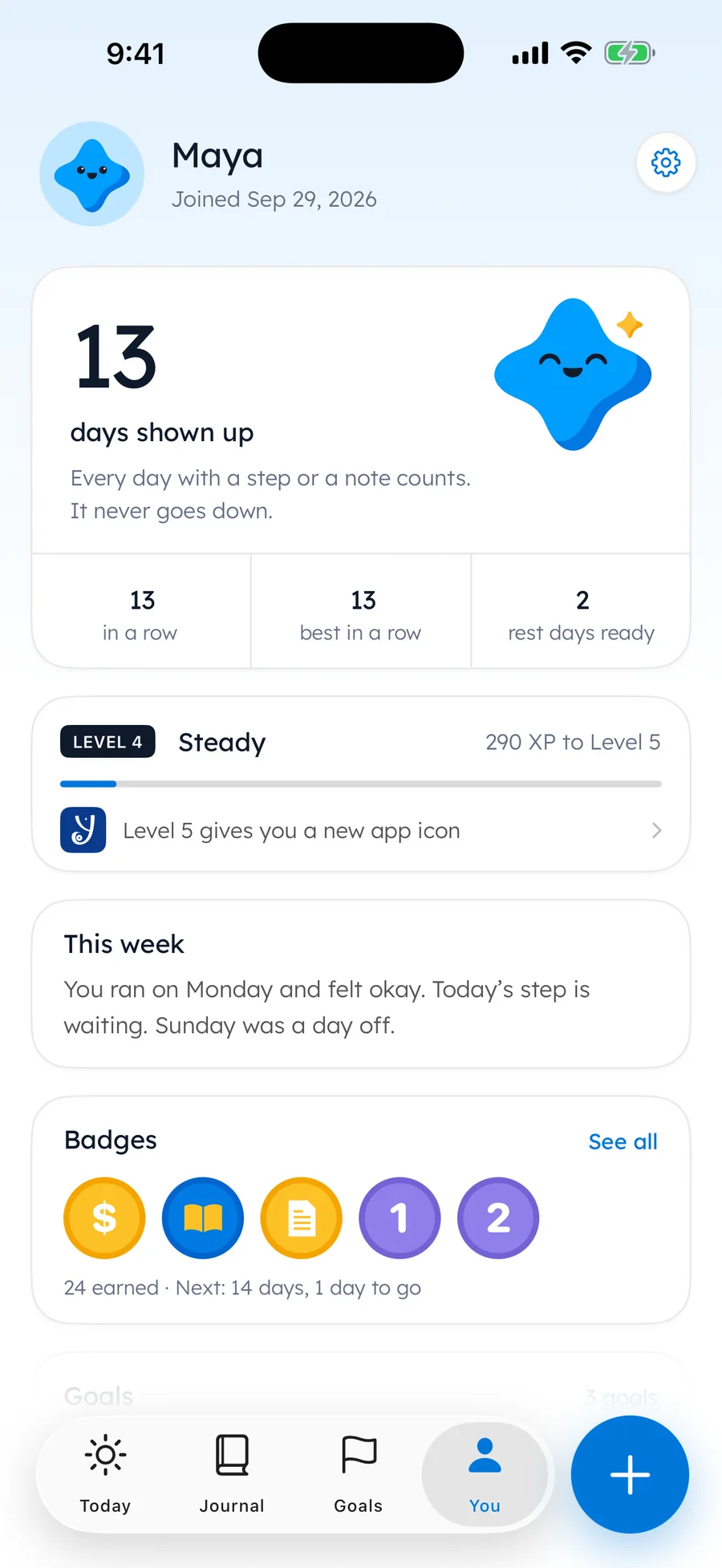
In Yumemira, that number sits at the top of the You tab. A day counts when you do your step or write a note. There’s no streak to lose, so a missed day leaves the total where it was.
Most lines worth keeping are about something you did, which is why the app pairs every step with a journal.
After a step, Mira, the app’s star, cheers “Nice. That counts.” and a button says Say how it went. You write one line while it’s fresh: “Read 2 pages. Bus was late.”
If you’d like the busy-day step and the count kept for you,  try it in Yumemira. It’s free to start.
The tally changes the question you ask at night, from “Did I break it?” to “Did I add one?”
On a tired evening, with the charger cable that only works at one angle, the second question is far easier to say yes to.
Usually, yes.
A one-week consistency plan
Seven days is enough to test the step and its time. Take any one goal: reading, walking, a gym habit or a one-line journal.
| Day | Step | If the day goes wrong |
|---|---|---|
| 1 | Pick 1 goal and its full step | “Chose reading. 10 pages, or 2.” |
| 2 | Do the full step after your anchor | “Busy. Did 2 pages. Done.” |
| 3 | Do the busy-day size on purpose | “2 pages. Felt too easy. Good.” |
| 4 | Full step, then one line about it | “Read 10. The chapter ended well.” |
| 5 | Whatever size fits today | “Missed it. Tomorrow is 2 pages.” |
| 6 | The day after any miss: small version | “Back. 2 pages before bed.” |
| 7 | Count your marks, then keep or adjust | “6 marks. Keeping the same time.” |
Day 3 looks lazy. It’s the most useful day on the list, because it proves the small version is real and allowed.
On day 7, count the marks and ignore the gaps. Then keep the step, move the time or shrink the busy-day size. Small changes, one at a time.
Your 5-minute consistency setup
Ticks stay in this browser. Nothing is sent.
When the week works, the same rules carry over to building any good habit. And if you’d rather start from a ready list, you can pick one of 26 ready goals in the app.
Back at the desk, the water bottle is still half full.
Tonight, write tomorrow’s busy-day step on a sticky note. Put it on the bottle.
Questions people ask
Why is it so hard for me to stay consistent?
Usually the plan was sized for a good day. When a busy or tired day comes, the full step feels impossible, so it gets skipped, and one skip starts to feel like failure. A smaller step and a busy-day version fix most of it.
What causes lack of consistency?
The common causes are a step that’s too big, no fixed time for it, too many goals at once, and stopping completely after one missed day. Each has a small fix: shrink the step, tie it to a routine, keep one goal, and never miss twice.
How do I stay consistent without motivation?
Make the step small enough that motivation barely matters, like 2 pages or 2 minutes. Tie it to something you already do every day, so you don’t have to remember. On low days, do the busy-day version and call it done.
How do I stop being inconsistent?
Pick one goal with a full step and a busy-day step, tied to a daily routine. After any missed day, do the small version the next day without catching up. Count total days you showed up instead of days in a row.
How long does it take to build consistency?
There’s no fixed number. One study from University College London found an average of 66 days for a habit to feel automatic, with a range of 18 to 254 days. Focus on the next small step, not a deadline.
How do I stay consistent with my goals?
Keep one goal at a time and give it a busy-day size. Plan what happens the day after a miss. Count the days you showed up. Once the step feels boring, it’s working, and you can add a second goal.
Sources
TopicStaying consistent

You earned the Showed Up badge
You read the whole guide. Now write tomorrow’s busy-day step on a sticky note.
0 XP

Yumemira is an iPhone app (iOS 18 or later).
How Yumemira worksYumemira is free to start. iPhone, iOS 18 or later.