
Small goals
Small goals: how to set one you can start today
The short answer
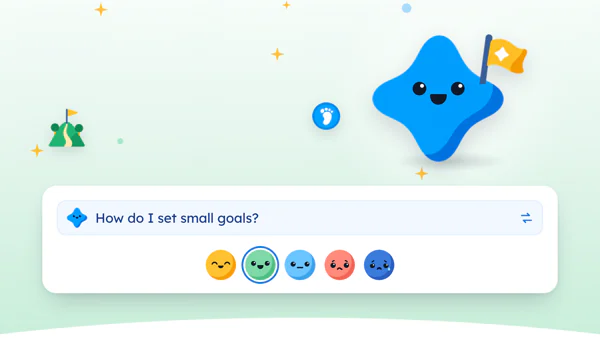
Small goals are big goals cut down to a size you can start today. Give yours a number and a unit, like 10 pages a day, then set a busy-day step too, like 2 pages. Do it at a time you already stop, such as right after dinner. Keep it that small for a week.
In 30 seconds
- A small goal has a number and a unit you can count.
- Set a busy-day step on day one, before you need it.
- Cut big goals down until today’s step fits in a gap.
- Grow the step slowly, and only when it starts to feel easy.
“Get fit” has been on your list since 2019. It has moved house with you twice.
“Walk to the end of the street after dinner” would have been done by now, probably several hundred times.
That’s the whole difference. One is a wish and the other is a step you can take, and only the step tells you what to do tonight.
We make an iPhone app built around this idea, so we’re not neutral here. A sticky note on the fridge does the same job.

Reading XP0 XP
What makes a goal small?
A small goal is one you can start today, without planning.
It has a number and a unit, and it’s tied to a moment you already have. “Read more” has neither. “Read 10 pages after dinner” fits on a sticky note with room left over for a drawing of a book.
Small doesn’t mean unimportant. It means the goal arrives in pieces you can actually pick up.
Here’s a quick test. If you can’t picture yourself doing it today, in the clothes you’re wearing, it’s still a big goal.
Picture “get fit” on a sticky note on the fridge, half hidden behind a takeaway menu and a wedding invitation from last spring, still waiting for someone to decide what it means.
Nobody ever does.
And small goals tell you things fast. After one week of 10 pages a night, you’ll know two of them:
- whether the time of day works
- whether you like the book
But a big goal can take a year to tell you it was the wrong goal.
If you can’t picture doing it today, shrink it.
So a small goal is also a cheap experiment. If it doesn’t fit, you’ve lost a week, and you change the number.
How to set small goals in 4 steps
Setting one takes about five minutes, and most of that is choosing. Do it on paper, in a notes app or wherever your shopping list lives.
Pick one thing.
One. The rest of the list can wait in a drawer.
Give it a unit.
Pages, glasses, minutes, calls or dollars. Something you can count without guessing.
Set today’s size.
Small enough that a normal evening, with dishes and messages in it, still leaves room.
Set a busy-day size.
A smaller version for the days that go sideways. It still counts as done.
Step 4 is the one people skip. It’s also the step that decides whether the goal is still alive in three weeks.
A long Tuesday, with and without one
Say you set “Read 10 pages a night”. Then a Tuesday turns into a long shift, a late bus and leftover rice eaten standing at the counter, with your shoes still on and your phone somewhere in a bag.
Without a busy-day size, the choice is 10 pages or nothing, and nothing usually wins. With one, the choice is 2 pages or nothing.
Two pages wins a lot more often.
Doing a small step on the bad days is most of how to stay consistent with anything. The good days mostly look after themselves.
Small goals to set for yourself this week
If nothing comes to mind, borrow one from the list below and change the number.
A goal you edit feels more like yours than one you invent from nothing. And for bigger things to aim at later, there are plenty of examples of goals to browse.
26 small goal examples with a step for today
Every goal below comes from the goal library in our app, with the starting size it suggests. You can copy them onto paper as they are.
| Goal | Starts at | Busy-day step |
|---|---|---|
| Drink water | 8 glasses a day | Drink 4 glasses of water |
| Walk | 20 min a day | Walk for 5 minutes |
| Take breathers | 3 breathers a day | Take 1 breather |
| Gratitude | 3 good things a day | Write down 1 good thing |
| Read | 10 pages a day | Read 2 pages |
| Write | 15 min a day | Write for 5 minutes |
| Save money | $10 a week | Put aside $1 |
| No-spend days | 3 times a week | Skip one small buy |
| Call family or friends | Twice a week | Send a short hello |
| Tidy up | 10 min a day | Tidy for 2 minutes |
The busy-day steps are tiny on purpose. A busy-day step has to survive a day you didn’t plan for, and those days don’t ask first.
More goals for your body
- Run: 20 minutes, 3 times a week. Busy day: run for 10 minutes.
- Work out: 20 minutes, 3 times a week. Busy day: work out for 5 minutes.
- Sleep on time: in bed by 10:30 pm. Busy day: wind down for 2 minutes.
- Stretch or yoga: 10 minutes a day. Busy day: stretch for 2 minutes.
- Eat more fruit and veg: 5 portions a day. Busy day: eat 2 portions.
- Less sugar or junk: every day. Busy day: swap one sweet thing.
- Wake up early: up by 6:30 am on weekdays. Busy day: get up when the alarm rings.
Goals for a calmer mind
- Meditate: 5 minutes a day. Busy day: meditate for 2 minutes.
- Less phone time: 30 minutes a day. Busy day: put the phone away for 10 minutes.
- Go outside: 20 minutes a day. Busy day: go outside for 5 minutes.
Goals for learning and making
- Learn a language: 10 minutes a day. Busy day: practice for 2 minutes.
- Practice an instrument: 15 minutes a day. Busy day: practice for 5 minutes.
- Study or focus: 50 minutes on weekdays. Busy day: focus for 10 minutes.
- Draw or create: 15 minutes a day. Busy day: draw for 5 minutes.
Goals for money, people and home
- Save for a trip: $10 a week. Busy day: put $1 in the trip fund.
- Cook at home: 4 times a week. Busy day: make a simple snack at home.
That’s 26. If yours isn’t here, make your own: 10 minutes a day fits almost anything you can time, with 2 minutes on a busy day.
These sizes are starting points, and nobody checks. If 8 glasses sounds like a lot, start at 4.
In Yumemira, the small-steps journal for iPhone, you pick one of all 26 ready goals or tap Make your own. Each goal arrives with its starting size and busy-day step filled in, and you can change both.
Shrink any big goal into today’s step
Big goals aren’t wrong. They just can’t be done on a Wednesday.
So keep the big goal at the top of the page, and write today’s step under it.
Then ask what one day of the goal would look like. Cut that in half until it fits in a gap you already have.
| If your big goal is… | Make today’s step… |
|---|---|
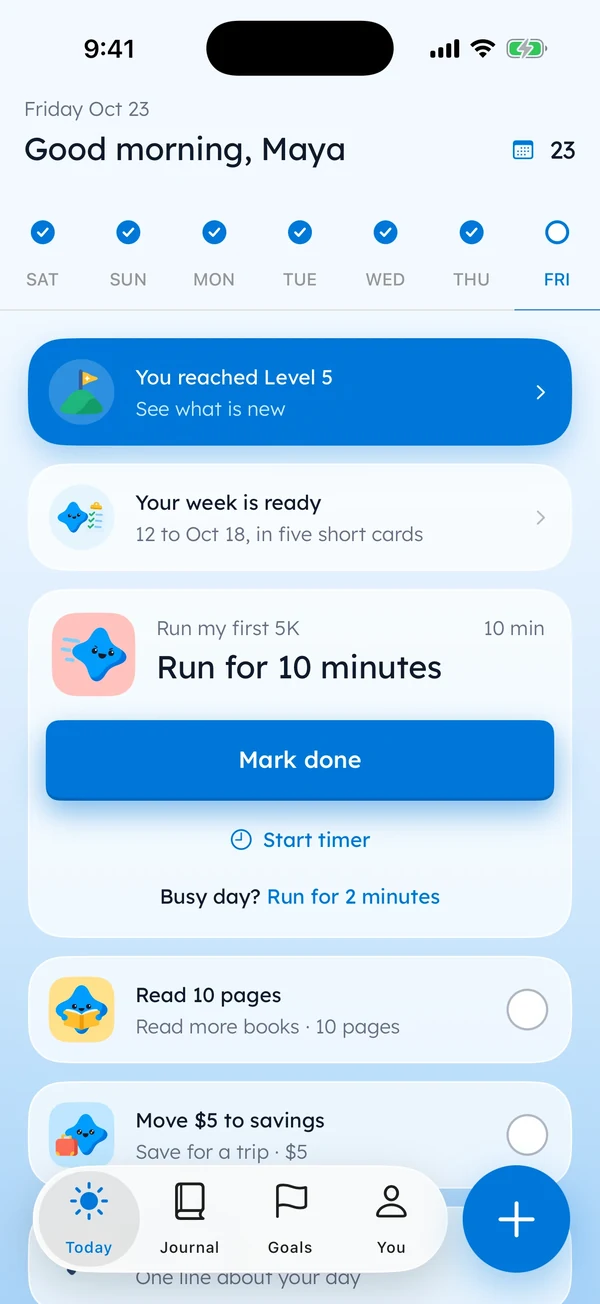
| Run a 5K | Run or walk-run for 10 minutes |
| Read 12 books this year | Read 10 pages |
| Save $500 | Put aside $10 this week |
| Learn Spanish | Practice for 10 minutes |
| Get the flat in order | Tidy one surface for 10 minutes |
Here are three of those, worked through slowly.
Run a 5K
A 5K is about 3 miles, which is a lot of miles for someone whose running shoes are currently holding a door open.
So today’s step is 10 minutes of walk-run: run a bit and walk a bit until the time is up. On a busy day, 2 minutes is the step.
Read 12 books in a year
Twelve books feels like homework. Ten pages a night feels like a bedtime habit, and over a year it comes to roughly a dozen ordinary-sized books.
So the step is 10 pages after dinner. On the nights when the book keeps sliding out of your hand, make it 2.
Save $500
$500 is a big number to stare at. $10 a week is a smaller one, moved on the same day each week.
That’s the step: $10 a week. On a tight week, put aside $1, which keeps the habit even when the amount is small.
There’s research behind starting this small, though it’s about people at work. Teresa Amabile and Steven Kramer studied the daily diaries of knowledge workers.
They found that progress in meaningful work (opens in a new tab), even small progress, mattered most on the good days.
That was work, and your goal is at home. But we like the idea it leaves behind: a step you can see is easier to take again.
Are mini goals and micro goals the same thing?
Mostly, yes. Mini goals and micro goals are the same idea: a goal cut so small that starting is easy.
Some people use “micro” or “tiny goals” for the very smallest version, like one push-up or one folded sock. In that sense, the busy-day steps above are micro goals. The starting sizes are small goals.
The labels matter less than two questions:
- Can you do it today?
- Can you do some of it on your worst day?
If both answers are yes, call it whatever you like.
A goal you can start tonight beats a perfect plan.
Small steps every day also add up in a way you can see. Ten pages a night is about 300 pages a month, which is a whole book, give or take a long one.
When the step starts to feel too small
At some point, 10 pages will feel easy. That’s the goal working.
The temptation is to jump to 50 pages after one good week, because a good week makes everything look possible, including a book the size of a brick.
Try growing it slowly instead: 10 to 12, then 15, a week or two at a time.
The behavior scientist BJ Fogg has a famous example of starting small: floss one tooth a day. In NPR’s piece on his research, he adds a rule for the days you feel like more.
“But if you want to do more, you do more.”
So the small size is a floor. If one night the book is good and you read 40 pages, enjoy it.
But tomorrow’s step is still 10.
What if even the busy-day step doesn’t happen? Then tomorrow’s step stays the same size, and nothing else changes.
In the app, there’s a setting for this called start small and grow, which raises the step slowly for you. On paper, write the new number in the margin when the old one gets easy.
Keep one line about each step
A small goal gets more interesting when you write down one line about each step. Just what you did and how it went.
If you’ve never kept a journal, starting with one line a day is the same idea from the writing side.
- “Read 10 pages. The detective is lying, surely.”
- “Walked to the corner and back. Neighbor’s cat followed.”
- “Put aside $1. Better than zero.”
- “Tidied one shelf. Found the charger cable that only works at one angle.”
After a month, those lines show you something a checkbox can’t: which steps you liked, and which ones you did while grumbling. That tells you which goal to grow.
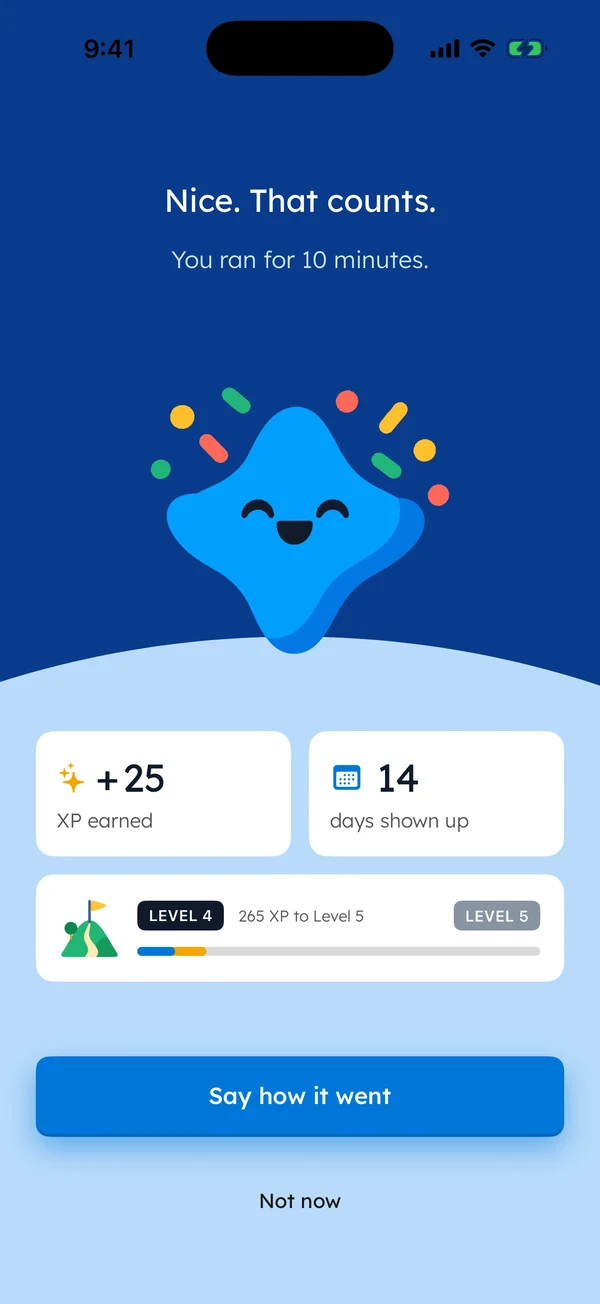
This is the loop the app is built on. You tap Mark done on the step, and Mira, the app’s star, cheers “Nice. That counts.”
Then a button says Say how it went, so you can write the line while the step is still fresh. If you’d like the step and the line in one place,  try it in Yumemira.
It’s hard to have nothing to say about something you did five minutes ago.
On paper, it’s a short list down the page, with the step on the left and the line on the right.
But it works the same way, and it’s the core of how to build a good habit that lasts past week one.
Pick your first one tonight
Before you put the phone down tonight, pick the goal that’s been waiting longest.
Write it at the top of a page, or in a note on your phone, then write its busy-day step under it.
Two pages, maybe, or one short hello.
“Get fit” can stay at the top. The street after dinner goes underneath.
Questions people ask
What is a small goal example?
“Read 10 pages a day” is a small goal. It has a number and a unit, and on a busy day it shrinks to 2 pages. Other examples are drinking 8 glasses of water a day or tidying for 10 minutes.
What is a small goal?
A small goal is a big goal cut down to a size you can start today. It names a number and a unit, like 20 minutes or $10 a week, so you know when you’re done and can repeat it tomorrow.
What are 10 short-term goals in life?
Start with these: drink 8 glasses of water a day, walk 20 minutes, read 10 pages, save $10 a week and call family twice a week. Then try these: tidy 10 minutes, cook at home, go outside, write 15 minutes and learn a language.
What are mini goals?
Mini goals are very small goals, cut so starting feels easy, like 2 pages of reading or a 5-minute walk. They work well as the busy-day version of a bigger daily goal, so a hard day still has a step in it.
How do I set small goals?
Pick one thing, give it a unit you can count, set a size that fits a normal day, and set a smaller busy-day size too. Try it for a week, then keep the size or grow it slightly.
Sources
TopicSmall goals

You earned the First Step badge
You read the whole guide. Now write one big goal and its busy-day step.
0 XP

Yumemira is an iPhone app (iOS 18 or later).
How Yumemira worksYumemira is free to start. iPhone, iOS 18 or later.