
Small steps
How to Build a Good Habit With Steps Too Small to Skip

The short answer
To build a good habit, pick one and make the first step too small to skip, like two pages or a five-minute walk. Do it right after something you already do every day, at a time you already stop. Plan a smaller version for busy days. Keep it that small for a week.
In 30 seconds
- Shrink the step until skipping it would feel silly.
- Do it right after something you already do every day.
- Decide the busy-day version before the busy day arrives.
- Mark it done and notice it, even when it’s tiny.
- After a miss, start again the next day. Never miss twice.
Picture a pair of running shoes by the front door, laces already loose, toes pointing at the street.
That’s a plan. A small one, but it works on mornings when most of you is still asleep.
You don’t need a new personality to build a good habit. You need the shoes by the door.
And if you like the idea of writing one line about each step, that’s the same method as starting a one-line journal.

Reading XP0 XP
How to build a good habit, from goal to step
A goal is where you want to end up. A habit is what you do often enough to get there.
A step is today’s piece of it.
| What it is | Example | |
|---|---|---|
| Goal | Where you want to end up | “Read 12 books this year” |
| Habit | What you do most days | “Read before bed” |
| Step | Today’s small piece | “Read 2 pages tonight” |
The top two rows sound good out loud. But the bottom row is the one you can do tonight, so every step below works on it.
Still choosing what to work on? These examples of goals can help you pick one. And once a habit is running, staying consistent is a separate question with its own answers.
Step 1: Make it too small to skip
BJ Fogg is a Stanford behavior scientist who wrote Tiny Habits (opens in a new tab). His advice is to keep the bar really low, even if it feels goofy.
In an NPR interview (opens in a new tab), his example was flossing one tooth a day.
One tooth. Nobody has a day too full for one tooth.
And on the good days?
“If you want to do more, you do more.”
The tiny version is the floor, and the floor is the part you keep.
Here’s a quick way to find your floor.
Ask whether you could do the step on your worst day of the month, the one with the late train and the phone at 4%. If not, cut it in half.
If your worst day can’t fit it, halve it.
- “Read more” becomes “read 2 pages”
- “Get fit” becomes “walk for 5 minutes”
- “Save money” becomes “put aside $1”
- “Drink more water” becomes “drink one glass”
They look almost too small to bother with. That’s the idea behind small goals: a step this size is hard to argue with.
Step 2: Tie it to something you already do
A new habit needs a cue. Fogg’s advice is to ask what the habit “comes after naturally”, so you aren’t relying on alarms or memory.
The best anchor happens on your worst days too.
Pick the anchor.
Something you do every day without thinking, like brushing your teeth or getting into bed.
Write one sentence.
“After [the anchor], [the tiny step].” Say it out loud once, so it sounds like a plan.
Put the step there.
The book goes on the pillow. The glass goes next to the toothbrush.
A few sentences that fit real days:
- After getting into bed, read 2 pages.
- After your first meal, walk for 5 minutes.
- After brushing your teeth, drink one glass of water.
- On payday, put aside $10.
Night shifts and odd hours work the same way. Tie the step to the end of the shift, whatever time that turns out to be, and let the clock do what it likes.
Step 3: Plan the busy day before it comes
Say a new habit gets through three calm weeks. Then a Thursday arrives with a deadline that moved and a dinner that ends at ten, and the normal step starts to look like a joke.
On that day, skipping feels reasonable. So decide the busy-day version now, while you’re calm, and count it in full.
Decide the busy-day version while the day is calm.
| Read | Walk | Save | |
|---|---|---|---|
| Normal day | “Read 10 pages” | “Walk 20 minutes” | “Save $10 a week” |
| Busy day | “Read 2 pages” | “Walk 5 minutes” | “Put aside $1” |
| Anchor | “After getting into bed” | “After the first meal” | “On payday” |
| After a miss | “2 pages tomorrow, no catching up” | “5 minutes tomorrow” | “$1 this payday, then carry on” |
A sticky note can hold all four rows. We make an app around this idea, so we’re biased. A pen works just as well.
In Yumemira, the small-steps journal for iPhone, the first two rows are the real starting points for these three goals.
Each of the 26 ready goals with a busy-day step comes with its own short version, and it counts in full.
When you mark a step done, Mira, the app’s star, cheers.
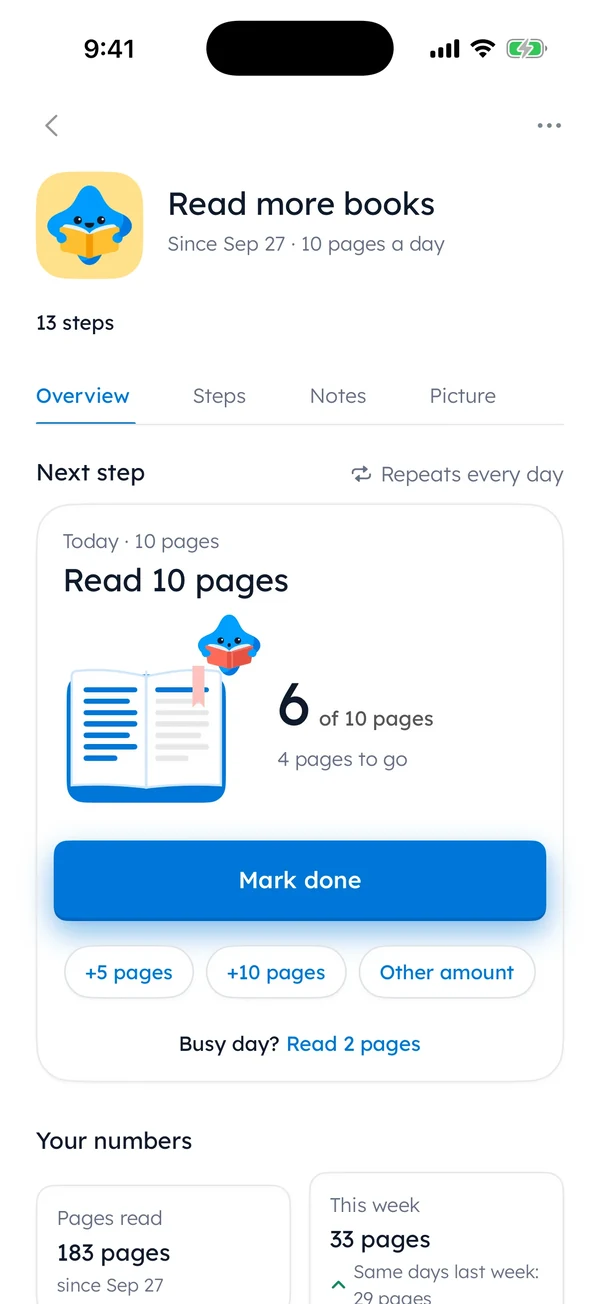
On a busy day, that 2-page step is the whole habit, in a size that fits.
Step 4: Mark it done, and notice it
Fogg’s third piece is to celebrate right after the step. In the same interview, flossing one tooth earns a smile in the mirror, because that small feeling of success helps the habit settle in.
Any small sign works:
- A quiet “done” to the empty room
- A fist bump with nobody
- A tick on the calendar by the fridge
It feels a bit silly for about two days.
And if that line becomes its own habit, you already know the method.
In Yumemira, you tap Mark done and Mira cheers “Nice. That counts.” Then Say how it went asks one question, so the line gets written before the moment is gone.
On paper it works the same way, with a tick and one honest line. The cheering star is optional.
Step 5: Never miss twice
Some days even the busy-day step doesn’t happen. There’s a useful fact about that.
Phillippa Lally’s team at University College London followed 96 people for 12 weeks as they built a new habit. In their 2010 study (opens in a new tab), “missing one opportunity to perform the behavior did not materially affect the habit formation process.”
So one miss is just one miss. James Clear’s version of this is to avoid the second mistake (opens in a new tab), because, as he puts it, “One mistake is just an outlier.”
The short version: never miss twice. After a miss, the next chance gets the busy-day step, with no catching up and no doubling.
After a miss, do the busy-day step next time.
How long does it take to build a habit?
There’s no fixed number. In Lally’s study, as James Clear sums it up (opens in a new tab), the average was 66 days before a habit felt automatic, and the range ran from 18 to 254 days.
Is a range that wide any use? It is, in one way: a habit that feels slow is still on track.
So skip the countdown.
Keep the step small and count the days you did it. The calendar can mind its own business.
Your habit on one sticky note
Ticks stay in this browser. Nothing is sent.
Tonight, with the phone already in your hand, type tomorrow’s step in its smallest size.
Then put it where you’ll trip over it, like the shoes by the door.
Questions people ask
What is the best way to build habits?
Start with one habit and make the first step tiny, like two pages or five minutes. Do it right after something you already do every day, plan a smaller busy-day version, and after a miss, start again the next day.
How long does it take to build a habit?
There’s no fixed number. One study at University College London found an average of 66 days before a new habit felt automatic, with a range of 18 to 254 days. Keep the step small and count the days you do it.
How do you make a habit stick?
Tie it to something you already do and keep a busy-day version ready. When you miss, do the small version the next day, so one miss stays one miss.
How do you start a new habit?
Pick one habit, shrink the first step until it fits your worst day, and choose an anchor you already do daily. Then do the tiny step tomorrow, right after the anchor, and notice that you did it.
Sources
- Do you have some bad habits? Good news, you can make new ones. Here's how (opens in a new tab)
- BJ Fogg, Tiny Habits (opens in a new tab)
- How are habits formed: Modelling habit formation in the real world (opens in a new tab)
- How Long Does it Actually Take to Form a New Habit? (Backed by Science) (opens in a new tab)
- Avoid the Second Mistake (opens in a new tab)
TopicStart journaling

You earned the Tiny Step badge
You read the whole guide. Now shrink one step until it’s too small to skip.
0 XP

Yumemira is an iPhone app (iOS 18 or later).
How Yumemira worksYumemira is free to start. iPhone, iOS 18 or later.