
Journaling ideas
What to write in a journal when you have nothing to say

The short answer
What to write in a journal: one true line about today, written at a time you already stop, like when you plug in your phone. Write something you did or noticed, plus a word for how it felt. A meal or a sound will do. Keep it that small for a week, and the blank page gets easier.
In 30 seconds
- One true line about today is a full entry.
- On a quiet day, write one sight, sound, meal or task.
- Copy a line from the table below and change one word.
- With nothing at all, do one small thing first and write about that.
The notebook is open. You’ve written the date and underlined it, and the page under it seems to want a novel.
Your day had a bus ride and a long email in it, and neither one feels worth the good pen, so the pen hovers for a while and goes back in the drawer.
It happens.

Reading XP0 XP
Why the page goes blank
The page goes blank because it seems to want a good entry, with a shape and a point.
Ordinary days don’t come with either.
If you’re brand new, the pillar guide on how to start journaling covers the setup. This page is for the night after, when the notebook’s ready and your head isn’t.
Here’s some comfort from 1660. Samuel Pepys kept one of the most famous diaries in English, and his entry for 2 January is mostly errands.
“so went to my office, where there was nothing to do.”
He got to a friend’s house too late for dinner, so he had bread and cheese with a cup of ale in the market instead, and later somebody taught him cribbage.
To be fair, the same entry carries news from Parliament. But it’s the cheese you remember.
What to write when nothing happened
The answer is one small, specific thing.
“Nothing happened” usually means nothing big happened, and small things make good lines.
Pick one thing you can still picture, and write that.
| Kind of line | Look for | A line it might get |
|---|---|---|
| A sight | The last thing that caught your eye | “Someone’s umbrella turned inside out at the bus stop.” |
| A sound | A noise you could still name | “The pressure cooker whistled 3 times. Dal again.” |
| A meal | What you ate, and where | “Lunch at the kitchen counter, standing up.” |
| A small task | One thing you finished | “Returned the library book, 9 days late.” |
| A feeling word | One word for the day | “Restless. Couldn’t sit through one episode.” |
Any one row will do. You don’t need all five.
If a line feels too plain, add one detail, like a number or a place. “Ate lunch” becomes “Lunch at the kitchen counter, standing up,” and now it’s a day you can see.
Copy a line for the day you had
Find the row that matches today and change one word so the line is yours. Every line here is made up, written to be borrowed.
| If today was… | Write something like… |
|---|---|
| Nothing happened | “New bus driver. He waved at everyone.” |
| A long shift | “12 hours on my feet. Rice, then bed.” |
| Good news | “Got the call. Told Mom first.” |
| An argument | “Argued about the dishes. Said sorry at nine.” |
| A sick day | “Stayed in with toast and a blanket.” |
| A lazy Sunday | “Didn’t leave the house. Finished the puzzle edge.” |
| A hard day | “Hard one. Glad it’s over.” |
The argument row is a good one to study. You can write that you argued without writing the whole argument, and the line still keeps the day.
Short lines leave room, too.
Read “Got the call” in a year and you’ll probably remember the rest, down to where you were standing when the phone rang.
Do one small thing, then write about it
Some days really are blank. So put something into the day before you write: one small thing, done without leaving the room, and then a line about it.
- Water the plant on the windowsill
- Read two pages of the library book
- Fold the laundry on the chair
- Answer the text you’ve owed someone since Sunday
Something you did five minutes ago still has all its details, like page 41 or the sock with no partner.
Do the small thing first, then write the line.
We make an app around this idea, so we’re not neutral here. A pen works just as well. But it’s easier to write about something you did than about how life is going, so the app starts with the doing.
In Yumemira, the small-steps journal for iPhone, you pick something you want and get one small step a day toward it. When the step’s finished, you tap Mark done.
Mira, the app’s star, says “Nice. That counts.” Then Say how it went opens one question, “How did it go?”, while the answer’s still fresh.
On paper, the same move works with a plant and a pencil.
What to write in a journal for beginners
The easiest start is one of three formats, kept for a week. Changing every night turns into one more decision, and that’s often what keeps the pen in the drawer.
One line.
One sentence about today, plus a word for how it felt. “Fixed the wobbly chair. Okay.”
A short list.
A few things from today, a few words each. “Bread. Late bus. Call from home. Rain.”
One question.
Answer a small question in one line, like “What made you smile today?”
The question format suits nights when your head’s empty, because the question does half the work. And if you’d like more ways to open the page, there’s a separate guide on how to start a journal entry.
In Yumemira, a new entry opens with a question from Mira. If it doesn’t fit, tap Another question, or “Write without one” for a plain line.
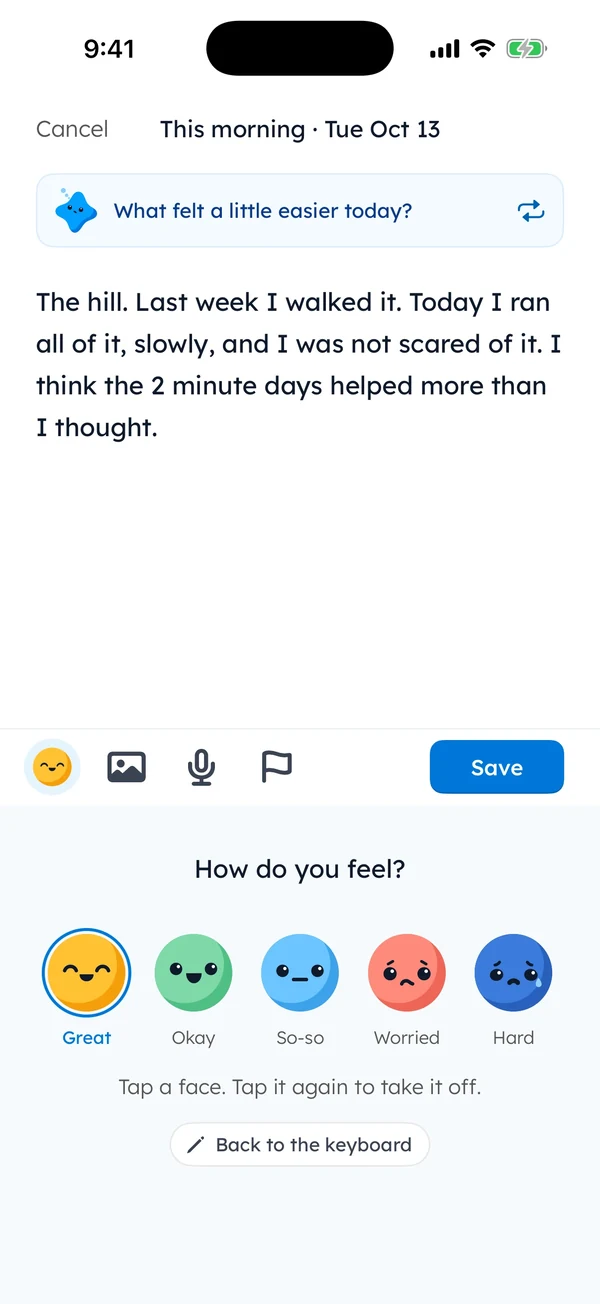
The paper version takes one sticky note. Write five small questions on it, and it’ll live inside the cover.
What to journal about daily, without repeating yourself
The trick is one question for a week, then a new one. The same question gets different answers, because even dull days differ.
These come from the app’s evening questions, and they work on paper too:
- “What was the best ten minutes of today?”
- “What made you smile today?”
- “What do you want to remember about today?”
- “What did your step feel like today?”
The first one’s the easiest on a tired night, because somewhere between the alarm and now there were ten minutes that went better than the rest, even if it was only the bus.
You can answer it with the light already off.
For more variety, try a set of beginner journal prompts. And if one line still feels like too much, micro journaling is the even smaller version.
What not to worry about
Handwriting and spelling can wait.
Nobody’s grading this, and the only reader is you, some time next March.
- Messy handwriting is fine, as long as you can read it later
- Spelling doesn’t get marked here
- Plenty of lines will be about soup
- Writing the same thing two nights in a row still gives you two lines
If paper feels like a chore, a phone is fine.
A one-line journal for iPhone or a plain notes app sits closer to your hand at night than a notebook on a shelf.
Worried your days aren’t interesting enough? Pepys wrote down bread and cheese, and people are still reading him.
Your line for tonight
Go back to the cheat table, find today’s row and change one word.
Then look at that underlined date. One borrowed line under it will do.
Questions people ask
What do I write in my journal?
Write one true thing from today: something you did, saw, ate or heard. Add one word for how the day felt. If nothing comes, write about the last photo you took today, then stop when the line ends.
What should I write in my journal every day?
Answer the same small question each day for a week, like “What was the best ten minutes of today?”, in one line. On busy days, five words will do. A fixed question means one less decision at night, so starting stays easy.
What do you write in a journal when nothing happens?
Write one small thing anyway, like a meal or a sound. A line such as “New bus driver. He waved at everyone.” is a full entry. On the quietest days, one word for how the day felt does the job.
What are some good things to write about in my journal?
Things you did, things you noticed, something someone said to you, and how the day felt. Pick one moment over a summary of the whole day. Small, specific details are easier to write tonight and easier to picture when you read them back.
Sources
TopicStart journaling

You earned the Quiet Day badge
You read to the end. Now copy the row that matches your day.
0 XP

Yumemira is an iPhone app (iOS 18 or later).
More about the daily journalYumemira is free to start. iPhone, iOS 18 or later.