
One line a day
Micro Journaling: Is One Sentence a Day Enough?
The short answer
Micro journaling means writing one sentence a day, and for keeping a record of your days, one is enough. Add a word for how the day felt if you like. Write it at a time you already stop, like brushing your teeth. Keep it that small for a week, then decide.
In 30 seconds
- One sentence a day counts as a real journal.
- Tie the sentence to something you already do every day.
- Boring lines count, and they’re the easiest ones to repeat.
- Write more when you want to, then go back to one.
You’ve read three articles about journaling. Each ran to 2,000 words. You’d settle for twelve.
Twelve words is one sentence. That’s the method (and yes, this page is longer than the habit).
If guides on how to start journaling lost you by page three, try this size.
We make an iPhone journal, so we’re not neutral. A pen works too.

Reading XP0 XP
What is micro journaling?
It’s a journal kept in one sentence a day. Some days that’s a full line, and some days it’s two words and a feeling.
The idea is older than the name.
Writer Gretchen Rubin describes turning a plain notebook into a one-sentence journal (opens in a new tab) while she worked on The Happiness Project. She wanted a journal, and she knew long entries wouldn’t last.
Her reason was the old line about not letting the perfect be the enemy of the good. That’s one writer and her own notebook, so read it as an example and nothing more.
Paper has a version too. Chronicle Books sells One Line a Day (opens in a new tab), a five-year memory book where each date’s page holds a short entry for each of five years.
So the space for each year is tiny. The page decides the length for you, and it decides small.
10 one-sentence journal examples
These are made-up examples for ordinary days. Each one is a single sentence, and none of them would interest a stranger.
- “The umbrella opened halfway and then gave up.”
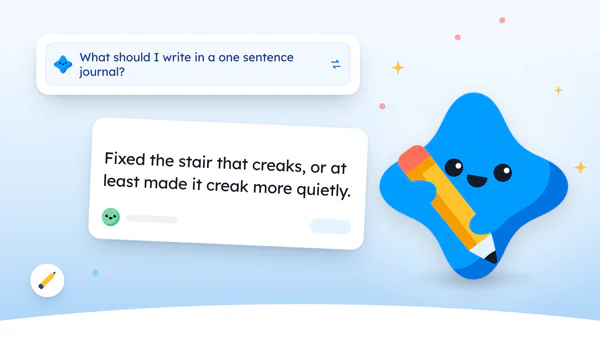
- “Fixed the stair that creaks, or at least made it creak more quietly.”
- “Cooked rice for two days and ate it for three.”
- “Called my aunt back after a week of meaning to.”
- “Read four pages on the train before the sun hit the window.”
- “Long shift, then a warm bus home.”
- “The plant grew a new leaf while nobody was looking.”
- “Quiet day with clean sheets at the end of it.”
- “Said no to one extra task, and nothing bad happened.”
- “Hard day, but the bakery still had bread at closing.”
Read them again. They’re dull.
That’s on purpose.
A boring line still counts.
Next March, the dull lines are the ones that show what an ordinary week looked like, from the bus that came early to the soup you made twice.
On paper, any notebook does the job. On a phone, a one-line journal on your iPhone can hand you a question when the empty box looks too big.
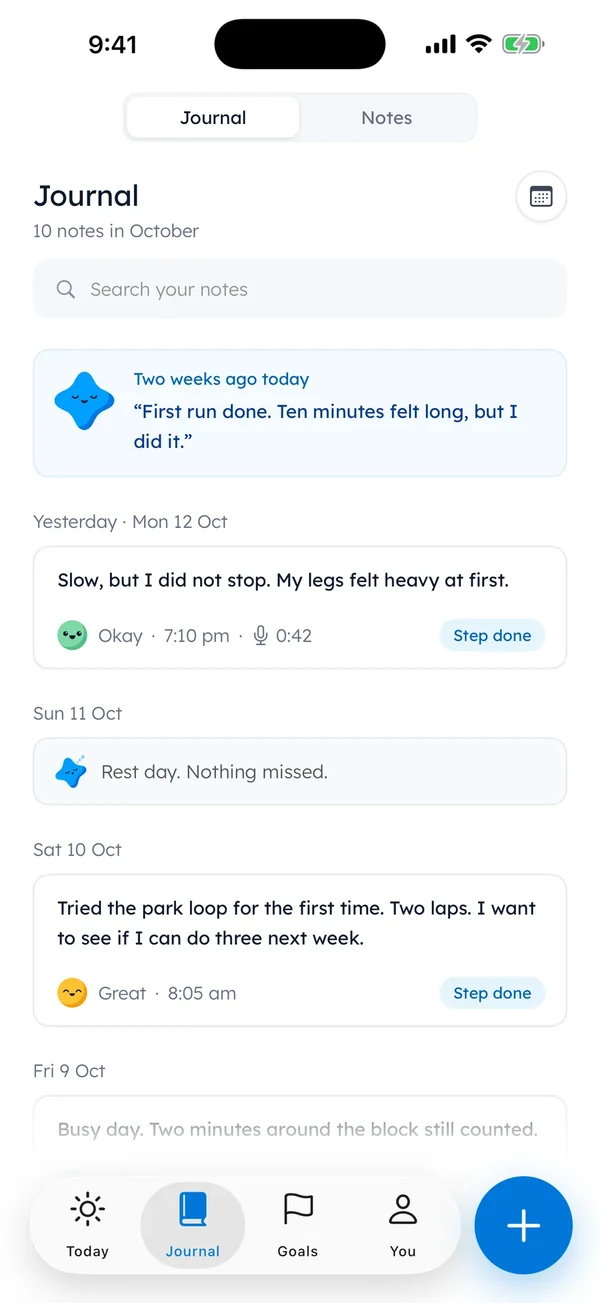
In Yumemira, the small-steps journal for iPhone, Mira (the app’s little star) asks one question. You answer in a line, then tap one of five faces, from Great to Hard.
Paper or phone, the sentence stays the same size.
Micro journaling vs regular journaling
Long and short journals each have a weak spot, and the weak spots show up on different days.
A long entry gives a big day room to spread out over a page or three, with the reasons and the whole conversation you keep replaying.
A short one keeps going through weeks with no room at all.
| Long journaling | Micro journaling | |
|---|---|---|
| Time it takes | As long as 1 to 3 pages take | About 1 minute |
| Words | A page or more | 1 sentence |
| What you keep | Reasons, details, whole conversations | The shape of each day, date by date |
| Where it breaks | Busy weeks and tired nights | Big days that need more room |
| Best for | Thinking a problem through on paper | A record on every kind of day |
Neither column wins every row. So pick by the week you’re having, and switch when the week changes.
Is one sentence a day enough?
Enough for what? That depends on the job you’re giving it.
- As a record of your days, yes: 365 dated lines a year.
- As a habit, yes. One sentence is the easiest size to repeat on a bad day.
- For a big decision, probably not. A hard conversation can need a page.
So one sentence is a floor. It’s the least you write on any day, and the most you ever have to.
But nothing stops a second sentence. Write the short line first. Add more if you want.
Short lines are quick to read back, too. In Yumemira, the Journal tab can bring an older line to the top under Two weeks ago today.
A page from two weeks ago takes a while to read.
A sentence takes a few seconds, which is about as long as anyone wants to spend remembering a random Thursday.
How to start a one-sentence journal tonight
Starting takes one decision: when the sentence happens.
Pick an anchor.
Something you do every day anyway, like setting an alarm or putting your phone on the charger. The sentence comes right after it.
Write one sentence.
Start with a verb if nothing comes. Plain words, any spelling.
Add a feeling word.
Optional: great, okay, so-so, worried or hard.
Stop there.
Close the notebook or the app, even if there’s room left.
The anchor matters more than the notebook.
Tie the sentence to something you already do. And then there’s no new time to remember.
Some days give you ten seconds between the last dish and the pillow, and some give you a whole quiet hour with nothing else on the list.
The sentence can stretch to fit.
| If you have… | Write something like… |
|---|---|
| 10 seconds | “Rain all day, so soup.” |
| 30 seconds | “Took the long way home past the bakery.” |
| 1 minute | “Missed the bus, so the next one got the whole chapter.” |
| 5 minutes or more | “Big news at work, so tonight gets a full page.” |
When one line grows into more
Some nights the sentence won’t stay one sentence. It’s allowed.
Say the day brought a job offer, and the line keeps running past the edge of the box. Keep going.
Then come back to one sentence the next night. Tomorrow can go back to one line.
The risk is the long version turning into the new rule. Then a busy week arrives with the bar set a page high, and the notebook ends up in a drawer under the takeaway menus.
A list of journal prompts helps on the longer nights. For the nights that seem empty, start with what to write in a journal when nothing happened: one plain fact, one verb.
Give the sentence something to say
There’s one more way to fill a quiet day. Do one small thing first, like reading two pages, then write the line about it.
Yumemira is built around that pairing. You mark a small step done, tap Say how it went and write while it’s fresh. On paper, the order is the same.
Tonight, before the phone goes on the charger, write one sentence that starts with a verb.
That’s about twelve words. And today is on paper.
Questions people ask
What is micro journaling?
It’s keeping a journal in very short entries, usually one sentence a day. Some people add one word for how the day felt. The point is a size small enough to write on any day, including busy and tired ones.
Is one sentence a day enough for a journal?
For a record of your days and a habit you can keep, yes. One dated sentence a day adds up to 365 lines a year. For thinking through something big, write more that night, then go back to one sentence.
What should I write in a one sentence journal?
Write one true thing from today, starting with something you did: cooked, called, read or fixed. Add a feeling word if you like. Ordinary lines are fine, because they show what a normal day looked like.
How long does micro journaling take?
About a minute on most days, because it’s one sentence. Tie it to something you already do every day, like charging your phone, so there’s no new time to remember.
Can I micro journal on my phone?
Yes. A notes app works, and so does a journal app. In Yumemira, the small-steps journal for iPhone, Mira asks one question, you answer in a line and tap a face. Paper works just as well.
Sources
TopicOne line a day
You earned the One Sentence badge
You read the whole guide. Now write one sentence tonight, starting with a verb.
0 XP

Yumemira is an iPhone app (iOS 18 or later).
More about the daily journalYumemira is free to start. iPhone, iOS 18 or later.