
Staying consistent
The 2-Minute Rule: How to Start a Habit on Your Busiest Day
The short answer
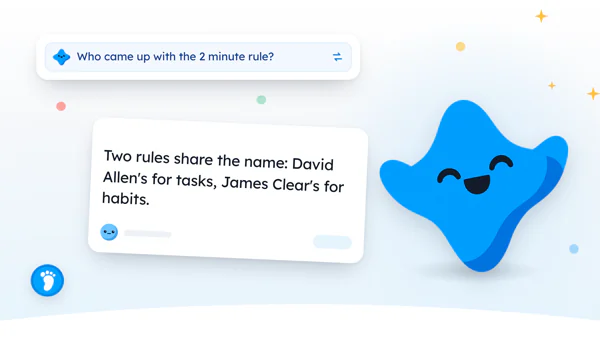
The 2 minute rule says to start a new habit with a version that takes two minutes or less, like reading 2 pages instead of 10. Do it at a time you already stop, like after dinner or at the end of a shift. Keep it that small for a week, then let it grow.
In 30 seconds
- Two rules share the name: David Allen’s for tasks, James Clear’s for habits.
- Tasks: if it takes under two minutes, do it now.
- Habits: start with a version that takes about two minutes.
- The small version counts in full. Doing more is allowed.
You don’t have 30 minutes today. You have the gap between the bus app saying “2 min” and the bus showing up, which everyone at the stop knows is closer to four.
That’s enough to start a habit. We make an iPhone app built on small steps, so we’re biased, but a sticky note works too.

Reading XP0 XP
What is the 2 minute rule?
It’s a way to make the start too small to dodge. Two people gave it the same name, and their rules fix two different problems.
- Allen’s rule is for tasks. In his Getting Things Done tip (opens in a new tab), anything that takes under two minutes gets done right away, because noting it and reading it later takes longer.
- Clear’s rule is for habits. In his article on the rule (opens in a new tab), a new habit should take under two minutes, so “read before bed” shrinks to one page.
Clear credits Allen for the first version in a footnote. So nobody’s fighting over it. They just picked the same timer.
Both answer an everyday question: how to stay consistent when the day is full before it starts.
If the start fits in two minutes, start it now.
Two rules with the same name
Here they are side by side. The difference is finish versus repeat.
| What | David Allen | James Clear |
|---|---|---|
| Made for | Tasks on your list | New habits |
| The rule | Under 2 minutes? Do it now. | Start with a 2-minute version. |
| Where it’s from | Getting Things Done | Clear’s 2013 article |
| An example | “Reply to the two-line email.” | “Read one page.” |
They’re easy to mix up, since both share a name and a number. And both are about getting moving, which doesn’t help.
Habits are the trickier kind, because they have to happen again tomorrow, and again on the day the late shift runs over and dinner is whatever’s left in the fridge door.
That’s Clear’s half.
Two-minute versions of 10 everyday goals
A two-minute version should still be the real thing, only smaller. Two pages is still reading.
But a short hello still counts as calling home, which surprises people who’ve been saving up for a long call since March.
Each row is a ready goal in our app, with its daily step and its busy-day version.
Most take about two minutes. A walk takes about five, and we’d rather say so than round it down.
| Goal | Full step | Two-minute version | A line it might get |
|---|---|---|---|
| Read | 10 pages a day | 2 pages | “2 pages. The chapter can wait.” |
| Walk | 20 minutes a day | About 5 minutes | “Once round the block before dinner.” |
| Stretch or yoga | 10 minutes a day | 2 minutes | “Stretched while the rice cooked.” |
| Meditate | 5 minutes a day | 2 minutes | “2 quiet minutes before opening messages.” |
| Tidy up | 10 minutes a day | 2 minutes | “Cleared the desk. Found three pens.” |
| Learn a language | 10 minutes a day | 2 minutes of practice | “Learned how to order tea.” |
| Gratitude | 3 good things | 1 good thing | “Good thing: the bus came early.” |
| Sleep on time | In bed by 10:30 pm | Wind down for 2 minutes | “Phone on the charger, lights low.” |
| Call family | Twice a week | A short hello | “Sent Mom a photo of the dog.” |
| Save money | $10 a week | Put aside $1 | “$1 in the jar. Small, but there.” |
Look at the last column. A two-minute step is easy to forget you did, and one line about it keeps it on the record.
In Yumemira, the small-steps journal for iPhone, every goal has a busy-day step under its normal one. Doing it counts as a full day. There’s a busy-day step for every goal, plus room for your own.
On paper, it works the same way. Write the small version next to the big one, and on a full day, do the small one without a debate.
Using the 2 minute rule for procrastination
Clear wrote his rule as a fix for putting things off. It works because the first move is the heavy one.
Once a book is open, page two costs very little.
So name the first physical move. “Work on the report” has no clear start. “Open the file and type the title” does.
- “Do my taxes” becomes “find last year’s form”.
- “Learn Spanish” becomes “open the lesson and do one card”.
- “Clean the kitchen” becomes “empty the sink”.
Each one fits inside a bus delay. Usually.
Name the first move, then do only that.
What to do after the two minutes
You can keep going, or you can stop. Both count.
Does that feel like cheating? Clear’s article has an answer for that: start, then stop when the two minutes end, so the small version is the whole habit for a while.
Say the whole day went to errands and a train that sat outside the station for forty minutes while your evening went with it. You read 2 pages at 10 pm and close the book.
That’s a full day.
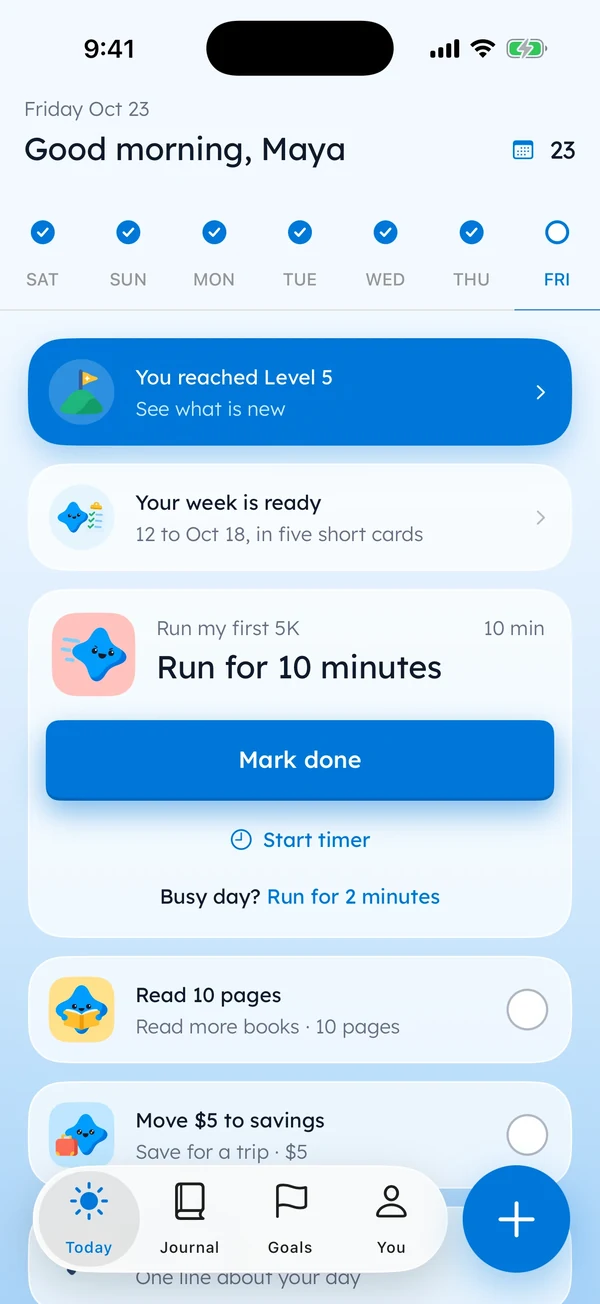
After a week of easy two-minute days, let the step grow a little, from 2 pages to 5. That’s how small habits turn into regular ones.
It’s also the first step of how to build a good habit. And if 2 pages is still too much on some nights, make it one.
Keep the small version around even when the big one feels easy. Busy days don’t send a warning first.
Questions people ask
What is the 2 minute rule?
It’s a rule for starting. James Clear’s version says a new habit should take under two minutes to do, like reading one page. David Allen’s older version says any task that takes under two minutes should be done right away.
What is the 2 minute rule for procrastination?
When you’re putting something off, find the first physical move that takes under two minutes, like opening the file or finding the form, and do only that. Starting is usually the heavy part, so a tiny start often carries you further.
What are examples of the 2 minute rule?
Read 2 pages instead of 10, or stretch for 2 minutes instead of 10. Send a short hello instead of making a call, or put aside $1 instead of $10. Each one is a smaller copy of the real habit.
Who came up with the 2 minute rule?
David Allen used it first for tasks in his Getting Things Done method. James Clear adapted it for habits in a 2013 article and credits Allen for the original version.
Does a 2-minute habit really count?
Yes. The point of the rule is to keep the habit alive on days when the full version won’t happen. Two pages is still reading, and the small version beats skipping the day.
Next time the bus app promises two minutes, read 2 pages while you wait.
For once, the two minutes might really be two.
Sources
TopicStaying consistent

You earned the Two Minutes badge
You read the whole thing. Now do two minutes of one goal tonight.
0 XP

Yumemira is an iPhone app (iOS 18 or later).
How Yumemira worksYumemira is free to start. iPhone, iOS 18 or later.