
Goal journal
How to keep a goal journal on paper or your phone (free page)

The short answer
A goal journal is a notebook, or a phone, where you write one goal at the top and then one small step and one line about it each day. Write the line at a time you already stop, like after dinner. Read the lines back once a month. Keep it that small for a week.
In 30 seconds
- Put one goal at the top of the page, not five.
- Each day gets a small step and one line about how it went.
- Write a busy-day step before you need it.
- Read the month back on its last day, then adjust the step.
Picture a gift-shop goal planner. It has pages for your vision, your why and your core values.
There’s no page for Tuesday.
But Tuesday is where a goal happens. This kind of journal is mostly Tuesdays: one small step and one line about it.
We’re biased, since we make an iPhone app for this. A pen works just as well.

Reading XP0 XP
What it is (and what it isn’t)
A goal journal follows one goal through ordinary days. Each day gets a row with the step you took and a short line about it.
It isn’t a planner. A planner holds the whole week, gas bill included, while this page only cares whether you did the one thing you said you wanted to do, and how it went.
One goal per page. A second goal gets its own.
How small should the goal be?
Small enough to start today. If yours still says “get healthy”, the tricks in small goals will cut it down.
You’re done cutting when it has a number and a unit, like 10 pages or 15 minutes.
How to keep a goal journal in 4 steps
The setup takes about five minutes, and any pen will do.
Write the goal at the top.
One line, with a number in it: “Read 12 books this year.”
Set today’s small step.
Something you can finish in one sitting, like 10 pages. Under it, add a busy-day step, like 2 pages.
Write one line after.
Do the step first, then say what happened in one sentence. Add a face if you like.
Look back once a month.
Read every line on the last day of the month, then decide what the step should be next.
Step 2 is the easy one to skip. But on a day that goes sideways, with a late meeting, a missed bus and dinner at nine, the busy-day step is the whole plan.
Step 3 can be plain.
“Read 10 pages. Fell asleep on page 9, finished in the morning.” That line is done.
A free page you can copy
Here’s the whole page, top to bottom. It fits any notebook, or the back of an envelope.
- The goal, in one line with a number in it.
- Why it matters to you, in a few words.
- The daily step for a normal day.
- The busy-day step, the smallest version you’d still accept.
- One row per day: the date, a tick, one line and a face.
- A look-back box of three lines at the bottom.
You fill in the top four once. After that, the page is just rows.
A notebook page holds about 15 rows, so two pages make a month, and the look-back box stays empty until the last day.
Paper or phone?
Both work. The best one is the one you’ll open at the time you already stop.
| Page part | On paper | On a phone |
|---|---|---|
| The goal at the top | Write it once, in pen | Pick from 26 goals or make your own |
| Today’s step | Copy it into each day’s row | Shown each day on Today |
| Busy-day step | Write a smaller one beside it | Built in, and it counts in full |
| One line and a face | A sentence and a quick doodle | One line and one of five faces |
| Monthly look-back | Flip back through the pages | Scroll the Journal or open the month calendar |
Paper wins on quiet. A phone wins on the nights when the notebook is in the kitchen, the lamp is off and you’re already under the blanket with no plans to move.
Either way, the line comes easier about something you just did. So the step goes first.
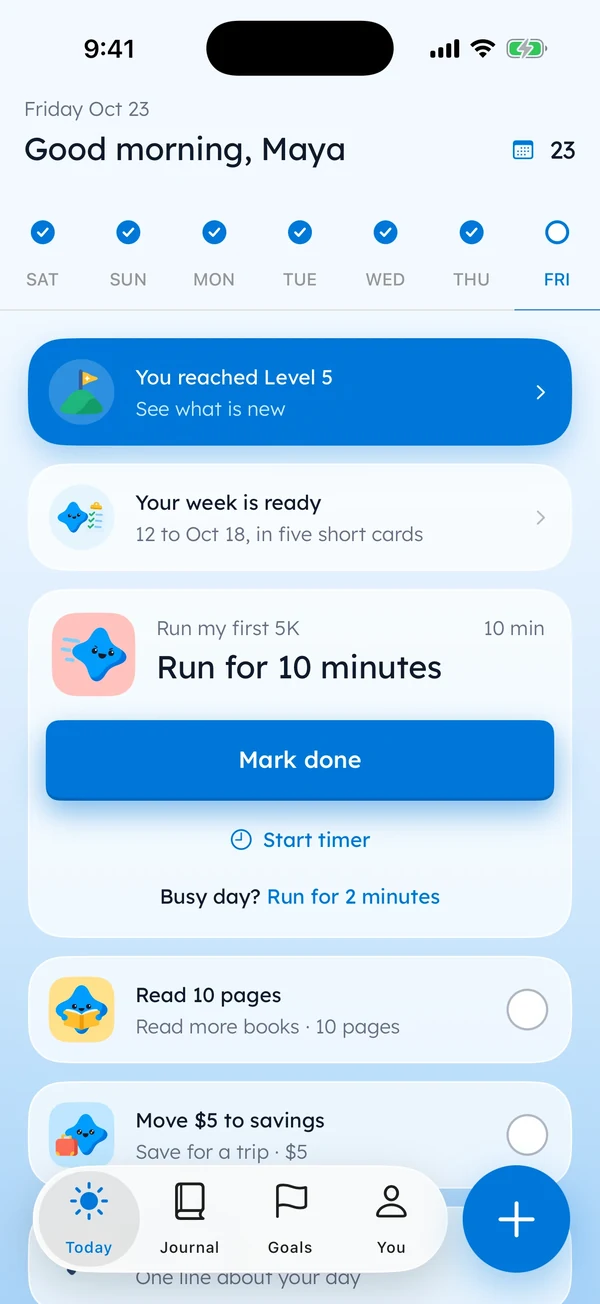
In Yumemira, the small-steps goal journal for iPhone, you pick from the 26 ready goals or make your own. Today shows the step, with a busy-day version under it.
You tap Mark done when it’s finished. Then “Say how it went” opens the line.
The faces are Great, Okay, So-so, Worried and Hard. On paper, a doodle does that job, and nobody grades the doodle.
40 goal journal prompts
A prompt helps on the nights when the line won’t come. One prompt, one line, then the pen goes down.
Before you start
- What do you want, in one sentence with a number in it?
- What would the first week of this look like on paper?
- What’s the smallest step that still feels like progress?
- What would the busy-day version of that step be?
- When does your day already have a gap of ten minutes?
- What stopped you the last time you tried this?
- What do you need within reach before you start?
- Who would you tell first when it goes well?
- What will you drop, so this one goal has room?
- How will you know, at the end of the month, that it moved?
 On a good day
- What made today’s step easier than yesterday’s?
- What did you notice while you were doing it?
- If you did a little extra, what kept you going?
- What would you tell yourself on day one now?
- Which part of the step felt the most like you?
- What did today’s step make room for afterwards?
- What’s one thing you want to remember about this day?
- Is the step starting to feel easy? Yes or no.
- What would make tomorrow’s step just as easy?
- Write the line you’d want to find a year from now.
 On a stuck day
- What got in the way today, in five words?
- Could you do the busy-day step right now, before bed?
- What’s the smallest piece of the step you did manage?
- Was today’s step too big, or was today too full?
- What would make tomorrow’s step smaller?
- What time of day would have worked better?
- What would you say to a friend stuck on the same step?
- What can you set out tonight for tomorrow?
- Which earlier line in this journal makes you want to try again?
- Write tomorrow’s step, and nothing else.
Monthly look-back
- How many rows have a tick this month?
- Which line from this month do you like best?
- On which days did the busy-day step save the day?
- What time of day shows up most in your good rows?
- Should next month’s step be bigger or smaller?
- What did you learn about the goal itself?
- Is this still the goal you want? Why, in one line?
- What surprised you when you read the month back?
- What one change would make next month easier?
- Write next month’s daily step and busy-day step.
Any answer can turn into a step. And once it’s a step, it’s one of your daily goals.
What a month of entries looks like
Say the goal is 12 books this year. The step is 10 pages a night, and the busy-day step is 2 pages.
| Day | Step | The line |
|---|---|---|
| 1 | 10 pages | “Started the book. Slow first chapter.” |
| 4 | 10 pages | “Read on the bus. Missed my stop by one.” |
| 9 | 2 pages | “Late shift. Two pages before bed.” |
| 13 | Rest day | “No book today. Back tomorrow.” |
| 21 | 15 pages | “Couldn’t put it down. Did extra.” |
| 30 | 10 pages | “Finished book one. Started book two.” |
Look at day 9. Two pages went in as a real row, and on the look-back it’s the row that held the month together.
Day 13 gets a line too.
Missed days get a line, never an apology.
On the last day, the look-back box might say: “22 rows ticked. Best time: the bus. Next month: same step, 12 pages on weekends.”
So the next month is planned in three lines.
When it’s more than one goal
What if you want water and a walk and an early night all on one page? That’s closer to a habit journal, with a grid instead of rows.
This page stays with one thing, so each line has room.
And if writing anything daily is new to you, the one-line method in how to start journaling works the same way, minus the goal at the top.
Your first page, tonight
The gift-shop planner can stay in the gift shop. One line at the top and one row for tomorrow will do.
Before the light goes off, write the goal at the top of a page and tomorrow’s step under it. If your phone is the notebook, those two lines go in the one-line journal.
Tomorrow is the first row, even if it’s a Tuesday.
Questions people ask
What is a goal journal?
It’s a notebook or app where you track one goal day by day. The goal sits at the top, and each day gets a row with the small step you took and one line about how it went.
How do you keep a goal journal?
Write one goal at the top of a page and pick a small daily step with a smaller busy-day version. After each step, write one line. At the end of the month, read the lines back.
What do you write in a goal journal?
Write the step you took and one line about what happened. Add a word or face for how it felt if you like. On stuck days, answer one prompt, like “What got in the way today, in five words?”
Is a goal journal the same as a planner?
No. A planner holds everything you need to do this week. This kind of journal follows one goal, with a small step and a line each day, so you can see how that one thing moved over a month.
How often should you look back at a goal journal?
Once a month works well. Read every row on the last day and notice which days went best. Then decide whether next month’s step should grow or shrink.
TopicSmall goals

You earned the Small Step badge
You read the whole guide. Now write one goal at the top of a page.
0 XP

Yumemira is an iPhone app (iOS 18 or later).
More about the daily journalYumemira is free to start. iPhone, iOS 18 or later.