
Small goals
Daily goals: 50 small examples you can do every day

The short answer
Daily goals are small, specific things you do every day, like reading 10 pages or drinking 8 glasses of water. Give each one a number and a busy-day version, like 2 pages. Do it at a time you already stop, such as right after dinner. Pick one, and keep it that small for a week.
In 30 seconds
- A good goal has a number you can check by bedtime.
- Every goal gets a busy-day version, and that version is enough.
- Start with one goal, two at most.
- After a missed day, start again with the small version.
For years your daily goal was “be productive”. That’s not a goal. That’s a mood.
A real one fits on a sticky note. You can tell by bedtime whether it happened.
Below are 50 of them, each with a smaller version for the days that go sideways.

Reading XP0 XP
What makes a good daily goal?
A good one passes three plain tests.
- You can count it. “Read 10 pages” can be checked by bedtime, while “read more” never ends.
- It hangs on something fixed, like brushing your teeth or getting off the bus.
- It shrinks. There’s a smaller version for the worst days.
Lists of goals tend to skip the third test. But the busy day is where a goal usually stops, somewhere between a late train, a sick child and dinner eaten standing up at the counter.
It doesn’t send a calendar invite either.
So size the goal for an ordinary day, the kind with a bus that comes on time and an evening that’s yours, and cut it again for a bad one.
Say the goal is walking:
- Ordinary day: 20 minutes.
- Busy day: 5 minutes, to the corner and back.
Both go down as a walk.
Write the busy-day version before you need it.
If it still feels heavy, it’s probably a big goal wearing a small coat. Our guide to small goals shows how to cut one down to today’s size.
Ten goals with a busy-day version
These ten come from the ready goals in our app, with the starting size it suggests and its own busy-day step.
The last column is the sort of line a person might write afterwards. Some of them are about biscuits.
| Area | Goal for today | Busy-day version | A line it might get |
|---|---|---|---|
| Body | Stretch for 10 minutes | Stretch for 2 minutes | “Stretched during the ads. Knees made noises.” |
| Body | Eat 5 portions of fruit and veg | Eat 2 portions | “Two portions. One was a banana on the bus.” |
| Body | In bed by 10:30 pm | Wind down for 2 minutes | “In bed at 10:40. Close enough.” |
| Body | A day with less sugar | Swap one sweet thing | “Swapped the biscuit for an apple. Missed the biscuit.” |
| Mind | Phone away for 30 minutes | Phone away for 10 minutes | “Phone in a drawer. Read the cereal box instead.” |
| Mind | Go outside for 20 minutes | Go outside for 5 minutes | “Five minutes on the front step. A neighbor waved.” |
| Mind | Write down 3 good things | Write down 1 good thing | “Good thing: the bus waited for me.” |
| Learning | Practise an instrument for 15 minutes | Practise for 5 minutes | “Five minutes of scales. The cat left the room.” |
| Learning | Draw for 15 minutes | Draw for 5 minutes | “Drew the mug. It looks like a vase.” |
| Home | Tidy for 10 minutes | Tidy for 2 minutes | “Two minutes. One clear chair, for the first time in weeks.” |
The third column is the one to read first. It’s the goal for the day when everything runs late, and those days arrive without asking.
So two minutes is still stretching. And five minutes on the step is still going outside, even if a neighbor is the only view.
On a bad day, the small version is the goal.
We make an iPhone app that works this way, so we’re not neutral here. A sticky note works just as well, as long as it sits where the goal happens:
- On the fridge, with the goal on top and the busy-day version underneath.
- On the bathroom mirror, if the goal hangs on brushing your teeth.
- Inside the book you’re reading, with both page counts on it.
In Yumemira, the small-steps journal for iPhone, today’s step sits on the Today screen above a big blue Mark done button. Under it, a line reads “Busy day?” with the smaller step.
Paper or phone, decide the small version on a calm evening. Then the busy morning has one less thing to decide.
50 daily goals examples, sorted by area
Here are 50 good ones, ten for each part of life, each with a normal size and a busy-day size.
The numbers are yours to change. Nobody’s grading this.
Ten for your body
- Drink 8 glasses of water. Busy day: 4 glasses.
- Walk for 20 minutes. Busy day: 5 minutes, even if it’s only to the shop.
- Stretch for 10 minutes. Busy day: 2 minutes, before you get out of bed.
- Eat 5 portions of fruit and veg. Busy day: 2 portions.
- Swap one sweet snack for something else. Busy day: swap half of it.
- Be in bed by 10:30 pm. Busy day: 2 minutes of winding down, phone face down.
- Get up when the first alarm rings. Busy day: sit up when it rings.
- Take the stairs instead of the lift once. Busy day: one floor.
- Cook one meal at home. Busy day: make a simple snack yourself.
- Do 10 squats while the rice cooks. Busy day: 3 squats.
Ten for a quieter mind
- Take 3 breathers through the day. Busy day: 1 breather.
- Sit still for 5 minutes with a timer. Busy day: 2 minutes.
- Write down 3 good things. Busy day: 1 good thing.
- Put the phone in another room for 30 minutes. Busy day: 10 minutes.
- Go outside for 20 minutes. Busy day: 5 minutes on a balcony or step.
- Eat one meal with no screen. Busy day: the first five bites.
- Charge the phone outside the bedroom. Busy day: face down, across the room.
- Listen to one song with nothing else going on. Busy day: the first minute.
- Look out of a window before you open any app. Busy day: 30 seconds.
- Write one line about today. Busy day: one word for how it felt.
Ten for learning and making
- Read 10 pages. Busy day: 2 pages.
- Practise a language for 10 minutes. Busy day: 2 minutes.
- Learn 5 new words. Busy day: 1 word, used in a sentence.
- Practise an instrument for 15 minutes. Busy day: 5 minutes of scales.
- Draw for 15 minutes. Busy day: one sketch of the nearest cup.
- Write for 15 minutes. Busy day: 5 minutes.
- Look up one thing you wondered about. Busy day: write the question down for tomorrow.
- Learn one line of a poem by heart. Busy day: read it out loud once.
- Do one page of a puzzle book. Busy day: one clue.
- Cook one new recipe step this week. Busy day: read the recipe through.
Ten for money
- Move $5 to savings. Busy day: $1.
- Write down everything you spent today. Busy day: just the biggest one.
- Make today a no-spend day. Busy day: skip one small buy.
- Pack tomorrow’s lunch tonight. Busy day: pack just the snack.
- Make tea or coffee at home. Busy day: carry water from home.
- Wait one day before any buy over $20. Busy day: leave it in the cart.
- Unsubscribe from one shop’s emails. Busy day: delete one unread.
- Check one bill or statement. Busy day: look at the balance only.
- Sell or give away one thing you don’t use. Busy day: put it by the door.
- Add $1 to a trip fund. Busy day: write the trip’s name on the jar.
Ten for home and people
- Tidy for 10 minutes. Busy day: 2 minutes, one surface.
- Make your bed. Busy day: pull the cover straight.
- Wash the dishes before bed. Busy day: soak the pan.
- Call one person you love. Busy day: send a short hello.
- Water one plant. Busy day: touch the soil and check.
- Put 5 things back where they belong. Busy day: 1 thing.
- Ask someone at home about their day. Busy day: ask, then listen to the whole answer.
- Clear the kitchen counter. Busy day: clear one corner.
- Send one thank-you message. Busy day: one line.
- Fold and put away one load of clothes. Busy day: just the socks.
That’s a lot of good ideas for one evening. The best pick is usually the one you keep mentioning, the thing you’ve said “I keep meaning to do that” about.
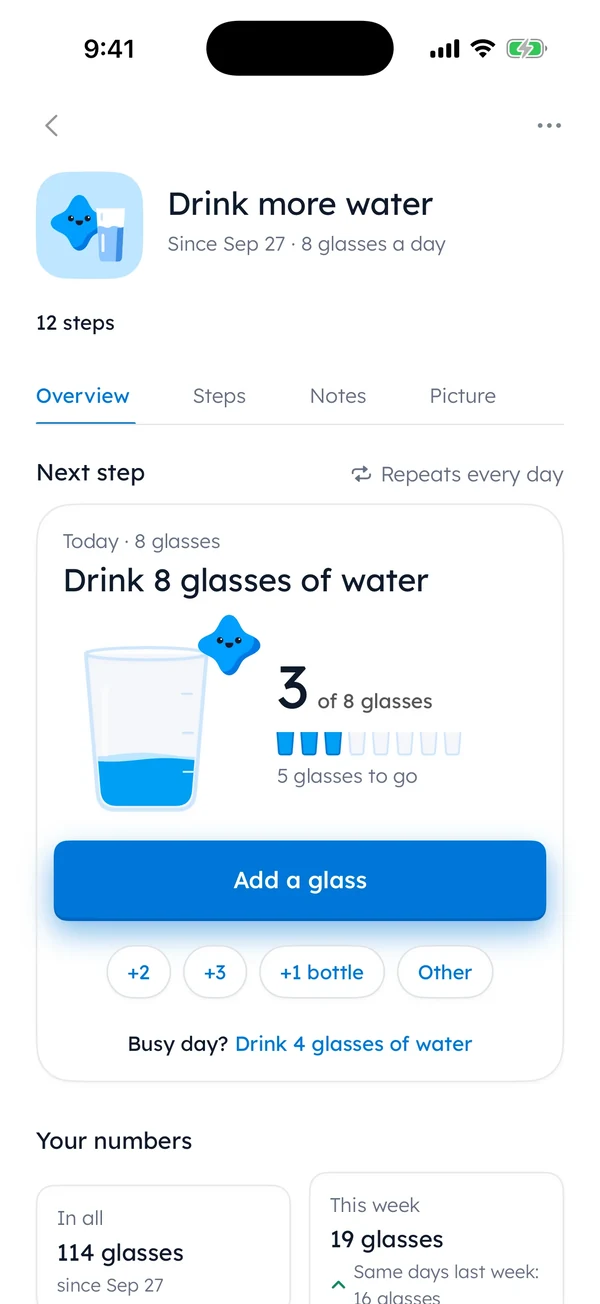
In the app, you can set goals that count in your own units: glasses, pages, minutes or dollars.
For goals that run longer than a day, our list of examples of goals has 100 more, each with a first step.
How many daily goals is too many?
One is enough to start. A second can join once the first feels dull.
Five at once tends to turn into a to-do list that glares at you from the fridge.
Here’s a rough guide. It’s our own rule of thumb, so bend it to your weeks.
| If your days look like… | Keep… |
|---|---|
| Brand new to this | 1, for the first week |
| Full but mostly predictable | 1 or 2 |
| Shifts that change every week | 1, tied to waking up |
| Exams, a move or a new baby | 1, the busy-day version only |
| Plenty of free evenings | 2 or 3, each with a busy-day version |
Add a second goal only after a dull, easy week.
Dull is a good sign here. It means the first goal runs without a fight, and as far as we can tell, the dull ones last longest.
When a goal does stop, it’s often because the week changed shape. Our guide on how to be consistent has a rule for the day after that: never miss twice.
Write one line after each goal
Doing the goal is half of it. The other half is one line about it, written right after.
Teresa Amabile and Steven Kramer read diaries kept by people at work. In a 2011 Harvard Business Review article (opens in a new tab), they reported that seeing progress, even small progress, was the biggest lift to motivation on a workday.
That research was about jobs. But the idea travels well to goals at home.
A line turns “did it” into something you can see later.
- “Read 2 pages. Busy day, and the book just got good.”
- “Walked to the shop and back. Bought bread I didn’t need.”
- “Phone in a drawer for 30 minutes. Finished the crossword.”
Write the line while the step is still warm.
On paper, that’s a notebook by the bed and one sentence before the light goes off. Any notebook works.
In our app, the line comes right after the step. You tap Mark done, and Mira, the app’s star, cheers “Nice. That counts.”
Then a button says Say how it went. If you’d like the line waiting for you each day,  try it in Yumemira.
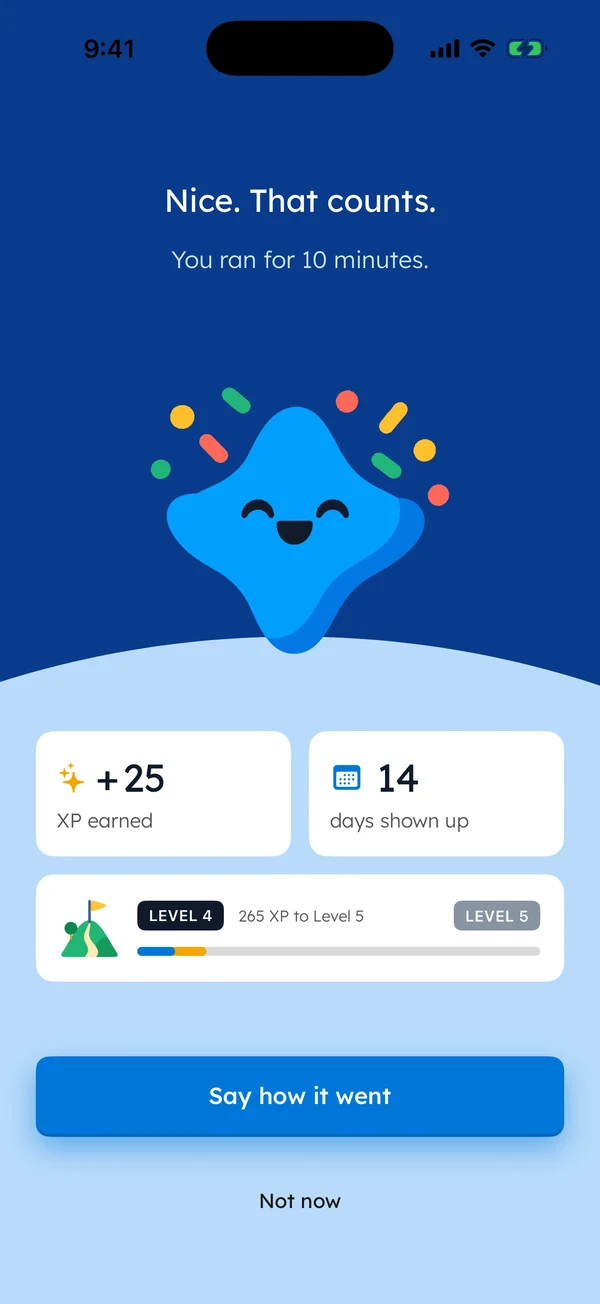
Either way, you end up with a list of days you showed up, in your own words. You can read it back next month, and some of it will make you smile.
Pick tomorrow’s goal tonight
One goal, one number, one smaller version. That’s the whole plan for tomorrow.
Pick one goal.
Take it from the 50 above, or from that thing you keep meaning to do.
Give it a number.
Pages, minutes, glasses, dollars. Something you can check by bedtime.
Write the busy-day version.
Make it small enough for your worst day last month.
Hang it on an anchor.
Choose the moment it happens, like right after dinner.
Then leave it somewhere you’ll see it in the morning. The fridge door is a classic for a reason.
“Be productive” can stay a mood. Tomorrow’s goal is ten pages, or two.
Questions people ask
What are some good daily goals?
Good ones are small and countable: read 10 pages, drink 8 glasses of water, walk for 20 minutes, tidy for 10 minutes or write one line about the day. Each should have a smaller busy-day version, like 2 pages, for days that run late.
What are examples of daily goals?
Examples include stretching for 10 minutes, putting the phone in another room for 30 minutes, practising a language for 10 minutes, moving $5 to savings and calling one person you love. Pick one that fits a moment you already have each day.
How many goals should I have each day?
Start with one for the first week. Add a second only when the first feels easy and a little dull. More than three at once tends to turn into a to-do list.
How is a daily goal different from a habit?
A goal for the day is something you choose to do today, with a number you can check. A habit is what that goal becomes when you keep doing it at the same moment, until it takes little thought. A goal like that is one way a habit starts.
Sources
TopicSmall goals

You earned the Idea Keeper badge
You read all 50. Now write tomorrow’s one daily goal and its busy-day version.
0 XP

Yumemira is an iPhone app (iOS 18 or later).
How Yumemira worksYumemira is free to start. iPhone, iOS 18 or later.