
Types of journaling
Journaling methods: 9 ways to journal, and who each one suits

The short answer
Journaling methods are the different ways to keep a journal: one line a day, bullets, prompts, morning pages, gratitude lists, photos, voice notes, lists and goal journals. Pick the one that fits the time you really have, do it at a time you already stop, like plugging in your phone, and keep it that small for a week.
In 30 seconds
- Pick a method by the minutes you have on a bad day.
- One line a day is the smallest; morning pages is the biggest.
- Mixing two methods is fine, and often easier.
- If a method stops fitting, swap it and keep the journal.
Say you’ve already tried a few. Bullet journaling (the ruler phase), gratitude lists (the forced phase), and then nothing at all (the honest phase).
If the honest phase lasted longest, that’s useful. The methods were bigger than your evenings.
We make an iPhone journal, so we’re not neutral here. A pen works just as well.

Reading XP0 XP
Journaling methods at a glance
Here are nine ways to journal, sorted from about a minute to three handwritten pages. If you’re brand new, the guide to how to start journaling walks through your first week.
| Method | Rough time | You need | Suits |
|---|---|---|---|
| One line a day | About 1 minute | Any pen, or a phone | Tired nights and first-timers |
| Bullets | 2 to 5 minutes | A notebook and 3 symbols | People who like to plan |
| Prompts | 3 to 10 minutes | One question | Blank-page nights |
| Morning pages | 3 handwritten pages | A notebook and a quiet morning | Early risers with time to spare |
| Gratitude list | 2 to 3 minutes | A pen | Ending the day on a good bit |
| Photo journal | Under 1 minute | Your phone camera | People who notice more than they write |
| Voice journal | 1 to 2 minutes | A phone | Days when typing feels like work |
| List journal | About 2 minutes | A pen | People who don’t like sentences |
| Goal journal | 1 minute, after a step | One small daily step | Wanting a goal and a journal together |
Pick by the minutes you have on a bad day.
The good days take care of themselves.
The 9 types of journaling, from one line to three pages
Each method gets a real example line, so you can see a normal entry before you buy anything.
1. One line a day
You write one true sentence about today, and stop. It’s the smallest method here, and the easiest one to restart after a gap.
A typical entry: “Rain all morning. Fixed the wobbly chair leg. Okay day.”
The guide to micro journaling covers it in full, with first lines for every kind of day.
2. Bullets (rapid logging)
The Bullet Journal method writes entries as short objective sentences, each with a symbol in front. Its own guide to rapid logging (opens in a new tab) uses a dot for a task, an “O” for an event and a dash for a note.
An entry might read like this:
- “• Call the landlord.”
- “O Dentist, 4 pm.”
- A dash, then “The new bakery opens at 7.”
The decorated spreads you see online are optional. Three symbols and a pen are the whole method, so the ruler can go back in the drawer.
3. Prompts
A prompt is one small question you answer in a line or two. It helps on nights when you’d happily write, if only someone asked you something.
Ask “What did you eat today that you’d eat again?” and you might get “Cold noodles at the counter. No regrets.”
But keep the question small. “What was the best ten minutes of today?” is a lot easier at night than “Who am I becoming?”
4. Morning pages
Julia Cameron describes morning pages as “three pages of longhand, stream of consciousness writing, done first thing in the morning” (her page, archived copy (opens in a new tab)). Nobody else reads them.
A morning might start: “Page one is mostly about the neighbor’s drill. Page two finds the actual worry.”
It’s the biggest method on the list. And it needs a calm morning, which not every week has. Our guide to morning pages compares the full version with smaller ones.
5. Gratitude list
You write three small good things from today. Aiming too high is one way the list starts to feel forced, so let them be tiny.
A list might read: “A seat on the train. Hot rice. The neighbor’s cat sat on my bag.”
If the list starts repeating itself, a fresh question helps. These gratitude journal prompts give you one for each night.
Four ways to journal with fewer words
These four suit people who’d rather snap, say, list or do something than write a paragraph about it.
6. Photo journal
You take one photo a day of something you want to remember, then add a few words. Your camera roll already holds a rough version of this, somewhere between the receipts and one blurry photo of a ceiling.
For example, a fogged bus window, with the line “Cold one. Bus was late.”
On paper, print a small photo now and then and write the date under it.
7. Voice journal
You say the line out loud instead of typing it. Most phones can record a voice note or turn speech into text.
Said out loud: “Walking home. The bakery was shut, so it’s cereal for dinner again.”
Talking to a phone in an empty room feels odd at first. The room won’t tell anyone.
So mix methods if that helps. In Yumemira, the small-steps journal for iPhone, one entry can hold a typed line, a face for how the day felt, up to six photos or your voice.
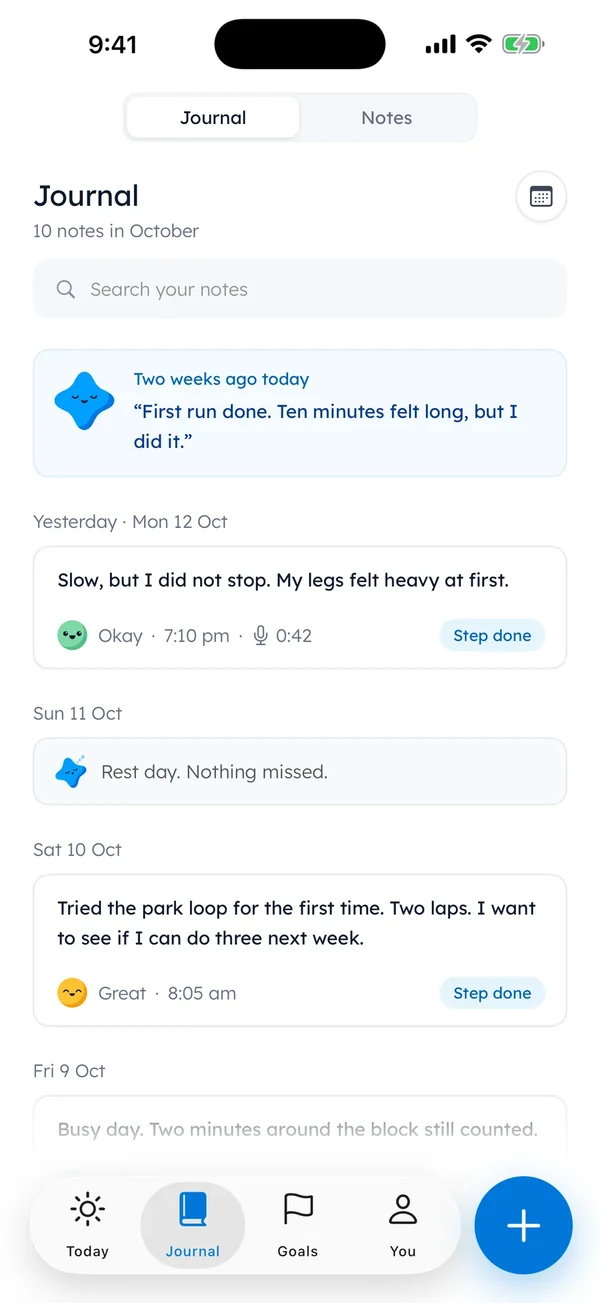
8. List journal
The journal becomes short dated lists instead of sentences. A list doesn’t have a blank-page problem, because you only need the first item.
A list for today: “Fixed today: the zip, and the Wi-Fi (by unplugging it).”
For list ideas sorted by how often you’d add to them, see these list journal ideas.
9. Goal journal
A goal journal starts from something you did. Do one small step first, then write a line about it, which is far easier than writing about a day where nothing seemed to happen.
A line after a step: “Walked 20 minutes. Found a shortcut past the school.”
In Yumemira, you tap Mark done on today’s step, and Mira, the app’s star, cheers “Nice. That counts.” Then Say how it went asks “How did it go?” while it’s fresh.
On paper it works the same way, minus the cheering. Here’s how to keep a goal journal with any notebook.
Swap the method before you quit the journal.
How to pick a journaling method
Start with the night you have most often. That’s the one the method has to survive.
| If you usually… | Try | A first line it might get |
|---|---|---|
| Have one minute and no energy | One line a day | “Long shift. Toast for dinner. Bed.” |
| Freeze at a blank page | A prompt | “Best ten minutes: the bus was nearly empty.” |
| Don’t like writing sentences | A list | “Ate today: rice, an apple, too much tea.” |
| Think better out loud | Voice | “Meeting went fine. I worried for nothing, as usual.” |
| Take photos more than notes | A photo journal | “Photo: the umbrella that didn’t open. Line: ‘Wet.’” |
| Want to finish something | A goal journal | “Read 10 pages before bed. The book finally got going.” |
Two rows at once is fine. A line on weeknights and a list on Sunday is still one journal, and it’s probably an easier one to keep.
Journal or diary?
The two words overlap a lot, and every method above works under either name.
Some people say diary when it’s mostly what happened, and journal when it also holds thoughts, lists or goals. The longer answer is in journal vs diary.
So for picking a method, the minutes matter more than the label.
Try one method for a week
Seven nights is a fair test.
It’s long enough to get past the strange first night, when the pen feels like it belongs to someone else, and short enough that a bad fit costs very little.
That’s the deal.
Try one method for seven nights before you judge it.
On night 8, read the week back. If the entries sound like you, keep the method. If they read like homework, use the swap rule.
And you’re free to put the line in your phone journal one week and in a notebook the next. The method travels with you.
When a method stops fitting
Methods wear out.
A gratitude list that felt warm in spring can feel like a form by autumn, and a three-page habit can shrink to half a page when work gets busy.
It happens.
So pick the smallest row that fits the night you’ve got. One line, with the light already off, is still a journal.
The ruler can stay in the drawer tonight.
Questions people ask
What are the different types of journaling?
Common types include one line a day, bullet journaling, prompt journaling, morning pages, gratitude lists, photo journals, voice journals, list journals and goal journals. They differ mostly in time and tools, from about a minute with one sentence to three handwritten pages each morning.
Which journaling method is best for beginners?
One line a day is the easiest place to start. It takes about a minute, needs nothing but a pen or a phone, and still works on tired nights. Once it feels too easy, try prompts or a short list.
How many minutes a day should I journal?
There’s no set number. One minute is enough for a one-line entry, and many methods take 2 to 10 minutes. Pick an amount you could still manage on your busiest day, and go longer only when you want to.
Can I mix journaling methods?
Yes. You can keep a daily line and a weekly list, or add a photo on days when words won’t come. Keep the same notebook or app and the same time of day, so the mix still feels like one habit.
Sources
TopicStart journaling
You earned the Method Finder badge
You compared all nine. Tonight, try the smallest one you haven’t tried.
0 XP

Yumemira is an iPhone app (iOS 18 or later).
More about the daily journalYumemira is free to start. iPhone, iOS 18 or later.