
Journaling for beginners
Journal vs diary: the real difference (and why it barely matters)

The short answer
Journal vs diary: a diary usually records what happened each day, and a journal often adds what you think about it. But dictionaries define each word with the other, so the difference is mostly habit. Pick either word and write one line at a moment you already pause, like the bus or bedtime.
In 30 seconds
- A diary leans toward events. A journal leans toward thoughts.
- Merriam-Webster lists each word in the other’s definition.
- Both words grew from the Latin word for “day”.
- Choose by the job you want done, then write one line.
The book had a gold clasp and a lock the size of a fingernail. The key went missing in week one, and the lock didn’t mind.
Today the same pages come with a linen cover and JOURNAL on the front. Same pages.
We make an iPhone journal, so we’re not neutral about the word. A pen works just as well.

Reading XP0 XP
The short difference between a journal and a diary
A diary keeps the facts of the day. A journal keeps your take on them.
- Diary: where you went, who called, what you ate.
- Journal: why that call’s still bugging you, and what you’d say if they rang again.
Plenty of books cross that line. A grandmother’s diary can be packed with opinions about the neighbours, while a journal bought off a shop shelf might hold nothing but dates and the weather. Covers fib a little.
Merriam-Webster’s entry for diary (opens in a new tab) uses one word as a synonym in its first sense: “journal”. Its entry for journal (opens in a new tab) does the same in reverse, so the dictionary sends you in a circle.
Use whichever word gets you to open the book.
And the method underneath doesn’t change, so the first steps of how to journal work for both.
Diary vs journal, side by side
Here’s how the two words usually get used. The dictionary’s caveat sits right below.
| Diary | Journal | |
|---|---|---|
| What goes in | Events, appointments, who you saw | Thoughts, questions, plans, sometimes events |
| Tone | A record: “this happened” | A conversation: “this is what I think” |
| Typical length | A few lines per date | One line to several pages |
| Where you see the word | Lockable notebooks, old published diaries | Notebook shelves, newspaper names |
| Locks and keys | A tiny lock, rarely a working key | Usually none, so privacy is up to you |
| A line it might get | “Parcel went to the wrong door. Got it back.” | “Dreaded knocking next door all day. It took two minutes.” |
The newspaper row is real. Merriam-Webster’s first sense of journal is “a daily newspaper”.
Its example is The Wall Street Journal. Not anyone’s diary.
In Yumemira, the small-steps journal for iPhone, the two jobs sit side by side too. The Journal tab holds a line about each day, with a face for how it felt.
Switch to Notes for the rest: a grocery checklist, a running playlist, a #travel plan.
Back on paper, a sticky tab does the same job. Days go at the front, lists at the back.
Where the words come from
Both words start with the Latin dies, which means “day”.
Diary turns up in English in the 1580s, from Latin diarium. According to Etymonline (opens in a new tab), that first meant “daily allowance”, and only later “a journal”.
Journal’s older. Etymonline (opens in a new tab) dates it to the mid-1300s, as a book of church services, by way of Old French.
It meant a personal diary by about 1600. A daily newspaper came by 1728.
| Diary | Journal | |
|---|---|---|
| First seen in English | 1580s | Mid-1300s |
| First meaning | “daily allowance” in Latin | A book of church services |
| Personal record | From the start | By about 1600 |
| Verb in Merriam-Webster | No | Yes: “to journal” |
So one word began as a daily allowance and the other as a book of church services.
Both are a long way from the notebook most of us picture, the one full of crushes and grocery lists that gets hidden under a mattress.
Neither one was built for feelings.
The table’s last row is grammar.
One word got a verb. Lucky word.
So which should you keep?
The short answer is to write what you need. Remembering the day calls for a diary line, and if something’s going around your head, write a journal line.
Say it’s a Wednesday, you paid a library fine, your sister called about the wedding, and the thing you can’t stop thinking about is whether to take the new job.
That’s two lines.
And that’s the whole journaling vs keeping a diary question: one line for the day, one for your head. The name on the cover doesn’t care which one you write.
| If you want to… | Write something like… |
|---|---|
| Remember what happened | “Rain. Found my other glove. Early night.” |
| Think something through | “Still unsure about the job. Better pay, longer commute.” |
| Notice something you did | “Read 10 pages. The book finally got good.” |
| Get a hard day out of your head | “Hard day.” |
| Plan tomorrow | “Tomorrow: call the bank before anything else.” |
Name the job first, then write one line for it.
If you’d like a phone to hold that line,  try it in Yumemira. It’s free to start.
Some nights nothing comes. Either style. A short list of what to write in a journal beats staring at the date.
Diary entry vs journal entry, with examples
Here’s one ordinary day written both ways. Both entries are made up, so swap in your own details.
- Diary: “Tuesday. Woke up late. Library book two weeks overdue, fine paid. Toast for dinner. Bed by 11.”
- Journal: “Spent the whole morning dreading the library desk, and it took two minutes. Next time, renew online.”
Both count. The first one tells next year’s you what happened, right down to the toast.
The second tells you how you think, and it slips in a small lesson about Tuesdays that next year’s you might actually be glad to find.
But you don’t have to choose. Write the facts, then one sentence about them.
The sample entries in our app’s Journal tab do exactly that.
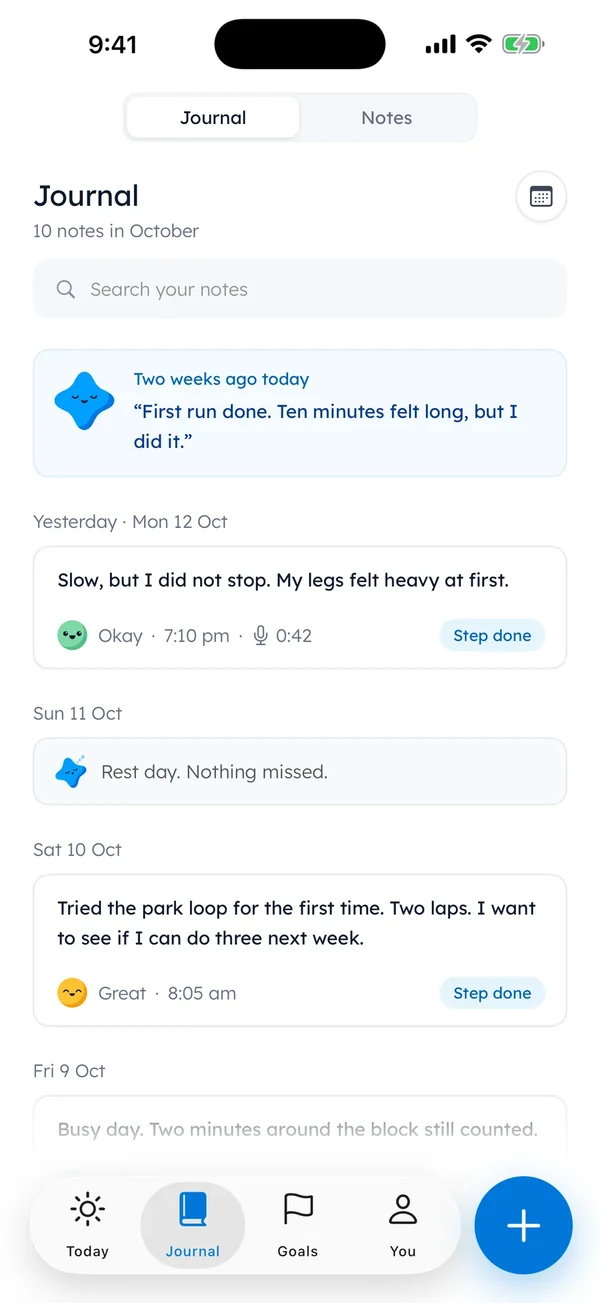
Look at Sat 10 Oct. “Tried the park loop for the first time. Two laps.” is diary. “I want to see if I can do three next week.” is journal.
For more shapes, from a single sentence to a list, see this journal entry example collection.
Other kinds of journals
Once the word stops mattering, the shape is the bigger choice. A few common ones:
- One line a day: one sentence per date, nothing more.
- Gratitude: a few things you were glad about.
- Bullet style: short dashes for tasks, events and notes.
- Goal journal: one small step today, then a line about how it went.
The last one is ours. Most lines worth keeping are about something you did, so the app starts with a step. Tiny ones.
Each shape has its own tradeoffs, and the types of journaling lays them out. Want to keep the little lock? Then read how to keep a diary private.
You can also keep one line a day in a journal on your iPhone, right next to the paper one.
That book was always a fine place to start. The key can stay lost.
Questions people ask
What is the difference between a diary and a journal?
A diary usually records events: what happened, where and with whom. A journal often adds thoughts about those events, like worries, plans or questions. In practice the words overlap, and dictionaries define each one using the other.
Is a diary the same as a journal?
Mostly, yes. Merriam-Webster lists journal inside its definition of diary, and diary inside its definition of journal. The difference is in how the words tend to get used, so pick the one you like and write in it.
Is it called a diary or a journal for adults?
Either word is fine at any age. Journal shows up on plenty of grown-up notebook covers, and diary works just as well. What matters is that you write in it.
Can a journal be private like a diary?
Yes. Privacy depends on where you keep it, not on the word. A paper journal can go in a drawer or a locked box, and a phone journal can sit behind your phone’s passcode.
Sources
TopicStart journaling

You earned the Word Settled badge
You know the difference now. Pick either word and write one line tonight.
0 XP

Yumemira is an iPhone app (iOS 18 or later).
More about the daily journalYumemira is free to start. iPhone, iOS 18 or later.