
Entry examples
Journal Examples: 12 Entry Shapes, From a Sentence to a Page

The short answer
Journal examples come in many shapes: one sentence, three bullets, a question and its answer, a list, or a photo with a caption. Pick the smallest shape that fits tonight and write it at a time you already stop, like setting your alarm. Keep it that small for a week, then try a longer shape.
In 30 seconds
- A single sentence is a complete entry. A full page is optional.
- Every example here is made up, so swap in your own details.
- On a tired night, match your energy to a shape in the cheat table.
You’ve been scrolling other people’s journal pages for twenty minutes. Every one has brush lettering, and somebody’s grocery list has a watercolor border.
Here are twelve that look like a normal weeknight. Each example is made up, so copy the shape and keep your details.
We make an iPhone journal, so we’re not neutral here. Every shape works on paper.

Reading XP0 XP
What do people write in journals?
Mostly ordinary days, written down plainly:
- what they ate
- who called
- what broke
- what got finished
Famous diaries look the same up close. On 3 January 1660, Samuel Pepys wrote about a frost and a lunch (opens in a new tab): his guests ate “a piece of beef and cabbage”, then played cards till dark.
The same entry reports Parliament passing an act about soldiers, the political news of the day, and it sits only a few lines away from the cabbage. History, meet lunch.
Three and a half centuries later, the lunch is still on the record. To be fair, his entries run long, and you don’t have to match him.
What’s worth borrowing is his choice of subject: what you ate belongs in a journal as much as the news does.
Journal entry examples at a glance
The six fastest shapes take two minutes or less. Each one gets its own example further down, along with six longer shapes.
| Shape | Made-up example | About how long | Good for |
|---|---|---|---|
| One line | “Fixed the wobbly chair. Okay day.” | 1 minute | Tired nights |
| Three bullets | “Rain. Leftover rice. Mum called.” | 2 minutes | Days full of small bits |
| A question and answer | “What surprised me? The bus came early.” | 2 minutes | Blank-page nights |
| One feeling word | “Worried. The landlord’s email came late.” | 1 minute | Nights with no energy left |
| A short list | “Books on the nightstand: 3. Finished: 0.” | 2 minutes | Things you collect |
| Photo and caption | “Burnt toast photo. Second try went better.” | 1 minute | Days that had a picture |
The times are our rough guesses for the writing part. Some nights the thinking takes longer, and that’s fine.
If you haven’t written a first line yet, start with how to start journaling, then come back for the shapes.
Short journal examples, a minute or two each
You can write these four half asleep. Each one fits on a phone screen or in the corner of a page.
1. One line
One sentence about something that happened, plus a word for how the day felt if you like.
- “Fixed the wobbly chair. Okay day.”
- “Long shift. Rice, then bed.”
- “Found the charger cable that only works at one angle. Kept it anyway.”
It’s the shape to fall back on during busy weeks, when dinner happens standing up and the notebook is somewhere under yesterday’s laundry on the chair. One line still fits. Micro journaling is this one shape, every day.
2. Three bullets
Three short facts, with no full sentences needed.
- “Rain.”
- “Leftover rice for lunch, again.”
- “Mum called about the wedding photos.”
It suits the kind of day that was busy without being memorable, where you could list what happened but couldn’t tell a story about it if someone asked. Bullets skip the story.
3. A question and its answer
The question goes first, then a one-line answer. The question does the work, because now you’re answering instead of inventing.
“What surprised me today? The bus came early, and nobody on it could believe it.”
4. One feeling word, then why
This one starts with a single word for the day and adds one reason. On days when the feeling is hard to name, the fact can go first and the word after.
Write the fact first, then the feeling.
- “Worried. The landlord’s email came at 9 pm.”
- “Proud. Finished the form I’d avoided since August.”
Medium entries, about five minutes
These take a little more time, or a phone with a camera in it. None of them needs good handwriting.
5. A list
A list grows one item at a time, so there’s never a blank page. Keep one topic and add to the same list on different nights.
- “Books on the nightstand: 3. Started: 2. Finished: 0.”
- “Things the microwave beeped at this week: soup, more soup.”
6. A photo and a caption
One photo, one line under it. A caption should say what the photo can’t show.
Say the photo is of burnt toast. The caption could be “Second try went better. The smoke alarm agreed.”
On paper, you can print the photo or sketch it badly, then add the line underneath.
In Yumemira, the small-steps journal for iPhone, up to six photos sit next to the line. See one-line entries, photos and faces for the rest.
7. A done list
This is everything you finished today, small things included. It’s the opposite of a to-do list, and nothing on it can go overdue.
- “Answered the email from Monday.”
- “Watered the plant.”
- “Read 10 pages.”
A done list is also the paper version of how our app starts an entry: you do one small step toward something you want, like 10 pages of a book, and Mira cheers.
Then Say how it went opens one question. The answer is still fresh.
8. A letter to someone
The entry is addressed to a person, written as if you’ll never send it. You won’t.
“Dear future me, the spare key is in the blue bowl. You’ll forget this by March.”
A real name at the top makes the words come out plainer, because you already know how you’d talk to that person, and the sentences follow the same voice. So pick someone.
It also gets around “Dear diary”, which can feel a bit strange.
Long entries for slower days
Long shapes suit a quiet weekend morning, or a night when the pen won’t stop. But they make a poor daily target.
9. A page about one moment
Ten minutes on a train is enough for a page. So is one bus stop.
Say you stood at the bus stop while the rain came sideways and your umbrella refused to open, until a stranger held hers over both of you for the whole twelve minutes without a word.
Write that moment slowly, sound by sound. The rest of the day can stay out.
Pick one moment and stay inside it.
10. A weekly look back
Once a week, you read the last seven entries and write a few lines about what came up twice and what changed since last Sunday, even if the answer is mostly rice. Seven entries, five lines about them.
“This week: rice dinners, two late buses, one finished book. The plant survived.”
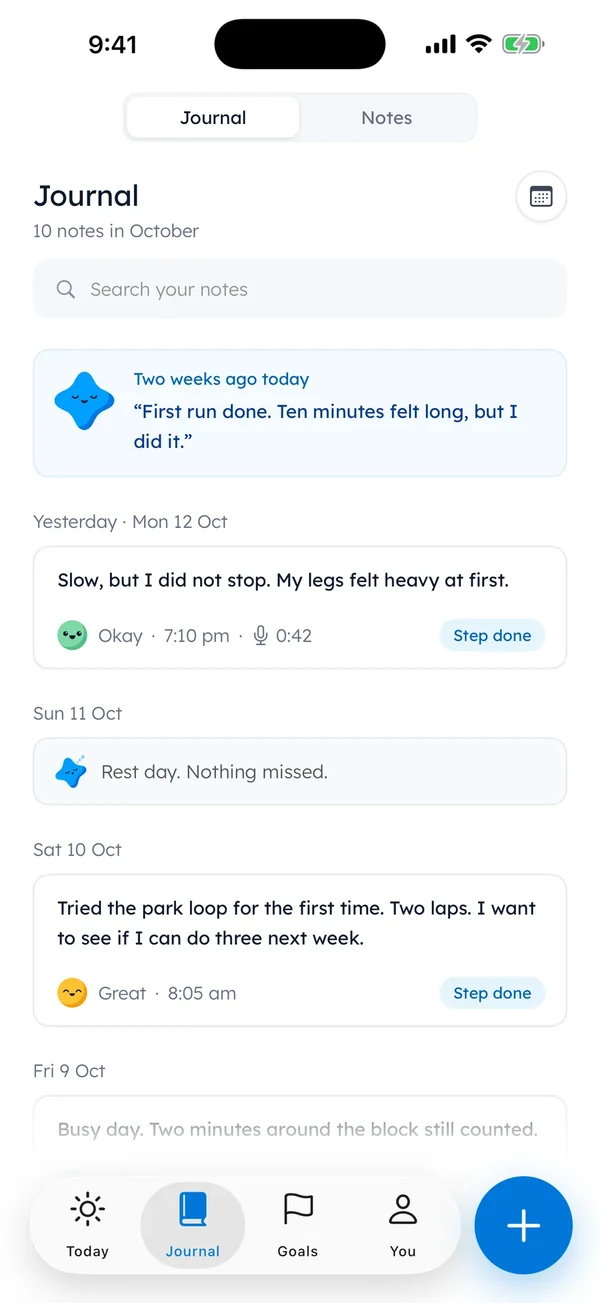
The card at the top of the app’s Journal tab brings back a line from two weeks ago. It’s a ready-made start for a look back. If you’d like that line waiting for you,  try it in Yumemira.
On paper, flip back seven pages.
11. A conversation
This is a short exchange, written the way it was said, with names or initials.
“Neighbor: Your cat is on my roof again. Me: I don’t own a cat. Neighbor: Then we have a bigger problem.”
The same night is the best time to write it down. But even a week later, the one line you remember is worth keeping, because exact words fade first.
12. A plan
A plan looks forward instead of back. It’s the slowest shape here, because it needs thinking as well as remembering.
- “Goal: read more.”
- “Step: 10 pages after dinner, 2 on a busy night.”
- “First book: the one already on the nightstand.”
Next week’s look back can check how the plan went.
Which shape fits tonight?
Match the shape to your energy, whatever other people post. The cheat sheet starts with the most tired kind of night.
| If tonight you have… | Try this shape |
|---|---|
| Almost nothing left | 1. One line, or 4. One feeling word |
| A few minutes after a busy day | 2. Three bullets |
| A blank head | 3. A question and answer |
| A photo from today | 6. A photo and a caption |
| A small win | 7. A done list |
| A slow morning or weekend | 9. A page about one moment |
| A week of entries behind you | 10. A weekly look back |
Mix shapes freely; one notebook can hold all twelve.
A one-line Monday and a full-page Saturday belong in the same notebook. And nobody checks which shape you used.
For more lines to copy, see what to write in a journal. For the very first sentence, there’s how to start journal entries.
Twenty minutes of scrolling pretty pages is about nineteen more than shape 1 needs.
So copy it tonight and change the details to yours. The watercolor border can wait.
Questions people ask
What do people write in their journals?
Mostly ordinary things: what they ate, who they talked to, what went wrong, what they finished. Famous diaries are full of meals and errands too. A plain fact about today, plus a word for how it felt, is a normal entry.
What is an example of a journal entry?
A short one: “Fixed the wobbly chair. Okay day.” A longer one describes a single moment, like waiting at a bus stop in the rain, in a few slow paragraphs. The short one is easier to repeat tomorrow.
How long should a journal entry be?
As long as you have energy for. One sentence works on tired nights, and a page suits slow weekends. Keep your daily size small enough to write on a bad day, and write more only when you want to.
What does a daily journal entry look like?
Usually the date, one to three lines about the day, and sometimes a word for the mood. Some days it’s a list or a photo with a caption instead. Keep the daily version short, so it fits into every kind of day.
Sources
TopicStart journaling

You earned the Twelve Shapes badge
You saw all twelve. Now copy shape 1 and swap in your own day.
0 XP

Yumemira is an iPhone app (iOS 18 or later).
More about the daily journalYumemira is free to start. iPhone, iOS 18 or later.