
Start again
How to get back into journaling after a break (start again today)

The short answer
To get back into journaling, skip the catching up and write one line about today: the date, then one thing you did or saw. Leave the skipped days empty. Write your next line right after something you do every day, like setting your alarm, and stay at one line for the first seven nights.
In 30 seconds
- Start with today’s date and one thing from today.
- Leave the skipped days blank. Nobody’s checking the dates.
- Write one line a night for 7 nights, after the same daily task.
- If you keep stopping, shrink the line until it fits a bad day.
Say the last entry is dated 14 March. It’s about a late bus and a sandwich. Now it’s October, and the notebook feels like a friend you forgot to text back.
The longer you wait, the bigger the reply feels. So don’t write the big reply.

Reading XP0 XP
How to get back into journaling without catching up
Coming back can feel like it needs an explanation. Where did April go?
It doesn’t need one. Write about today, and only today. The next entry is simply the next one, whatever date sits above it.
The March page and tonight’s line can sit side by side with nothing between them. Your camera roll does this all the time, with a beach photo from summer sitting right next to a blurry picture of tonight’s dinner.
That’s allowed.
This is the method from how to start journaling, used on a harder night. It’s also what keeps how to daily journal simple on ordinary weeks: one line about one day, then stop.
Tonight’s entry only has to cover tonight.
Your first line back, by how long it’s been
The size of the gap changes your first line a little. Only a little.
| If it’s been | Write something like | Skip this |
|---|---|---|
| About a week | “Long week. Made soup on Sunday, finally.” | Listing every day you skipped |
| About a month | “Back. Fixed the wobbly chair today.” | An apology to the notebook |
| About a year | “A year later. New job, same blue mug.” | A summary of the whole year |
| Several years | “2 October. The plant on the shelf has a new leaf.” | Rereading every old page first |
Look at the right column. Every item in it makes the first night longer, and a long first night is the one you’ll put off.
Old pages are worth reading. But save them for night three, after two new lines, so the rereading doesn’t replace the writing.
What to do with the empty pages
If your journal has dated pages, the gap is easy to see. A whole run of blank days sits between March and tonight, looking like homework.
You have three fair choices:
- Leave them blank and write on today’s page.
- Write one line across the gap, like “Took a break.”, and carry on.
- Start a new notebook, and keep the old one on the shelf.
Pick one and move on. None of them changes what you write tonight.
Choose whichever gets you to tonight’s line fastest.
On a phone it’s simpler. There are no blank pages, just a jump between two dates in a list.
Three rules for starting again
One line back is a start. These rules are for the nights after it.
No catching up.
Don’t fill in the months you skipped, not even as a summary. If something from the gap still matters, it’ll turn up in a line about today.
One line for seven days.
Keep each entry to one line for the first week, even when you’d like more. A long first week makes the notebook heavy enough to put down again.
Same place in your day.
Tie the line to something you already do daily, like setting tomorrow’s alarm or taking off your work shoes, whatever time that is.
For the first week, stop after one line.
We make Yumemira, the small-steps goal journal for iPhone, so we’re not neutral here. A pen works just as well for all three rules.
The lines worth keeping are often about something you did, so the app starts there. You pick something you want, take one small step a day, and Mira cheers when you tap Mark done.
Then Say how it went lets you add the line while it’s fresh.
And a gap doesn’t undo anything. Days shown up never go down, and rest days are built in.
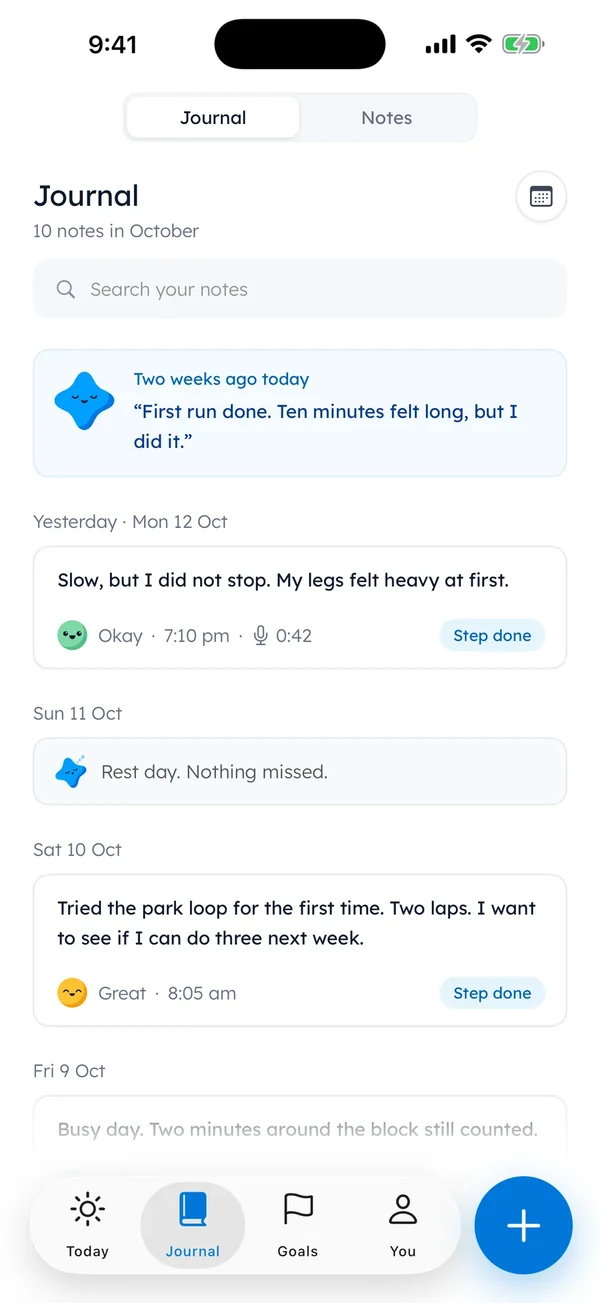
For plain writing, there’s a journal that asks one question each time you open a new entry. On paper, the same idea works too: water the plant, then write the line about it.
If the one-line rule sounds familiar, it’s close to micro journaling with a seven-day timer on it. In week two, you can write as much as you like.
If you keep stopping and starting
Waiting for a Monday to begin again is a known pattern.
Three Wharton researchers called it the fresh start effect (opens in a new tab). In their data, people started on goals more often right after dates like a new week, a new month or a birthday.
That’s useful to know. But it also means you can wait a long time for the right Monday, while the notebook sits on the shelf under a library book and the pen slowly dries out in the drawer.
Any date at the top of a fresh page can do that job. Tonight’s included.
If the pattern is stop, start, stop, the first thing to check is the size of the line. A line that only fits a good evening will stop on the next bad one.
“One mistake is just an outlier.”
So on the night after a skip, the smallest line you have is the right one. “Late. Bed.” will do.
Tonight, before you set your alarm, open to the page after 14 March. Write the date and one thing from today.
That’s the text back, and it can be short.
Questions people ask
How do I start journaling again?
Write today’s date and one thing you did or saw, and leave the skipped days alone. Then write one line a night for a week, right after something you already do every day, like setting your alarm.
Should I start journaling again?
If you miss having somewhere to put your days, it’s worth a try, and the cost is one line tonight. Give it seven nights. If it still feels like a chore after that, try a smaller entry or a different time of day.
Do I need to catch up on the days I skipped?
No. Catching up turns the first night back into homework, and homework is easy to put off. Start with today. If something from the gap still matters, it will come up in a line about now.
What should I do with the empty pages in my journal?
Leave them blank, write one line across them such as “Took a break.”, or start a new notebook. All three work. On a phone there are no empty pages, only a jump between two dates.
Sources
TopicStart journaling

You earned the Welcome Back badge
You read to the end. Tonight, write the date and one thing from today.
0 XP

Yumemira is an iPhone app (iOS 18 or later).
More about the daily journalYumemira is free to start. iPhone, iOS 18 or later.