
Daily journaling
How to journal every day (even on your busiest days)

The short answer
To journal daily, hang one line on something you already do every day, like plugging in your phone. Keep a 10-second minimum: the date and one word about today, plus a face for how it felt. On busy days, write only that. After a skipped night, just write tonight. Keep it that small for a week.
In 30 seconds
- Hang your line on a cue you already have every day.
- The minimum is the date and one word. Add a face.
- On a busy day, write the short version and stop.
- After a skipped night, write tonight. Never skip two in a row.
Day 1: two pages and a small drawing of the sun in the corner.
Day 2: a paragraph.
Day 3: you look at the notebook like it owes you money.
One thing to know first: we make an iPhone app built on this idea, so we’re not neutral. Everything below works with a pen and paper too.

Reading XP0 XP
Why daily journaling stops on day 3
If your journal stopped on day 3, look at day 1. It set a size that a tired night can’t match.
Two pages take twenty minutes, a quiet room and the kind of mood that only turns up on a Sunday afternoon with nothing planned. One line takes about as long as finding the pen.
A tired night has very little to offer:
- About ten seconds of attention
- One free hand
- One thing you remember from today, even a small one
Day 1 wants to be impressive. Day 40 only wants to exist, so build for day 40.
Size the entry for your most tired night.
New to all this? Read how to start journaling first. This page is for day 9, day 23 and the evening the dishwasher leaks onto the kitchen floor.
How to make journaling a habit with a cue you already have
Your line goes right after something you already do every day without thinking. That old habit is your cue, and it turns up even on the worst nights.
A clock time like “journal at 9 pm” breaks the first night you’re stuck on a delayed train or asleep on the sofa with the TV still talking to nobody.
A cue travels with you.
| If you always… | Right after, write something like… |
|---|---|
| Brush your teeth at night | “Teeth done. Long day. Okay.” |
| Plug in your phone | “Phone at 4%. So was I.” |
| Make the first coffee | “Coffee. Rain again. Wrong shoes.” |
| Finish a shift | “Shift done. Feet done. So-so.” |
| Get into bed | “In bed by 11. Read nothing. Fine.” |
| Lock the front door | “Checked the lock twice. Good day, mostly.” |
Then keep the journal where the cue happens. A notebook beside the charger, with the pen inside it, saves a walk to the other room.
What if no cue fits, because your days move around with shifts or travel? Then a reminder can stand in for one.
In Yumemira, the small-steps goal journal for iPhone, reminders belong to each goal. They stay off until you turn them on, and you choose set times or every few hours.
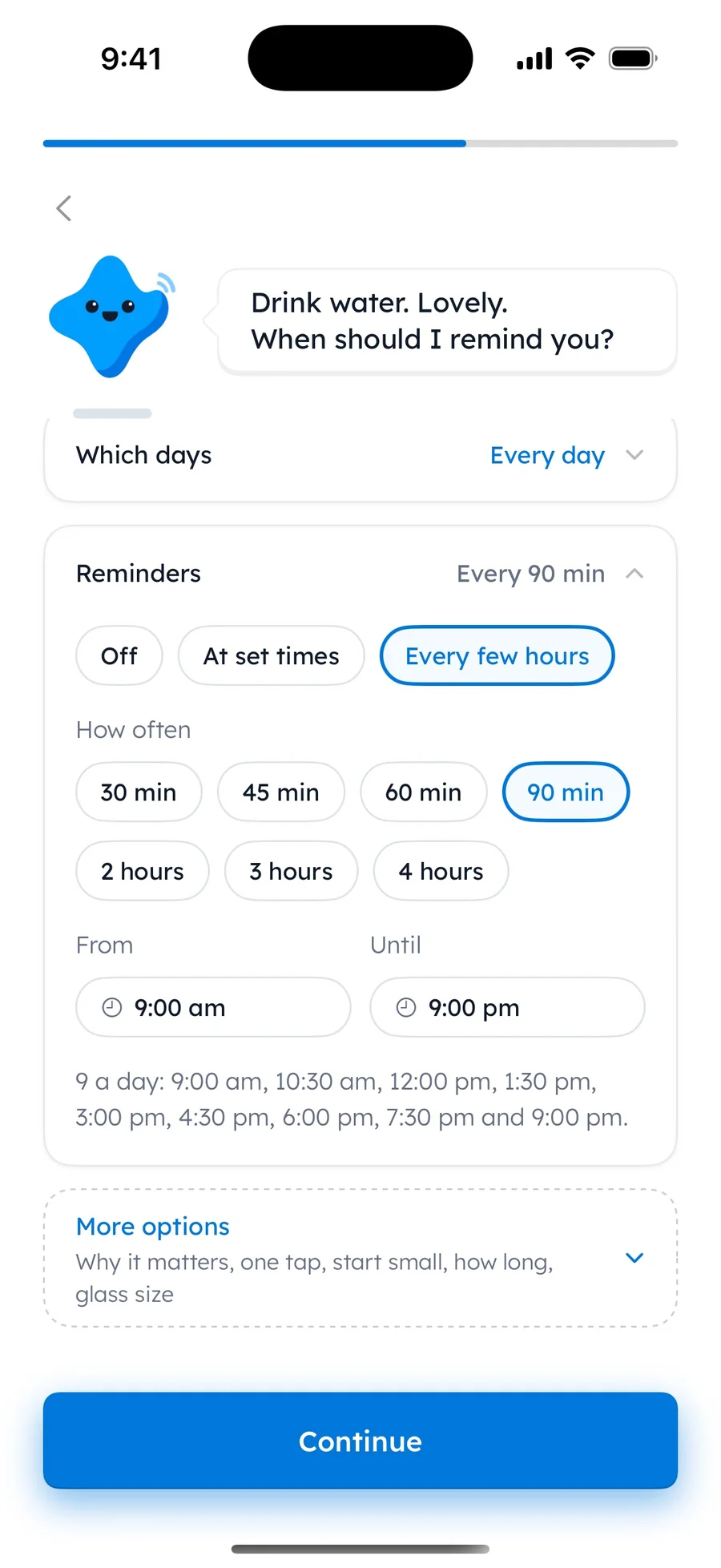
On paper, the reminder is the pen left on your pillow. Hard to miss. Only a little risky.
What counts as the 10-second minimum
Write the date and one word about today, then add a face for how it felt. On any night, that’s a full entry.
Write the date.
Or just the weekday. “Thu” is fine.
Write one word or fact.
“Dentist.” “Rain.” “Pasta again.”
Add a face.
Draw one, or write great, okay, so-so, worried or hard.
Put together, that’s a floor line: “Thu. Dentist. So-so.”
It reads like a weather report for your day. Short and true.
Most nights you’ll write more, because the pen gets going once it’s out. But the floor isn’t the target. It’s the line you can’t fail to write.
On a bad night, the floor line is the entry.
How to journal daily on your busiest days
The busy-day version is best decided now, while you’re calm. Then a full day never has to make that choice for you.
Say it’s a Thursday with work, a school pickup, a late bus and a later dinner. By the time the cue arrives, the floor line is all you’ve got.
And that’s enough.
Daily journal writing tends to break on days like that, because the day feels too big for one line. And it is. So you pick one moment and write only that:
- “The quiet minute in the car before going in.”
- “Ate lunch standing at the counter.”
- “Laughed at the wrong moment in a meeting.”
The app does the same thing for goals. Each goal has a smaller busy-day step, and doing it fills in the whole day.
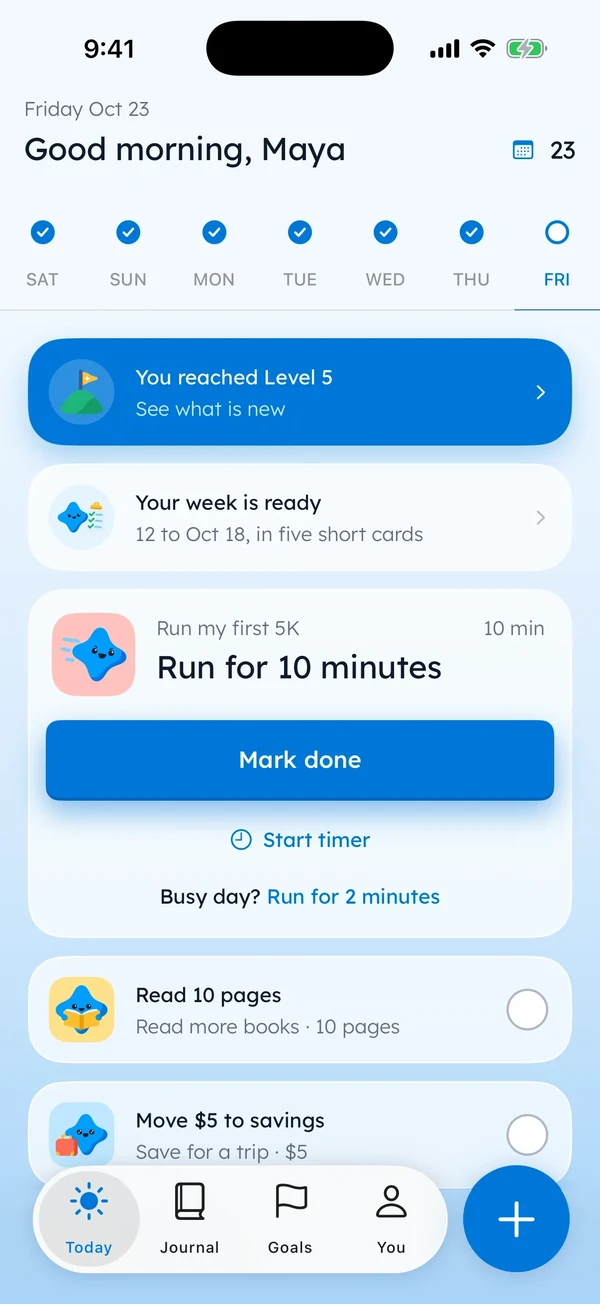
The Gratitude goal’s busy-day step is “Write down 1 good thing”, which is more or less a floor line with a better attitude.
What to do after you skip a few days
The fix is one line tonight, about tonight. The empty days can stay empty.
Catching up means rebuilding a whole week from memory on a Sunday, which turns one small job into five and makes the notebook feel like homework. Tuesday can stay a mystery.
James Clear puts the rule well: one slip is an outlier, but two in a row is “the beginning of a pattern.” (opens in a new tab) So the house rule is never skip twice.
A few first lines for the night you come back:
- “Back. Thursday. Okay.”
- “Ten days off. Today: soup.”
- “Gap. Rain. Glad to be here.”
The first half has some evidence behind it.
In a 2010 study of how habits form (opens in a new tab), led by Phillippa Lally, missing one chance to do the new behavior “did not materially affect the habit formation process” (James Clear’s summary (opens in a new tab)).
It’s one study, and it looked at single missed chances. Read it as encouragement, and keep the rule anyway.
Tonight’s line is the whole repair job.
Yumemira counts days the same way: a day counts when you do your step or write a note.
You get days that add up and never go down, and there’s no streak to lose.
If the gaps keep coming back for every habit, not only the journal, how to stay consistent looks at that bigger pattern.
Should you journal in the morning or at night?
Either works. The best time is the one with the most dependable cue, kept for a week.
Night is good for looking back, since the day is finished. Morning suits you if evenings belong to kids or late shifts.
Work nights? Your “night” line can go right after the shift ends, even at 7 am. The cue matters more than the clock.
On the evenings you have time and want more than a floor line, take one question from a list of journal prompts and let it run as long as it likes.
Your first 7 days of daily journaling
Use the first week to test one cue, and to practice both the floor line and the comeback. Each night takes under a minute.
| Day | After your cue, write | If you skip, the next night |
|---|---|---|
| 1 | “Picked my cue: the phone charger.” | “Back. Charger again. Okay.” |
| 2 | “Thu. Dentist. So-so.” | “Skipped Thursday. Friday: pizza.” |
| 3 | “Long day. One moment: the quiet car.” | “Back. Tired. Hard.” |
| 4 | “Nothing much, except the dog sneezed.” | “One night off. Today: soup.” |
| 5 | “Bus late. Ate. Bed. Fine.” | “Back. Rain, bus, tea.” |
| 6 | A floor line on purpose: “Sat. Laundry. Okay.” | “Back. Still laundry.” |
| 7 | Read the six lines back, then: “Six lines. Not bad.” | “Read what’s there, then tonight’s line.” |
Day 6 is the useful one. A calm-night floor line makes the short version feel normal on a wild night.
Before night 1
Ticks stay in this browser. Nothing is sent.
Night 1 can be tonight, even if tonight is mostly over.
Write the floor line. On day 3, nobody owes anybody money.
Questions people ask
Is it normal to journal every day?
Yes. Daily is a common way to keep a journal, and it can be easier than writing now and then, because a daily line hangs on a routine. Writing a few times a week is also fine if that suits you better.
How do I make journaling a habit?
Tie it to something you already do every day, like plugging in your phone, and keep the entry tiny. The date and one word make a full entry. Write that every night for a week before adding more.
How long should I journal each day?
Plan for about ten seconds and allow as long as you like. The short version keeps the habit alive on busy nights, and on calm nights you can keep writing. Just don’t make the long version your daily rule.
What if I skip a few days of journaling?
Write one line tonight, about today, and leave the skipped days empty. Catching up turns a small habit into a big job. The rule that helps most is simple: try never to skip two nights in a row.
Should I write a daily journal?
If you’d like a record of ordinary days, it’s worth a week’s test. One line a night takes less than a minute, and reading a month of lines back shows you things a single entry can’t.
What are good journaling tips for beginners?
Keep entries short and tie them to a routine you already have. Decide your busy-day version in advance. After a gap, skip the catching up and write tonight’s line.
Sources
TopicStart journaling

You earned the Every Day badge
You read the whole guide. Tonight, after your cue, write one floor line.
0 XP

Yumemira is an iPhone app (iOS 18 or later).
How Yumemira worksYumemira is free to start. iPhone, iOS 18 or later.