
List journaling
List journaling: 30 list journal ideas when sentences are too much

The short answer
List journaling means keeping your journal as short lists instead of sentences, and the best list journal ideas are small: what you ate today, or this week’s small wins. Pick one list below, add a few items at a time you already stop, like plugging in your phone, and close the notebook. Keep it that small for a week.
In 30 seconds
- A short dated list is a full journal entry.
- Pick a list by how often you’d add to it.
- Items without verbs are fine, and quicker to write.
- When one item wants more, give it one extra line.
- Keep yearly lists at the back, or pinned on your phone.
Some time in the early 1490s, Leonardo da Vinci wrote a to-do list that jumps from cannons to studying the sun to how people skate in Flanders, then simply says “Draw Milan.”
That’s from NPR’s look at the list (opens in a new tab), in translation, so the words aren’t exactly his. No paragraphs, though.
Yours can start with what you ate today.

Reading XP0 XP
What is list journaling?
List journaling is a journal kept in short lists, one item per line, often without full sentences.
The Bullet Journal method has a close cousin of this, called rapid logging (opens in a new tab). Its own example cuts a sentence about a bakery down to “Bought cake and went home.”
So you drop the grammar and keep the facts.
If you’re new to journaling, the plain one-line way to start journaling is the place to begin. Lists are for the nights when a full sentence feels like a lot.
A list also has an end you can see. A blank page never says when you’ve written enough.
And on a night when you’re half asleep, with the lamp still on and the charger cable just out of reach, an end you can see matters more than the notebook.
Four items. Done.
Write the item, not the sentence about the item.
Which list should you start with?
Start with a list you’d add to at least once a week. A yearly list is lovely, but you’ll forget it exists by February.
| List | How often | Items it might get |
|---|---|---|
| What you ate today | Tonight | “Toast. Dal and rice. One stolen chip. Tea.” |
| Sounds from today | Tonight | “Pressure cooker. A drill next door.” |
| Small wins | Daily | “Replied to the email. Left on time.” |
| Small repairs | Weekly | “Wobbly chair. The bathroom light.” |
| Things that made you laugh | Weekly | “The dog’s face when the toast fell.” |
| Songs this month | Monthly | “One old song, two new ones from a friend.” |
| Things you learned to do | Monthly | “Folded a fitted sheet. Nearly.” |
| Words you learned | All year | “Petrichor: the smell after rain.” |
The top rows suit tired nights, since they only need today’s memory.
But the bottom rows need a page you can find again in June. So keep the yearly lists at the back of the notebook, or pin them on your phone.
How to keep a list journal on paper or in Notes
You need one page per list and a place you’ll see it.
Pick one list.
One from the table above. More lists can wait a few weeks.
Title it with the month.
“Meals, October” tells you later what you were looking at.
Add two to four items.
At a time you already stop, like setting tomorrow’s alarm.
Make the page easy to find.
A sticky tab on paper, or a pin on a phone.
On paper, keep nightly lists at the front and yearly ones at the back, so you’re not flipping past a phone number you don’t recognize to find “New words.”
It happens.
Any notes app works on a phone. We make one of these, so we’re not neutral here, and a pencil works just as well.
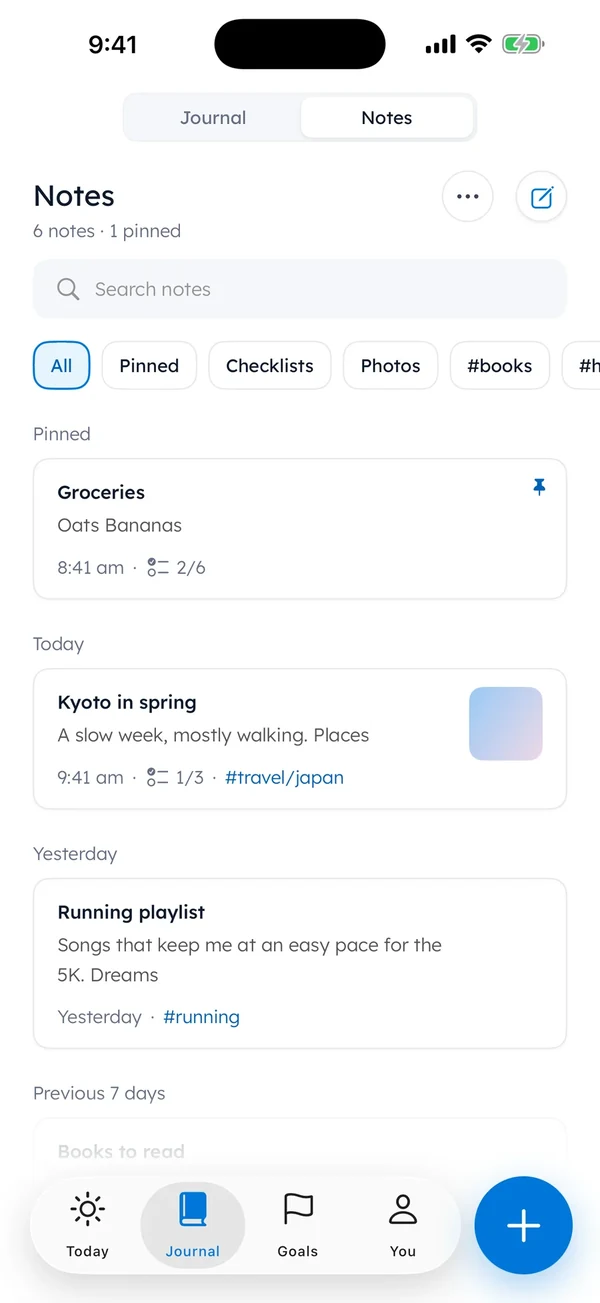
In Yumemira, the small-steps journal for iPhone, the Journal tab has a Notes side. Typing “- “ starts a list, “[] “ starts a checkbox and “#” starts a tag like #october.
And a list you’ll keep all year can be pinned, so it sits at the top.
A checklist suits a list with an end, like things you’re putting off. A plain list suits the ones that only grow, like songs or new words.
30 list journal ideas, by how often you add
Each idea has a real example underneath. Copy the shape and swap in your own day.
Lists for tonight
- What you ate today: “Banana, rice, two biscuits, soup, more biscuits.”
- Sounds from today: “Bus brakes. Rain on the window.”
- Who you talked to today: “Sister, the bus driver, the man at the bakery, the cat.”
- What’s in your bag right now: “An old receipt and an umbrella that never opens.”
- Small wins from today: “Found the charger. Sent the birthday card.”
- Colors you noticed: “A yellow raincoat. Orange sky at six.”
- Things you’re putting off: “Dentist call. The drawer of cables.”
- One word for each part of the day: “Slow. Busy. Busy. Okay.”
Lists that grow all week
- Meals this week: “Mon: noodles. Tue: noodles. Wed: something new.”
- Small repairs: “Tightened the chair. Cleared phone storage.”
- Places you went: “Office, the market, the post office twice, a friend’s roof.”
- Things that made you laugh: “A sign that said ‘Fresh fish, also umbrellas.’”
- Messages you were glad to get: “A photo from Dad of his tomato plant.”
- Things you finished: “The library book. The last of the rice.”
- Questions you looked up: “How long to boil an egg. Why cats push things off tables.”
- Things you’d do again next week: “The walk after dinner.”
Lists for the month
- Songs this month: “One old song I’d forgotten. Two from a friend’s playlist.”
- Things you learned to do: “Change a bike tire. Make proper chai.”
- Recipes you tried: “Egg fried rice: good. Banana bread: very heavy.”
- Changes at home: “New lamp. The plant moved to the window.”
- Things you said no to: “A late meeting. A third coffee.”
- Best ten minutes of each week: “Week 2: tea on the step before work.”
- Videos and articles that stayed with you: “The one about how pencils are made.”
Lists that run all year
- Things you got better at: “Parallel parking. Saying ‘I don’t know.’”
- New words: “Sonder, from a crossword. Thank you in Tamil.”
- People you met for the first time: “The new neighbor with the very loud parrot.”
- A small bucket list: “See the sea in winter. Learn ten words of Japanese.”
- Favorite small things: “Warm socks from the dryer. The first sip of tea.”
- Things you stopped doing: “Checking email in bed. Mostly.”
- Lists you started and dropped: “Birds seen: 1. Pigeon.”
That last one is real advice in disguise. A dropped list can stay where it is, half empty, while a new one starts on the next page.
When a list item wants to be a sentence
Some nights, one item on the list won’t sit still. “Long call with Mom” has a whole evening behind it.
So give it one extra line under the item, and leave the rest alone.
Call it the zoom-in. The list stays a list, and one item gets a close-up.
One item can grow. The rest can stay short.
| If tonight is… | Try a list like… |
|---|---|
| Too tired for sentences | “Rice. Bed.” |
| Too full to sort out | “Meeting, school pickup, call with Mom, laundry.” |
| Ordinary in every way | “Sounds: microwave beep, the neighbor’s radio.” |
| Hard | “Got through it.” |
| Good in one small way | “Win: the plant has a new leaf.” |
Some weeks, the short items turn into short lines, and nobody planned it. That’s how lists slide toward the journal entry examples that run a little longer.
Lists that start with doing something
The easiest list to keep is a list of things you did, because each item already happened.
So if tonight’s list looks thin, do one small thing first. Read two pages, water the plant or fold the laundry on the chair, then add it.
Most of the lines worth keeping are about something you did, and our app starts there too.
In Yumemira, you pick something you want, like reading more, and each day brings one small step, like 10 pages. When you tap Mark done, Mira, the app’s star, cheers “Nice. That counts.” Then she offers Say how it went.
If you’d like your step and your lists in one place,  try Yumemira on iPhone.
On paper, it’s the same trick with a pencil: one small thing, then one more item on the list.
Read your lists back
After a month, read one list all the way down. It takes about a minute.
Thirty days of meals will tell you a month ran on noodles, which you probably suspected, and a month of sounds might remind you the drill next door finally stopped in week three.
Some items will mean nothing.
Others will bring back a whole Tuesday from one word. If a list starts to feel like a chore, swap it for another of the 30, or borrow from these things to keep in a journal.
Tonight’s list
Before you put the phone down, write list 1: what you ate today. A few items, no verbs, no full stops needed.
Leonardo had cannons and the sun on his list. Yours can have toast.
Questions people ask
What is list journaling?
List journaling is keeping a journal as short lists instead of paragraphs. Each entry is a few items under a title, like what you ate today or this week’s small wins. It’s quick, and you can see when you’re done.
What lists should I write in my journal?
Start with one you’d add to every week, like meals, small repairs or things that made you laugh. Then add a nightly list, like sounds from today, and one yearly list, like new words, at the back.
What are list journaling prompts?
They’re titles for a list instead of questions for an essay. “Sounds from today” or “Things I finished this week” are prompts, and the answer is two to five short items, written without full sentences.
What is the difference between journaling and bullet journaling?
Journaling is any kind of writing about your days. Bullet journaling is one method with its own layout, which logs tasks, events and notes as short bullets. List journaling sits close to it, with fewer rules.
Sources
TopicStart journaling

You earned the List Keeper badge
You read all 30. Tonight, list what you ate today and stop.
0 XP

Yumemira is an iPhone app (iOS 18 or later).
More about the daily journalYumemira is free to start. iPhone, iOS 18 or later.