Morning journaling
Morning pages: what they are, plus a short version for busy mornings
The short answer
Morning pages are three pages of longhand writing, done first thing in the morning, about whatever crosses your mind. Julia Cameron made them part of The Artist’s Way. If three pages won’t fit, write half a page for 5 minutes, or one line at a time you already stop. Keep it that small for a week.
In 30 seconds
- The method: three handwritten pages before the day starts, kept private.
- There’s no wrong topic. Write what’s in your head.
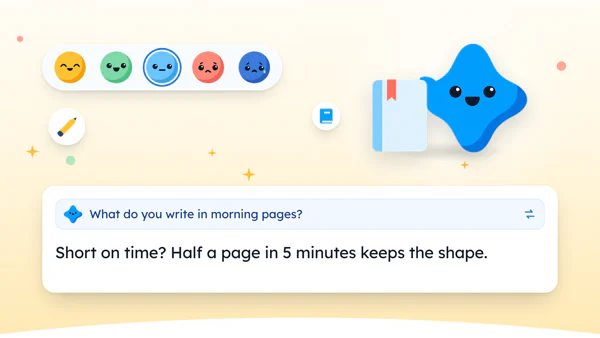
- Short on time? Half a page in 5 minutes keeps the shape.
- One line a day is the smallest version that still works.
The whole method fits in one line of Julia Cameron’s old web page: three pages, longhand, first thing in the morning.
Say you tried it on Monday. Half a page in, the toddler woke up. Page two is still blank.
That half page is worth keeping.

Reading XP0 XP
What are morning pages?
Morning pages are a daily writing practice from Julia Cameron’s book The Artist’s Way (opens in a new tab), first published in 1992. You fill three pages by hand before the day starts.
Her own page, saved by the Internet Archive in January 2024, calls it stream of consciousness writing. You write whatever comes next, in the order it comes, and fix nothing.
“There is no wrong way to do Morning Pages.”
The page (opens in a new tab) says the pages aren’t meant to be art, or even “writing.” They’re for your eyes only, and they can be about anything.
It also makes big promises about what the pages do for the rest of your day, which is a lot to ask of three sheets of lined paper.
Those are her words, and we haven’t measured them. So the rest of this sticks to the method.
If you’re new to all of this, our guide on how to start journaling begins smaller, with one line a night.
How to start the three pages
Bring a notebook and a pen to the first part of your morning. Then write three pages without stopping, and close the notebook.
Leave the notebook out.
Put it and a pen where you’ll sit first thing, so there’s nothing to find.
Write before anything else.
The method says first thing in the morning, before the day pulls you in.
Write by hand.
Cameron’s page says longhand, so the original version uses paper.
Keep the pen moving.
Write what’s in your head, even “I don’t know what to write.”
Stop at three pages.
Close the notebook and keep the pages to yourself.
Step 4 is the strange one. Somewhere on page three, with the tea going cold and nothing left to say about that email, you’ll catch yourself writing about how long page three is.
That’s allowed.
Fill the pages, then stop. Don’t fix them.
But a notebook with lines helps, and so does a cheap pen you won’t mind losing. Nobody’s grading the handwriting.
Morning pages vs journaling one line a day
Both are journaling. Morning pages ask for three pages every morning, and one line a day asks for a single sentence at a time you already stop.
| Morning pages | One line a day | |
|---|---|---|
| Time | Three full pages, however long your hand takes | About 1 minute |
| Tools | Pen and paper, written by hand | Any notebook or app |
| When it suits | Mornings with time before anyone needs you | Busy mornings, late shifts, any spare minute |
| What you keep | Pages for your eyes only | Short lines you can reread in seconds |
| If you skip a day | Three new pages the next morning | Tomorrow’s line, nothing to catch up |
Three pages is a big ask before work. And on a morning with a lunchbox to pack and a phone that’s already buzzing, three pages can be the first thing to go. The smallest version is one line.
Most of the lines worth keeping are about something you did. So Yumemira, the small-steps journal for iPhone, starts with one small step a day, then a line about it.
A new entry opens with a question from Mira, the app’s star. On a morning entry, the top of the screen says “This morning”. If the question doesn’t fit, Another question swaps it.
On paper, it works the same way. Write the date and one line about the morning. Then add a word for how it feels.
The 5-minute version for busy mornings
The short version keeps the shape and drops the length. Write by hand for 5 minutes first thing, then stop when the timer does.
That usually comes to about half a page, depending on your handwriting and on how loud the kitchen gets once everyone else in the house is awake and looking for their shoes.
| If you have… | Write… |
|---|---|
| Half an hour to yourself | Three full pages, the original method |
| 10 minutes | One page: “Woke up thinking about that email again.” |
| 5 minutes | Half a page: “Rain again. The meeting moved to 10.” |
| 2 minutes | Three sentences, starting “Right now I’m thinking about…” |
| 1 minute | One line: “Cold toast. Big day. Starting anyway.” |
| Already out the door | One line on the bus: “Forgot the umbrella. Fine.” |
Only the top row is Cameron’s method. The rest are our smaller versions, so call them short morning writing.
Stop when the timer stops, even mid-sentence.
Stopping on time matters more than it looks. If 5 minutes keeps turning into 25, the notebook starts to feel like a trap on the mornings when 5 is all you have.
So stop.
If the page stays blank even for 5 minutes, borrow a question from a list of morning journal prompts, which are short enough to answer before the first cup is done.
Morning or night?
Morning pages belong to the morning by design. A short line works at either end of the day, so pick the time that survives a bad week.
Picture two weeks of entries. On the busy days, the line went in at 8:05 am, typed with one thumb while the toast was still in the toaster. On the slow days, it waited.
The page doesn’t care which.
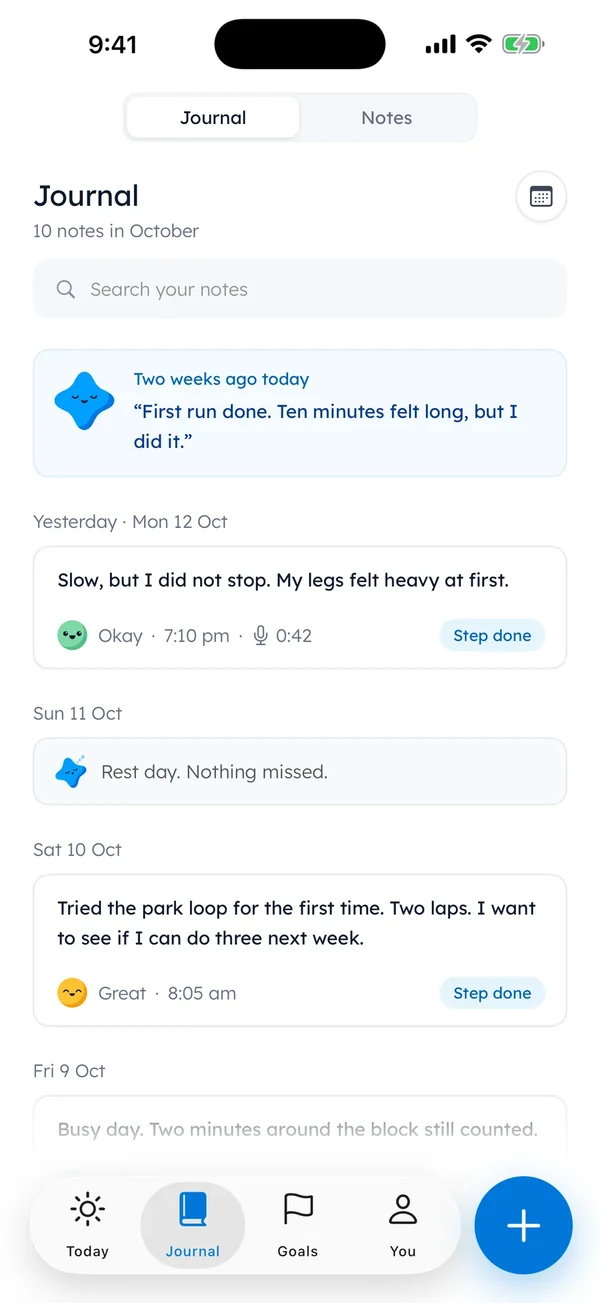
Pick the time you’ll still have on a bad week.
If mornings belong to children, a commute or an early shift, night is a fair choice. The best time to journal guide goes through both.
Can you write them at night? Not as morning pages, by Cameron’s definition. But it’s still a journal, and you can keep one line a day in a journal on your phone.
If you stopped, start with a smaller page
Start again tomorrow with whatever fits the morning, even if that’s half a page or one line. The pages you already wrote are still yours.
Say you kept it up for nine mornings and then missed a Tuesday. By Saturday the notebook had moved from the kitchen table to a drawer, under the takeout menus.
It happens.
Tomorrow’s page doesn’t need yesterday’s pages.
You can also switch methods for a while:
- Types of journaling lists a few that fit a smaller morning.
- Micro journaling is the one-sentence version.
- When three pages fit again, the notebook opens to the next clean page.
Tonight, put the notebook on the table where you’ll sit tomorrow, pen inside.
Half a page before the toddler wakes. One line if the toddler wins.
Questions people ask
What are morning pages?
Morning pages are three pages of longhand writing done first thing in the morning, about whatever crosses your mind. The practice comes from Julia Cameron’s book The Artist’s Way, first published in 1992. The pages are private and there’s no wrong topic.
Do morning pages have to be handwritten?
Julia Cameron’s page describes them as longhand, so the original method is pen and paper. If typing is the only way you’ll write in the morning, a typed version is still morning writing. Just know it’s your own variation, not her method.
What do you write in morning pages?
Anything in your head, in the order it comes: today’s plans, a worry about an email, what you dreamed, the noise from the street. If nothing comes, write “Right now I’m thinking about…” and finish the sentence.
Can I do morning pages at night?
By Cameron’s definition, morning pages are written first thing in the morning. Writing at night is a different practice, an evening journal. If mornings don’t work for you, a short line at night is a fair choice.
What’s the difference between morning pages and journaling?
Morning pages are one kind of journaling with fixed rules. You write three pages by hand before the day starts, and nobody else reads them. Other journaling can be any length at any time, from a single line at night to a list of three things.
Sources
TopicStart journaling
You earned the Half a Page badge
You read the whole guide. Tomorrow morning, write half a page, or one line.
0 XP

Yumemira is an iPhone app (iOS 18 or later).
More about the daily journalYumemira is free to start. iPhone, iOS 18 or later.