
Morning and night prompts
Morning and night journal prompts: 60 for either end of the day
The short answer
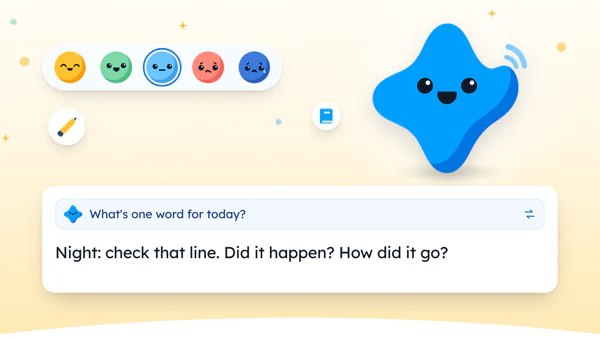
The most useful morning journal prompts ask about one thing you’ll do today, and when. At night, answer the partner question: did it happen, and how did it go? Write the line at a time you already stop, like the first coffee or the bus, and keep it that small for a week.
In 30 seconds
- Morning: write one thing you’ll do today, and when.
- Night: check that line. Did it happen? How did it go?
- Every prompt below fits in one line.
- One end of the day is fine. Pick the one you’ll keep.
Benjamin Franklin started his daily plan at 5 am with a question: “What good shall I do this day?”
By his own account, sticking to the plan was the hardest part. Which is comforting.
We make an iPhone app on the same idea, so we’re not neutral here. A pen works too.

Reading XP0 XP
What to write in a morning journal
A morning entry can be one small thing you’ll do today, plus when you’ll do it. That’s all.
Say it’s early. One eye open, coffee not ready.
You can still manage one sentence about the day ahead, and the night line will check it later.
Of all the journal prompts out there, this pair might be the easiest to keep, because by breakfast the night question is already half written.
| If you have… | Write something like… |
|---|---|
| 10 seconds, one eye open | “Today: 20-minute walk, before lunch.” |
| A minute while the toast browns | “Walk at 1. If it rains, the stairs instead.” |
| Five minutes on the bus | “Walk at 1, stairs if it rains. Leftover rice for lunch.” |
| A packed day ahead | “Packed day. Busy-day version: 5 minutes.” |
| No idea what today holds | “One thing today: reply to that email.” |
None of these explain anything. Name the thing, then name when. The why can wait for a slow Sunday.
Julia Cameron’s morning pages (opens in a new tab) are three pages of longhand writing, which is a lovely practice if your mornings come with an hour to spare and nobody is shouting about a missing shoe.
This version fits between the alarm and the shoe.
30 morning journal prompts
Each of these takes one line. The first group names today’s step, and the other two are for mornings when you want a change.
Name today’s step
- What’s one small thing you’ll do today?
- When today will you do it?
- What’s the busy-day version of it?
- What could get in the way, and what will you do then?
- Where will you be when you do it?
- What do you need to have ready?
- How will you know it’s done?
- What did you do toward it yesterday?
- What would make it easy to start?
- Who, if anyone, should know about it?
Look at the day ahead
- What’s one word for how you feel right now?
- What’s the one thing today that can’t move?
- What are you curious about today?
- Who do you want to talk to today?
- What’s one thing you’ll say no to today?
- What can wait until tomorrow?
- What do you want to notice today?
- What would a small win look like today?
- What’s the first job once you’re dressed?
- What’s for lunch, and has anyone decided?
Half awake, one line
- What did you dream about, if anything?
- What woke you up: an alarm, the light or a noise?
- What does the light outside look like?
- What was the first thing you drank today?
- What are you wearing, and why that?
- What sound is in the room right now?
- What’s one thing from yesterday you want to carry into today?
- What’s one thing from yesterday you can leave there?
- Finish this: “Today I’ll…”
- Finish this: “By tonight, I’d like to…”
The third group is for mornings when planning feels like too much (number 26 works before your eyes are fully open).
Most mornings, though, number 1 is all you need.
So answer it the same way every day. The page fills with small plans, some kept and some dropped by noon, and both kinds are worth reading back in a month.
One step, a line at each end of the day
You write one goal’s step in the morning and check it at night. Six ordinary goals show the shape.
| Goal | Morning line | Night line |
|---|---|---|
| Read more | “10 pages after lunch, the blue book.” | “Read 10. The detective is clearly lying.” |
| Walk | “20 minutes, the long way to the shop.” | “Walked the long way. Two dogs, one shower of rain.” |
| Save | “Today’s amount goes in before noon.” | “Moved it at 11. Skipped the vending machine.” |
| Meditate | “5 minutes, right after brushing my teeth.” | “Did 5. Thought about lunch for 4 of them.” |
| Call family | “Call Dad on the bus home.” | “Called. He told the fence story again.” |
| Tidy | “Clear the chair with the clothes on it.” | “Chair is clear. The floor is another matter.” |
Read across any row and you get a tiny story with a beginning and an end.
Write the step in the morning. Check it at night.
Most lines worth keeping are about something you did, so our app starts with the step.
In Yumemira, the small-steps journal for iPhone, the Today screen already holds the morning line: today’s step, with a smaller busy-day version under it.
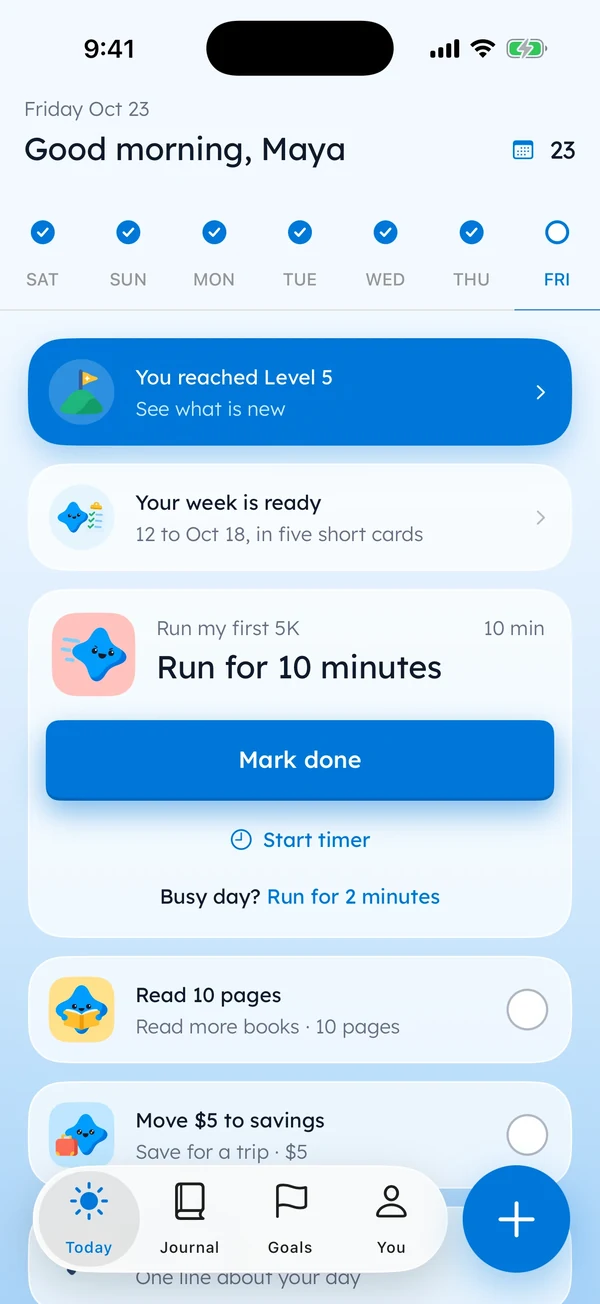
When the step is finished, you tap Mark done and Mira cheers “Nice. That counts.”
Then Say how it went opens one question, “How did it go?”, while the walk is still in your legs.
On paper it works the same way. The plan sits at the top of the page, and the answer goes under it before the light goes off.
30 night journal prompts
Night prompts look back at the morning line. The first group checks the step, and the other two cover the rest of the day.
Check the step
- Did you do this morning’s step? What happened?
- When did you do it, and where?
- What made it easier than you expected?
- What got in the way?
- Did you do the full step or the busy-day version?
- How did the step feel, in one word?
- What would you change about it tomorrow?
- What’s tomorrow’s step: the same, or smaller?
- If you skipped it, what was the day like instead?
- What’s one detail from doing it that you’d forget by Friday?
Look back at the day
- What’s one thing that went to plan?
- What’s one thing that didn’t, and does it matter?
- Who did you talk to most today?
- What did you eat that was worth remembering?
- What was the slowest part of the day?
- What made you laugh, even a little?
- What did you finish today?
- What did you start today?
- What were you doing halfway through your day?
- What would you tell the person who wrote this morning’s line?
Close the day
- What’s one word for today?
- What are you glad is done?
- What can wait until morning?
- What will you put out for tomorrow?
- What’s tomorrow’s first small thing?
- What’s still on your mind, in one line?
- Finish this: “Today I…”
- Finish this: “Nothing happened today, except…”
- What’s one thing from today worth keeping?
- Which face fits today: great, okay, so-so, worried or hard?
The last group doubles as journal prompts before bed, for when the light is already off and you’re typing with one thumb.
Number 58 is the except trick. You finish the sentence with the first thing that comes to mind, and some nights that will be a sandwich.
In the app, a new entry at night can open with a question from Mira, like “What did your step feel like today?”
If it doesn’t fit, Another question swaps it. Or you can write one line, morning or night without a question at all.
What Franklin’s little book shows
Franklin’s two questions show that the pair is old. His notebook shows that even its inventor didn’t keep the plan perfectly.
In his autobiography, he describes a “little book” with a page for each of 13 virtues.
Each page was ruled in red ink, with a column for each day of the week. Another page held his daily plan, hour by hour, with a question at the start and the end.
“What good shall I do this day?”
The evening question was its mirror: “What good have I done to-day?”
He marked each slip with a little black spot and scraped the spots out before the next round, until the pages were full of holes.
So he moved the whole thing onto ivory pages, marked in pencil, that he could wipe clean with a wet sponge. (We’d have bought a new notebook.)
And after all that, he wrote that his scheme of Order, the part with the hour-by-hour schedule, “gave me the most trouble”.
Borrow the two questions and leave the 5 am start.
Should you journal in the morning or at night?
Neither end is better for everyone. Pick the end you’ll keep, tied to something you already do, and give it a week.
- Mornings suit you if you plan best before the day starts talking back.
- Nights suit you if you’d rather write about something already done.
- Both ends give you a plan and its check.
But one end, kept every day, beats two ends kept now and then (ask Franklin).
If you only write at night, number 55 turns into tomorrow’s plan. If you only write in the morning, number 8 checks yesterday.
If you’re new to all of this, the beginner journal prompts keep every question small, and the daily journal prompts give you a fresh one for each day of the month.
And if you still can’t choose, the best time to journal goes through both ends in more detail. Tie the line to something that happens every day anyway.
Franklin needed red ink and a wet sponge. You need one line tonight.
Questions people ask
What should I journal in the morning?
The easiest answer is one small thing you’ll do today and when, like “Walk at 1, stairs if it rains.” If you have more time, add one word for how you feel. Keep it to one line so it fits before the day starts.
How do I start morning journaling?
Start tomorrow with one line: “Read 10 pages on the bus home.” Write it at a time you already stop, like the first coffee. Once that feels easy, add what might get in the way and the busy-day version.
Should I journal in the morning or at night?
Choose the time tied to something you already do every day, then try it for a week. Mornings suit planning and nights suit looking back. Doing both gives you a plan and a check, but one steady end is fine.
How do I start journaling before bed?
Check the morning plan first: did it happen, and how did it go? Then write one word for the day, or what you’re glad is done. On a long day, a short line like “Didn’t walk. Long day.” is a full entry.
Sources
TopicJournal prompts

You earned the Two Questions badge
You read both ends of the day. Tonight, answer one night prompt in one line.
0 XP

Yumemira is an iPhone app (iOS 18 or later).
Yumemira on iPhone: Lock Screen and widgetsYumemira is free to start. iPhone, iOS 18 or later.