
When to journal
Best time to journal: morning or night? Pick the one you’ll remember

The short answer
The best time to journal is the time you’ll actually remember, which is usually right after something you already do every day. Mornings suit plans, and nights suit looking back. Pick one moment at a time you already stop, like the kettle clicking or the phone going on its charger, and keep it that small for a week.
In 30 seconds
- Pick the slot by its cue, not by the clock.
- Mornings suit plans. Nights suit looking back at the day.
- Shift workers can use the end of a shift as their night.
- Missed your slot? Write at the next cue you hit.
7:10 am. You promise yourself you’ll write tonight.
11:40 pm. You promise you’ll write first thing tomorrow, and both of you mean it, and neither of you can find the pen.
There’s a third option: write right after the kettle clicks.
We make an iPhone app for this, so we’re not neutral here. A pen works too.

Reading XP0 XP
The best time to journal is the one with a cue
Either end of the day works. What decides it is a cue you already have, something your day does without asking you first.
Morning lines look ahead, and night lines look back. That’s most of the difference, and the rest is which end of your day is less crowded.
So if you’re still working out how to journal at all, choose the quieter end and stop comparing.
Pick the slot you’ll remember, then keep it a week.
Is it better to journal in the morning or evening?
Neither wins for everyone. Each slot has its own cue and its own kind of line, plus one thing that gets in the way.
| Time | Cue you already have | A line it might get | Watch out for |
|---|---|---|---|
| Morning | The kettle clicks or the coffee drips | “Call the bank before 10. Then nothing heroic.” | Rushing out with the pen still capped |
| Midday | The first bite of lunch | “Morning went fine. Somebody took my stapler again.” | Skipping it on the busy days |
| After work | Shoes off at the door | “Big meeting went okay. Ate the last mango.” | The TV asking if you’re still watching |
| Bed | The phone goes on its charger | “Long day. Best part was the window seat on the bus.” | Drifting off halfway through the line |
The last column is worth reading first. The watch-out is usually what ends a journal.
And you probably already know which one is yours.
How to pick your slot in one minute
You can choose in the time it takes to make tea.
Find a cue that never skips.
Think of something you do every single day, at home or away. The charger and the toothbrush are hard to miss.
Put the line right after it.
Leave the notebook where the cue happens, with the pen inside, so there’s no walk to another room.
Add a reminder, for now.
A phone alarm labelled “one line” will do for the first week. Turn it off once the cue does the job.
The cue matters more than the alarm.
An alarm can ring while you’re squeezed onto a crowded bus with both hands full, but a cue only happens in a place where the notebook is already waiting.
In Yumemira, the small-steps journal for iPhone, reminders belong to a goal, like reading or drinking more water.
They stay off until you turn them on. Then you choose At set times or Every few hours.
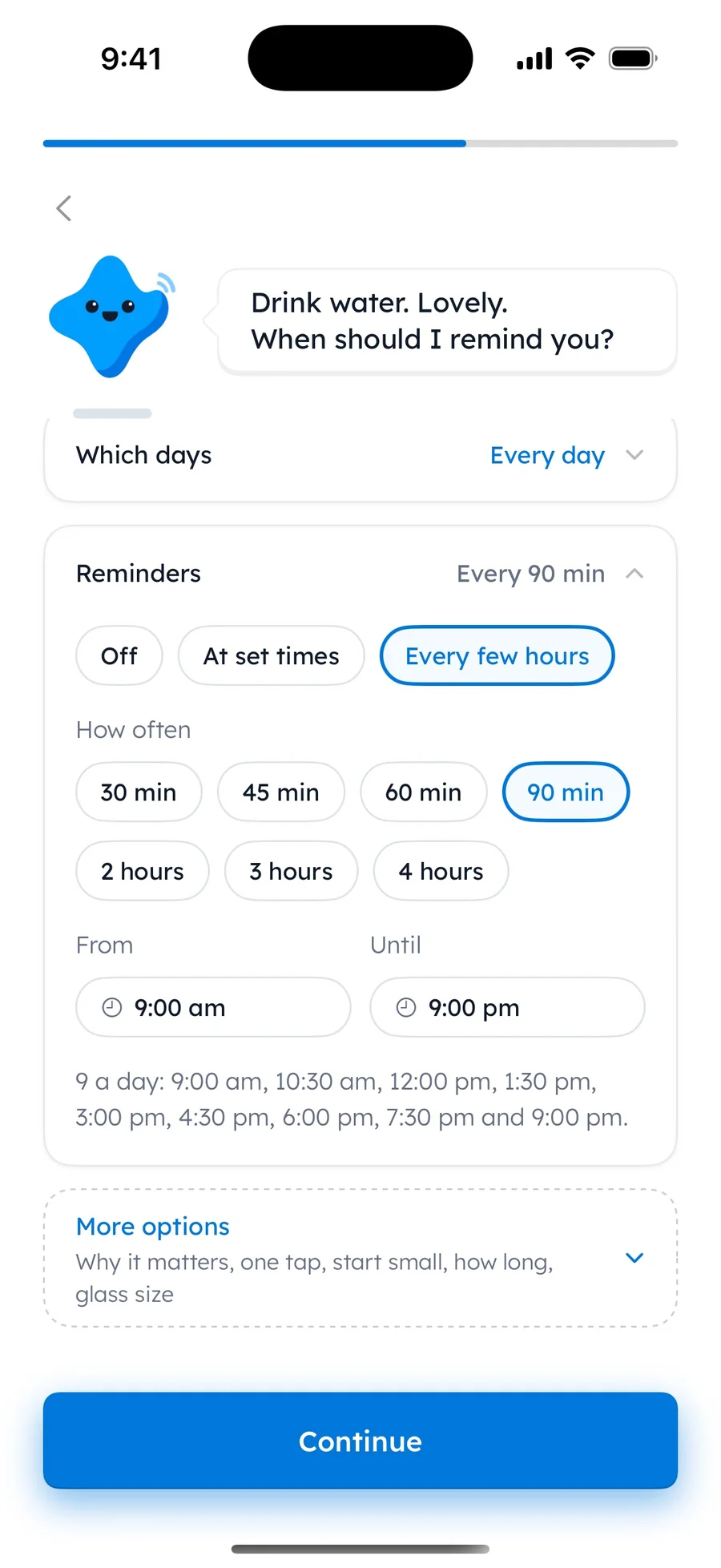
That’s on purpose. The reminder points at the step, like 10 pages of a book, and the line about it comes afterwards, while the pages are still fresh in your head.
It’s hard to have nothing to say about something you did two minutes ago.
But the journal’s question changes with the clock, too.
Before noon, Mira might ask “What would make today a good day?” After 6 pm, it could be “What do you want to remember about today?”
Journaling in the morning
A morning line looks ahead. It’s a plan, or one thing you’d like to happen, written before the day has a chance to argue.
- “Finish the report. Then lunch outside if it’s dry.”
- “Call Grandpa back. He’s been waiting since Sunday.”
- “Water the basil before it gives up.”
The risk is speed. Mornings are full of shoes, keys and a missing sock, so the line has to be short enough to write standing up.
Write the plan, then go. Tonight can check it.
But if you’d like a question to start from, try a list of what to write in morning journal. Any one of them fits in a line.
Journaling before bed
A night line looks back. The day is over, so you’re writing about something that already happened, and the first word is easier to find.
Say the house is finally quiet, the dishwasher has stopped grumbling to itself in the dark kitchen, and you’re lying down with nothing in particular to report.
Pick one moment. It might be the window seat on the bus.
It might be the soup.
The real risk at night is the obvious one: you drift off mid-sentence.
So on tired nights, keep the bed line to five words, something like “Long day, soup, bed, done.” Longer lines are for the nights you want them.
If you work shifts or nights
Your “night” might be 8 am, with the curtains shut and the street outside just starting its day. Use the end of your shift as the cue.
That could be the locker, the bus home or the moment your shoes come off. What matters is that it happens every working day, whatever the clock says.
Days off can borrow a different cue, like the first cup of something hot, drunk sitting down for once, with nowhere to be until the afternoon.
And on weeks when the rota keeps moving, a line after every shift is how to journal everyday when your days won’t stay still.
So it’s still a journal that asks a question at any hour. It just can’t see your rota.
What if you miss your time?
Write at the next cue.
A morning line written at lunch is still a morning line, only with better information, since by then you know whether the plan survived the first hour of the day.
Missed your slot? Write at the next cue.
There’s no need to wait for tomorrow’s slot, and no need to write two lines to make up for it.
Tonight, before the phone goes on its charger, write down which cue you’re picking.
Tomorrow the kettle clicks, and the pen’s already out.
Questions people ask
What is the best time to journal?
The best time is the one you’ll remember, usually right after something you already do every day, like making coffee or charging your phone. Morning suits plans and night suits looking back. Give one of them a week before you judge it.
Is it better to journal in the morning or at night?
Neither is better for everyone. Morning lines tend to be plans and night lines tend to look back on the day. The less crowded end of your day, tied to a cue you already have, is the one to try for seven days.
Should I journal before bed?
You can, if bedtime is when your day finally goes quiet. Keep it short, one or two lines about something that happened today, so it doesn’t turn into homework. On tired nights, five words and a face will do.
Can I journal at lunch or on my commute?
Yes. Midday works well if lunch is the one pause you always get. On a bus or train, a phone is easier than paper, and a line about the morning so far does the job. Driving days are the exception.
TopicStart journaling

You earned the Curious Reader badge
You picked your time. Tonight, write which cue it hangs on.
0 XP

Yumemira is an iPhone app (iOS 18 or later).
More about the daily journalYumemira is free to start. iPhone, iOS 18 or later.