
Self-reflection
Self-reflection meaning: a plain definition and a small method

The short answer
The meaning of self-reflection is plain: an honest look back at something you did or felt, so you can choose what to do next. Tonight, while the toothbrush is still in your hand, write one line about one moment from today. End it with what you’d try next time. Keep it that small for a week.
In 30 seconds
- Self-reflection is a look back that ends in a next step.
- Replaying the same moment over and over isn’t the same thing.
- A 2-minute method asks three short questions about one moment.
- Read your lines back once a week to spot patterns.
Type “self reflection vs” into Google and one suggestion is “self reflection vs overthinking”. From the inside, the two can feel identical.
Say a meeting went badly today. You’ve replayed it in the shower for 20 minutes, and in the shower version you were brilliant.
That’s thinking about it. Reflection is the bit after.

Reading XP0 XP
Self-reflection meaning, in plain words
Self-reflection means looking back at something you did or felt, with an honest eye and without the courtroom drama, and then deciding what comes next.
Merriam-Webster’s entry for self-reflection (opens in a new tab) points to self-examination (opens in a new tab), defined as “a reflective examination (as of one’s beliefs or motives)”. Self-reflection itself dates back to at least 1644.
Its listed synonyms include introspection and soul-searching, which sound like something done on a mountain at sunrise, while most weeknights happen on a couch with one sock off.
In daily life, it has three small parts:
- Something real from today, like a meeting or a text that went sideways.
- An honest look at your part in it, without a verdict.
- One thing you’d keep or change next time.
The third part is the easiest to skip. But it’s the part that changes next Thursday.
Look back at one real thing, then look forward once.
So any question can start it. A list of journal entry prompts has plenty, though one question beats a page of them.
What self-reflection looks like on an ordinary day
It looks small: usually one honest sentence about a moment you’d otherwise just replay.
After a meeting
You talked over a colleague halfway through their point. Replaying sounds like “Why do I always do that?” on a loop.
Through the next meeting. The trip home. Most of the evening.
Reflecting sounds like one line: “Talked over them in the budget meeting. Next time, let them finish.”
After an argument
The argument was about whose turn it was to take out the bins.
But it was never really about the bins, and by the time you noticed, last spring’s dishes and a forgotten birthday had both come up too.
So the reflecting line skips the bins: “Snapped, but mostly tired. Say that first next time.”
After a good day
Good days deserve a look too.
Say the walk home felt great for no clear reason, shopping bag cutting into your fingers, sky going orange over the bus stop while you waited at the lights.
“Walked home the long way and felt good. Again on Friday.” Now you know one thing that works.
Replaying vs reflecting, and how to tell
Both start from the same moment. Replaying keeps asking why, while reflecting asks what happens next, and only once.
| Replaying | Reflecting | |
|---|---|---|
| What it asks | “Why did that happen again?” | “What would help next time?” |
| Where it ends | Back at the start | At one small next step |
| An example line | “Can’t believe that came out.” | “Said too much. Ask a question first next time.” |
| How long it takes | The whole shower, and the bus | About 2 minutes |
| What’s left after | The same knot | A line you can read later |
Replaying feels like work because it’s tiring. It just doesn’t go anywhere.
And the shower version where you said the clever thing? It never leaves the bathroom.
So the fix isn’t thinking less. It’s thinking once, then putting it on paper, so the thought has somewhere to land and you can stop carrying it around the kitchen all evening.
If a thought has no next step, write one.
A 2-minute method for looking back
Answer three questions about one moment from today, a line for each. Any paper works.
The moment.
Name one moment in plain words. “The budget meeting ran long.”
One keeper.
One thing that went well, even a tiny one. “Had the numbers ready.”
One try.
One change, small enough to do this week. “Ask one question before answering.”
That’s it. Done before the toothpaste is back in the cup.
Yumemira, the small-steps journal for iPhone, is ours, so take this next bit with that in mind. A pencil stub and an old envelope do the same job.
In the app, a blank entry opens with a question from Mira, and Another question swaps it for a different one.
Most moments worth a look back are things you did. So the app gives you one small step a day, and Say how it went asks while it’s fresh.
Back to the meeting, though. Any one of those three questions would have made the shower a lot shorter.
Questions to go further
Once the three questions feel easy, swap one out now and then.
- “What would you tell a friend who did the same thing?”
- “What’s one thing to stop doing?”
- “What surprised you today?”
Big questions are fine too. But at bedtime, with one eye already closed, they tend to get “not sure”, which is honest and hard to build on.
Small ones get real answers.
On nights when three feels like too much, the first question alone will do. A named moment is easier to return to than a vague day.
For 60 short ones sorted by moment, try these self reflection journal prompts. For questions about what you like and value, there are journal prompts for self awareness.
Make it weekly
Once a week, read your lines back. It takes about five minutes.
One line is small. Seven can show a pattern.
Maybe the same meeting turns up three times. Or Fridays keep going well for a reason you never spotted on the day, because you were too busy living Friday to notice.
Single days hide that.
Seven short lines show what one long one can’t.
If you’d rather keep one line a day in a journal on your iPhone, Yumemira brings the week back on Sunday.
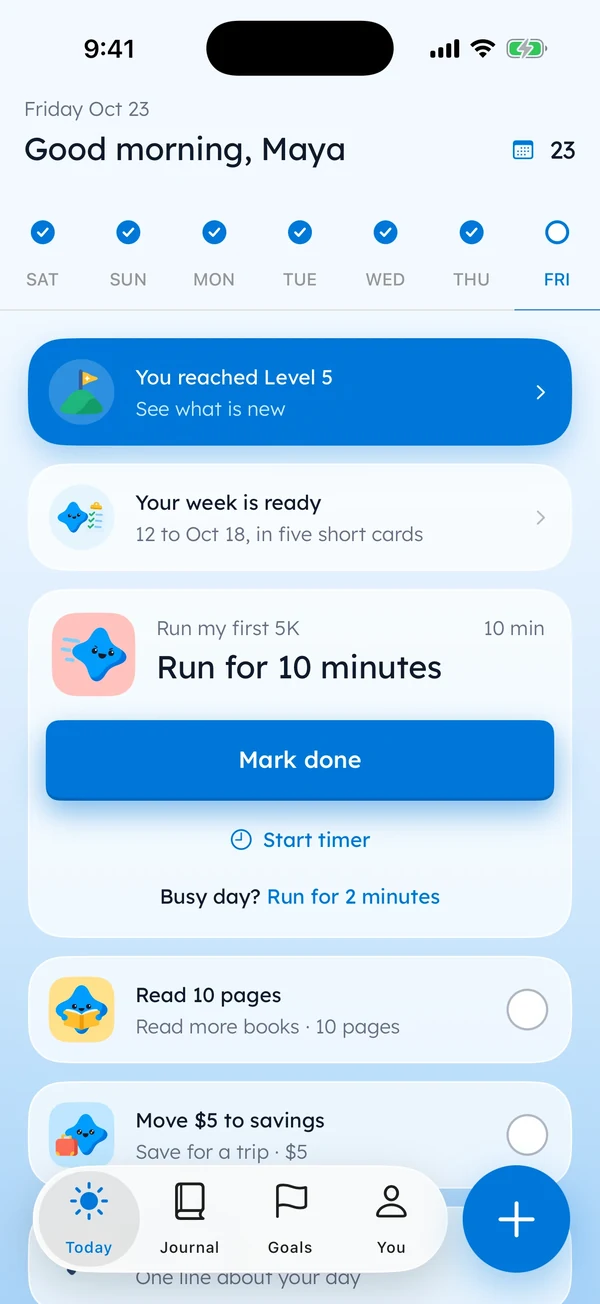
In  Yumemira on iPhone, a Your week is ready card shows up on the Today screen, with the week in five short cards.
For a longer look back each month, see how to journal for self growth.
Tonight, pick the moment you replayed most today and write its next-time line.
Then the shower can go back to being a shower.
Questions people ask
What is the meaning of self-reflection?
Self-reflection means taking an honest look at what you did and felt, so you can choose what to do next. Merriam-Webster lists it under self-examination: a reflective look at your own beliefs or motives.
What is an example of self-reflection?
After a tense meeting, you write: “Talked over a colleague. Next time, let them finish.” It names the moment and your part in it, then ends with one thing to try.
What is the difference between self-reflection and overthinking?
Self-reflection looks at a moment once and ends with a next step. Overthinking replays the same moment again and again without deciding anything. If the thought has no next step, you’re probably replaying it.
How do I practice self-reflection daily?
Pick one moment from today and write what happened in one line. Then add one thing you’d keep and one thing you’ll try next time. It takes about two minutes. Read the lines back once a week.
Is self-reflection the same as self-awareness?
Not quite. Self-awareness is knowing what you tend to think, feel and do. Self-reflection is the act of looking back at one moment on purpose. Doing the second, often, is one plain way to build the first.
What’s another word for self-reflection?
Merriam-Webster points self-reflection to self-examination, and lists introspection and soul-searching among its synonyms. In everyday talk, people also say “looking back” or “taking stock”.
Sources
TopicJournal prompts

You earned the Curious Reader badge
You read the whole definition. Tonight, write one next-time line.
0 XP

Yumemira is an iPhone app (iOS 18 or later).
More about the daily journalYumemira is free to start. iPhone, iOS 18 or later.