
Self-growth
How to Journal for Self-Growth Without Turning It Into Homework

The short answer
To journal for self-growth, take one small step toward something you want, then write one line about what you did. Tie it to something you already do, like switching off the bedroom light. Once a month, read the lines back and look for what moved. Give the small version a week before you add anything.
In 30 seconds
- Write about a step you took, not about who you’d like to be.
- One small step and one line take about a minute.
- Once a month, spend 10 minutes reading the lines and counting.
- A slow month still leaves something true to read.
Picture the self-help book on your nightstand. Half its pages are yellow with highlighter, and a bus ticket marks chapter 4.
Every yellow line made sense at the time. None of them says what happened the next morning.

Reading XP0 XP
What journaling for self-growth looks like day to day
Most days, it looks a bit dull: one small step, then one line about it.
That’s it.
There’s no essay about the person you hope to become. No list of values in your best handwriting, either. Just short lines like these:
- “Read 2 pages. Kept one idea about asking better questions.”
- “Spoke up in the team call. Short, but it got said.”
- “Walked to the corner shop instead of ordering. Cold out.”
They look tiny on their own. But thirty of them in a row show where a month really went, which is more than a page of yellow highlighter has ever managed to say.
The daily part is an ordinary writing habit. If it’s new, start journaling with one line, and borrow the tricks for how to journal every day.
Self-growth adds two things: a step before the line, and a look back at the end of the month.
The one-step method, in four parts
Four parts, and the third one does most of the work.
Pick one area.
Learning, courage, money, people or your body. One for this month; the others can wait.
Shrink the step.
Small enough for your worst day: 2 pages, 5 minutes, one sentence in a meeting.
Write one line after.
What you did, plus one detail that would be gone by Friday.
Look back once a month.
Ten minutes, on a day you choose, with every line in front of you.
A line written right after the step is specific. And specific lines are the ones worth reading a month later.
Write what you did, then one detail you’d forget.
A logbook doesn’t draw lessons. Neither does the line, and that’s what keeps it from feeling like homework.
Facts only.
Five growth areas, with a step and a line
One row is enough for the next month. The last column is what you’ll check in the look back, so you know what you’re collecting from day one.
| Area | Small step | A line it might get | What to look for in a month |
|---|---|---|---|
| Learning | Read 2 pages | “Two pages. Kept one idea: ask before guessing.” | How many ideas you kept |
| Courage | Say one thing in a meeting | “Asked why the deadline moved. Voice shook a bit.” | Whether it got easier |
| Money | Put aside $1 | “Skipped the vending machine. $1 in the jar.” | The total, and what you skipped |
| People | Send one short hello | “Texted an old friend. Got a photo of her dog.” | Who you’re closer to now |
| Body | Walk 5 minutes | “Walked to the bus stop and back. Light rain.” | How often you went |
The steps are small on purpose. A step that fits your worst day still gets a line on your worst day.
None of the rows fit? Then keep the shape and swap the words. Any area works, as long as the step is something a camera could catch you doing.
Where our app fits
Most of the lines worth rereading are about something you did, whether it was two pages before bed or one sentence said out loud in a meeting that usually goes by without you.
We built our app around that idea, so we’re not neutral here. A notebook with a pen does the same job.
In Yumemira, the small-steps journal for iPhone, you pick one goal to grow or make your own, and each day brings one step. Tap Mark done when it’s finished, and Mira cheers “Nice. That counts.”
Then Say how it went opens the writing box for your line. Two minutes after a step, the detail is still fresh.
And on paper, the order is the same. Step first, line second, while the detail is still there.
Your monthly look back
The look back happens once a month, on a quiet evening or a slow Sunday morning, and it means every line, start to finish, in the order you wrote them.
It’s a shorter read than the self-help book, and you’re the main character.
Four questions to bring along:
- Which step happened most often?
- Which line surprised you on the second read?
- What got easier between week 1 and week 4?
- Should next month’s step stay the same or grow a little?
The ten minutes go like this, shown here for a learning month.
| Minutes | Do this | A line it might get |
|---|---|---|
| 1 to 4 | Read every line, no notes yet | “18 lines. Most of them were about two pages.” |
| 5 to 6 | Count the days you did the step | “18 days out of 30.” |
| 7 to 8 | Mark the line that surprised you | “Day 12: finished a whole chapter by accident.” |
| 9 to 10 | Write next month’s step | “Same 2 pages. One idea a week in the margin.” |
Count what you did before you judge how it went.
Counting comes first, because a number is hard to argue with.
A tired brain at the end of a month will swear nothing happened, often while flipping past thirty days of lines, in your own handwriting, that say otherwise.
And the pencil tally in the margin will still say 18.
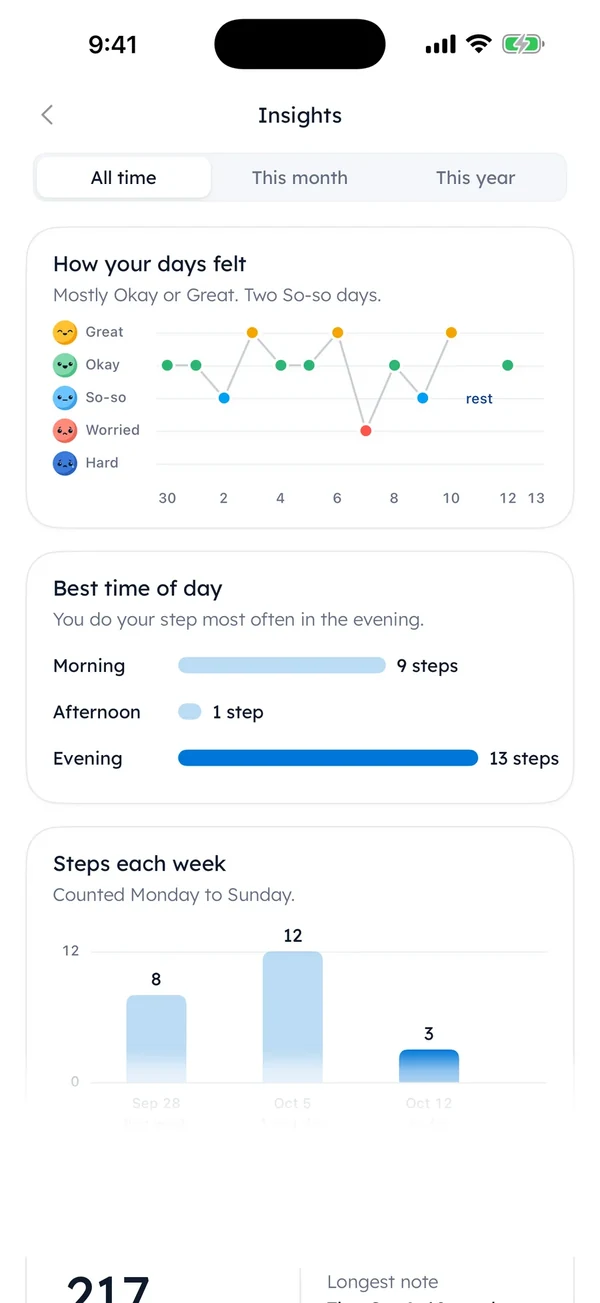
With Pro, Insights does the counting in the app. On paper, a pencil tally does the same job.
More questions sit in these self reflection journal prompts, grouped by day, week and month.
When a month looks like nothing moved
Some months, the look back is short. Say there are nine lines in thirty days, and five of them say “Too tired.”
But read them anyway. All nine.
Nine lines still show which days the step happened, and the days it worked are the best clue you have when you choose next month’s step.
Journal prompts for self growth
Prompts help on nights when the line won’t come. These eight all ask about something you did, so the method stays the same.
Eight prompts about something you did
- What did you do today that you couldn’t do a year ago?
- What did you try today for the first time?
- Where did you pick the slightly harder option today?
- What did you learn today that you could explain to a friend?
- What went wrong today, and what would you change next time?
- What did you finish today that had been waiting a while?
- Who showed you something useful today?
- What step would make tomorrow a little braver?
For questions about who you are, try these journal prompts for self discovery.
And for a bigger target to aim the steps at, the personal development goals examples turn vague goals into ones you can count. The line itself can live in a one-line journal or a plain notebook.
Tonight’s step
The book with the yellow pages is a good place to start.
The highlighter can stay on the nightstand. One line will do.
Questions people ask
How do you journal for self-growth?
Pick one area, like learning or courage. Take one small step a day, then write one line about what you did and one detail. Once a month, read every line back, count the days you did the step and choose next month’s step.
What are good journal prompts for self growth?
Good ones ask about something you did today. Try “What did you try today for the first time?” or “What did you do today that you couldn’t do a year ago?” They’re easier to answer in one line than questions about who you want to be.
How often should I journal for self-improvement?
A line a day works well because it’s tied to a step you take daily. If daily doesn’t fit, a few lines a week still give you enough to read back. The monthly look back is the part worth keeping regular.
What should I look for when I reread my journal?
Start by counting: how many days you did the step. Then look for the line that surprised you and anything that got easier between the first and last week. Use what you find to set next month’s step.
TopicStart journaling

You earned the Small Step badge
You read the whole method. Tonight, take one small step and write one line.
0 XP

Yumemira is an iPhone app (iOS 18 or later).
How Yumemira worksYumemira is free to start. iPhone, iOS 18 or later.