
Habit stacking
Habit Stacking Examples: 30 ‘After I…’ Pairs You Can Use Today

The short answer
Habit stacking examples follow one sentence: “After I [something I already do], I will [one new thing].” For example, after you pour your coffee, drink one glass of water. Tie the new habit to something you already do at a time you already stop, keep it under 2 minutes, and keep it that small for a week.
In 30 seconds
- Pick an anchor you already do every single day.
- Make the new habit small enough to finish in 2 minutes.
- Give every stack a busy-day size that still counts.
- Start with one stack. Add a second after a week.
“After I pour my coffee, I…”
Fill in the blank with one tiny thing. That’s the whole trick, and the coffee does most of the work.
Below are 30 ways to finish the sentence. We make an iPhone app for small daily steps, so we’re not neutral here. The back of a receipt works just as well.

Reading XP0 XP
What habit stacking is, in one line
Habit stacking means tying a new habit to one you already do. You don’t pick a time, you pick a moment that already happens.
Most people meet the idea in James Clear’s habit stacking (opens in a new tab) chapter of Atomic Habits. He credits the method to BJ Fogg, who called it “anchoring”.
He also thanks S.J. Scott, whose book of that name gave him the phrase. Clear’s fill-in formula is short.
“After/Before [current habit], I will [new habit].”
Two blanks. That’s all.
Two of his rules are worth keeping close.
- The anchor happens as often as the new habit.
- It’s specific enough that you know the exact second it’s done.
Use an anchor you’ve never once skipped.
Brushing your teeth qualifies.
What about “after work”? That can mean 5:30 pm on a Monday, or a bus seat at 11 pm on a Thursday after a shift that ran long, so it’s a weak anchor.
Stacking is one of the plainest answers to how to stay consistent. So the pairs below are sorted by the part of the day they hang on.
Each one also has a smaller version for days that go sideways.
Morning habit stacking examples
Mornings are full of anchors. The alarm and the toothbrush turn up whether you’re ready or not.
Morning stacks
- After I switch off the alarm, I will put both feet on the floor before I touch the phone. Busy day: one foot.
- After I sit up on the edge of the bed, I will take one slow breather. Busy day: one breath.
- After I brush my teeth, I will try to touch my toes three times. Busy day: once.
- After I pour my first coffee or tea, I will drink one glass of water. Busy day: a few sips.
- After I make the bed, I will clear one surface in the room. Busy day: move one cup.
- After I sit down with breakfast, I will sketch my mug for 5 minutes. Busy day: one line of it.
- After I put on my shoes, I will step outside and look at the sky for a minute. Busy day: the window.
- After I find a seat on the bus or train, I will practice 5 new words in the language I’m learning. Busy day: one word.
Number 6 sounds odd until you try it. The mug is right there and it holds very still.
And nobody has ever complained about a bad drawing of a mug.
For more ideas sorted by the minutes you have, there’s a longer list of morning routine ideas.
Habit stacks for the workday
“Workday” means whenever your shift happens. These anchors don’t care about the clock, only the order.
Workday stacks
- After I clock in or log on, I will write down the one task that matters most. Busy day: three words.
- After I end a phone call, I will stand up and roll my shoulders. Busy day: one roll.
- After I finish lunch, I will walk for 5 minutes. Busy day: the long way to the bin.
- After I sit down to eat, I will put my phone face down for 10 minutes. Busy day: until the first bite.
- After I walk past the snack machine, I will keep walking. Busy day: slow down and keep walking.
- After I make my afternoon tea, I will send one short hello to a friend. Busy day: two words.
- After I close my laptop or end my shift, I will tidy my desk or locker for 2 minutes. Busy day: throw out one thing.
Number 13 is a habit made of not doing something. It still needs an anchor, and a snack machine is a very loud one.
So give every stack a busy-day size, even the odd ones.
The small version is the one you’ll lean on in the week when the bus is late every morning and the inbox fills faster than you can empty it.
Size the habit for your worst day, not your best.
Habit stacks that end with one line
These seven are for anyone who wants to remember the days as well as get through them. Each one ends with one written line.
Stacks that end with a line
- After I plug in my phone at night, I will write one line about today. Busy day: one word for how it felt.
- After I turn off the TV, I will write down one good thing from today. Busy day: a single noun.
- After I get into bed, I will read 2 pages, then write one line about them. Busy day: the line only.
- After I sit down with my first coffee, I will write one thing I want from today. Busy day: “Get through it.”
- After I finish lunch, I will write one line about the morning. Busy day: “Morning: done.”
- After the bus doors close on the way home, I will type one line about the day. Busy day: five words.
- After I finish any small step, I will write how it went. Busy day: “Done. Okay.”
Number 22 is the one we built an app around: do one small thing, then write a line about it while it’s fresh. It’s hard to have nothing to say about something you did 4 minutes ago.
On paper, that’s a notebook and a pen next to the anchor.
In Yumemira, the small-steps goal journal for iPhone, the step and the line sit side by side.
- Tap Mark done on today’s step, and Mira cheers “Nice. That counts.”
- Tap Say how it went and write the line while it’s fresh.
Here are ten of the pairs again, each matched to one of the 26 ready goals in the app.
| After I… | I will… | Ready goal |
|---|---|---|
| Pour my first coffee | Drink one glass of water | Drink water |
| Sit down with breakfast | Sketch my mug for 5 minutes | Draw or create |
| Find a seat on the bus | Practice 5 new words | Learn a language |
| Finish lunch | Walk for 5 minutes | Walk |
| Walk past the snack machine | Keep walking | No-spend days |
| Make my afternoon tea | Send one short hello | Call family or friends |
| Take off my work shoes | Tidy for one song | Tidy up |
| Sit down on the couch | Play for 5 minutes | Practise an instrument |
| Get into bed | Read 2 pages | Read |
| Turn off the TV | Write down one good thing | Gratitude |
But a stack needs a cue you’ll actually see. If your phone is the first thing you pick up after the anchor, the step can sit right there on the Lock Screen.
A thing you touch every day still beats any screen, though. The coffee doesn’t need a notification.
Evening habit stacking examples
Evenings get crowded with dinner, messages, laundry and whatever the day left on the counter. So these anchors are things you touch: keys, shoes, plates, the light switch.
Evening stacks
- After I drop my keys in the bowl, I will walk around the block before I sit down. Busy day: to the corner and back.
- After I take off my work shoes, I will tidy for the length of one song. Busy day: half the song.
- After I start cooking dinner, I will add one extra vegetable to the plate. Busy day: an apple on the side.
- After I wash the last dish, I will set out tomorrow’s mug. Busy day: just the mug, no spoon.
- After I sit down on the couch, I will play my instrument for 5 minutes before the TV goes on. Busy day: one scale.
- After the episode ends, I will move a small amount into my trip savings. Busy day: open the account and look.
- After I close the curtains, I will write 50 words of the story I keep meaning to start. Busy day: one sentence.
- After I set tomorrow’s alarm, I will put my phone to charge across the room. Busy day: the far side of the bed.
Number 26 is a stack that sets up another stack. Tomorrow’s coffee now has a mug waiting next to it.
That’s about as organized as a mug gets.
How to pick your first habit stack
You don’t need all 30. You need one stack, and picking it takes about three minutes.
Five anchors.
List things you did today without thinking: the alarm, the toothbrush, the charger, the shoes, the bus.
One new habit.
Pick the one you’d be pleased to have done a week from now, sized to 2 minutes.
The full sentence.
Write “After I…, I will…” in full, then a busy-day version next to it.
The anchor is where most stacks wobble. Clear’s rule helps here: you should know the exact second it’s done.
| Instead of… | Try… |
|---|---|
| “After breakfast” | “After I put my bowl in the sink” |
| “When I get home” | “After I drop my keys in the bowl” |
| “In the evening” | “After I set tomorrow’s alarm” |
| “During my break” | “After I sit down with my tea” |
| “Before bed” | “After I plug in my phone” |
Write the anchor as something your hands do.
When one stack feels easy for a full week, add a second. The 2 minute rule covers the sizing side.
Want even smaller options? Our list of micro habits has plenty.
When a stack falls over
Some days the anchor happens and the new habit doesn’t. You poured the coffee, drank it standing at the counter while reading a message about something else entirely, and remembered the water around 4 pm.
It happens. Usually the anchor is too vague, or the new habit is too big for that kind of day.
- Move the anchor to something more physical. “After work” becomes “after I take off my shoes”.
- Shrink the habit to its busy-day size for a week.
- Put the cue where you’ll see it: the glass next to the coffee jar, the book on the pillow.
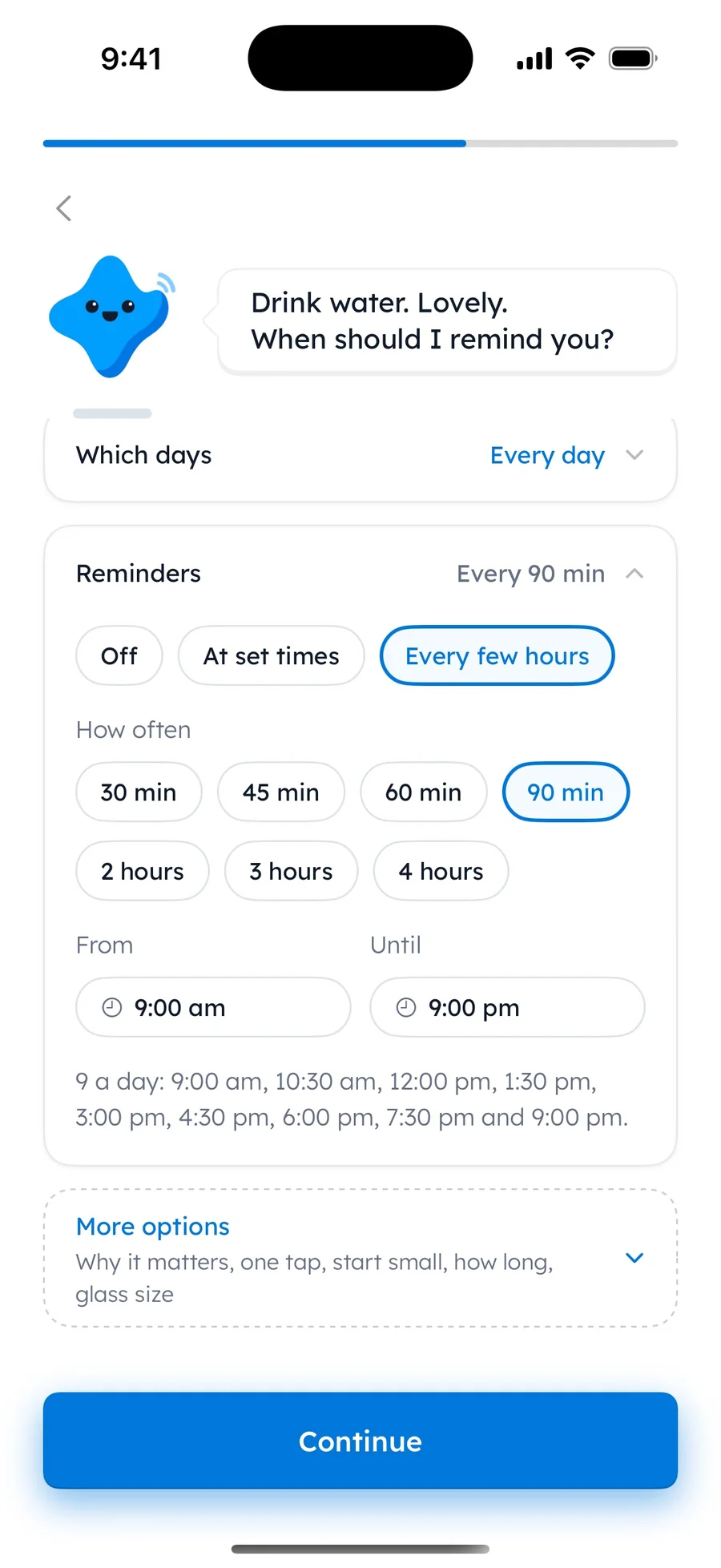
Sometimes the anchor really is a time, like a lunch break that always starts at 12:30. In that case, Yumemira can remind you then.
For the longer view, our guide on how to build a good habit picks up where this list stops.
Tonight, before you put the phone down, finish the sentence from the top.
“After I pour my coffee, I will…” The coffee already knows its part.
Questions people ask
What is a habit stacking example?
“After I pour my morning coffee, I will drink one glass of water.” The coffee is a habit you already have, and the water comes right after it. Every stack follows the same shape: an old habit, then one small new one.
How many habits can you stack at once?
Our advice is one, for at least a week. When that one runs without thinking, add a second to the same anchor or a new one. Stacking five new habits on day one turns a small change into a long list.
What if I forget the new habit?
Usually the anchor is too vague or the habit is too big. Move the anchor to something your hands do, like plugging in your phone, and shrink the new habit to its busy-day size for a week.
Is habit stacking from Atomic Habits?
It’s best known from a chapter of James Clear’s Atomic Habits. Clear credits the method to BJ Fogg, who called it anchoring, and says the phrase came from S.J. Scott’s book Habit Stacking. The “After I…, I will…” formula is Clear’s.
Can you habit stack at night?
Yes. Night has strong anchors, like plugging in your phone or setting an alarm. Pick one and add something you can finish in a minute or two, like writing one line about the day.
Sources
TopicStaying consistent

You earned the First Stack badge
You read all 30. Tonight, finish one ‘After I…’ sentence.
0 XP

Yumemira is an iPhone app (iOS 18 or later).
Yumemira on iPhone: Lock Screen and widgetsYumemira is free to start. iPhone, iOS 18 or later.