
Small goals
Daily, weekly, monthly and yearly goals: a one-page goal ladder

The short answer
To set daily, weekly, monthly and yearly goals that connect, write the yearly goal first, then divide it into what one month and one week would need. Then pick a daily step small enough for a bad day. Do it at a time you already stop, like after dinner. Keep it that small for a week.
In 30 seconds
- Write the year first, then divide it down, one rung at a time.
- Every rung is the one above it, cut into smaller pieces.
- Add a busy-day rung for the long days.
- Only today’s rung needs doing today.
Yearly goal: “Get my savings in order.”
Daily goal: “…”
A lot of plans stop at those three dots. The year got a nice sentence, and the day got a pen hovering over the page.
So shrink the year the way you’d shrink any of your small goals, one rung at a time, until today has a step.

Reading XP0 XP
How daily, weekly, monthly and yearly goals fit together
Each goal is the one above it, divided. The year sets the direction, and the day is the only part you can actually do.
- Year: the thing you’d like to be true in twelve months.
- Month: a checkpoint, so you know if the year is on track.
- Week: a plan small enough to fit around a full week of work and laundry.
- Today: one step, the normal size.
- Busy day: the same step, cut down to two minutes.
The year is the easy part to write.
You can do it in a café on the first of January, with a good pen and optimism that lasts, if we’re honest, until the second Tuesday, when the alarm goes off in the dark.
Only the bottom rung needs doing today. The others just tell you which way it points.
So when a yearly goal feels too big to start, don’t argue with it. Divide it.
The goal ladder, filled in three ways
Three real kinds of goal, each stepped down from one year to one busy day. The numbers are small on purpose.
| Rung | Save for a trip (USD) | Read more | Learn a language |
|---|---|---|---|
| Year | “$600 for a trip in June” | “12 books” | “Order food in Spanish” |
| Month | “$50” | “1 book” | “20 short lessons” |
| Week | “About $12” | “About 70 pages” | “5 lessons” |
| Today | “Put $2 aside” | “Read 10 pages” | “1 lesson (about 10 minutes)” |
| Busy day | “Put $1 aside” | “Read 2 pages” | “Practise for 2 minutes” |
The math, so you can check it: $600 over 12 months is $50 a month.
A month is a little over four weeks, so a week comes to about $12. And $12 over seven days is about $1.70, which rounds up to $2.
Reading works the same way. Say a book runs about 300 pages. A month is a bit over four weeks, so one book a month is roughly 70 pages a week, which is 10 pages a night.
The language column is the one that looks least like math. “Order food in Spanish” is a year. Twenty short lessons is a month, five is a week, and one lesson (about ten minutes) is tonight.
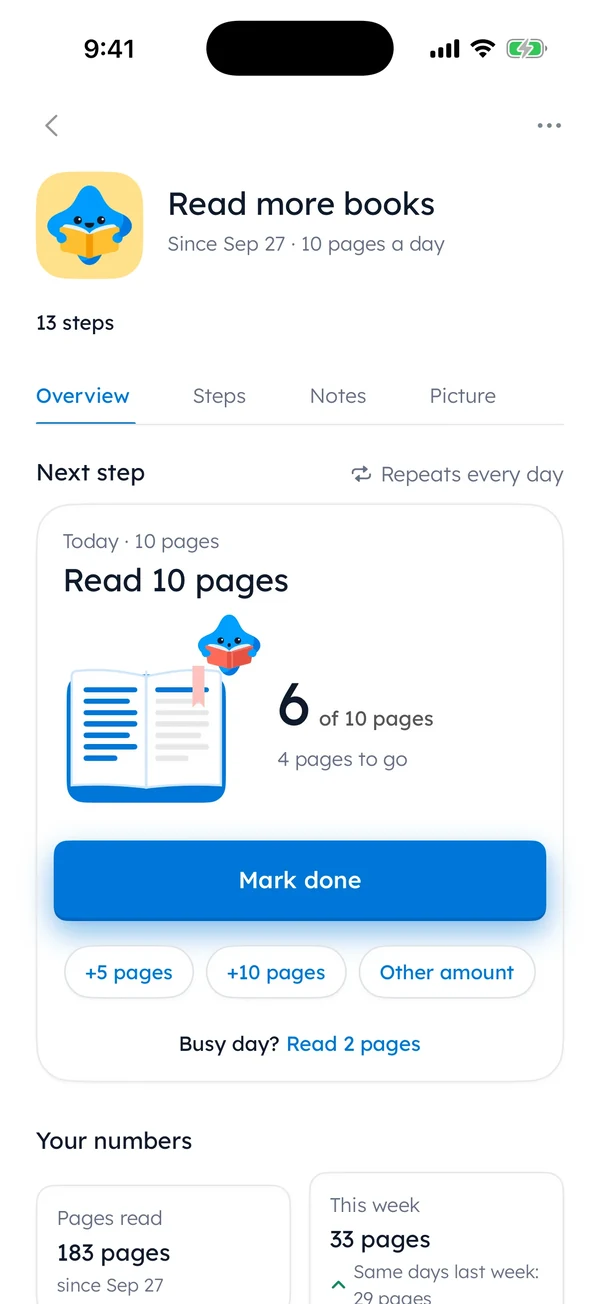
The busy-day row comes from the app’s own defaults. We make Yumemira, the small-steps goal journal for iPhone, so we’re not neutral here.
A pencil and the back of an envelope work just as well.
In the app, every goal has a busy-day step, and it counts in full. For a trip fund it’s “Put $1 in my trip fund”.
Save for a trip starts at $10 a week, and you can change the amount and the days. Here’s a laptop fund set up the same way.
The app holds the step and the busy-day step, plus a weekly amount and a total if you want one.
The month rung can live on paper, where you’ll see it on Sunday.
Make your own ladder in five minutes
Start at the top and divide, don’t guess. One rung per step.
Write the year.
One sentence, in your own words. “Read more” works, but “12 books” is easier to divide.
Divide by twelve.
That’s the month. If it doesn’t divide neatly, round to something you can say out loud.
Divide by four.
That’s the week. Round up a little, since some weeks lose a day.
Pick today’s step.
What would one ordinary day of that week look like? Write it as an action: “Read 10 pages”.
Shrink it.
For a busy day, cut today’s step to the size you could do half asleep. Two pages. One dollar. Two minutes.
The fifth step is the one templates leave out. It’s also the rung you’ll use most in a hard month.
If the busy-day step feels silly, it’s the right size.
Your ladder in 5 minutes
Ticks stay in this browser. Nothing is sent.
If you get stuck at step 1, how to set goals goes through picking the goal itself. This page starts once you have one.
A printable daily, weekly, monthly and yearly goals template
Five rungs and one line, short enough to fit on a single page.
Print this bit, or copy it into a notebook or your phone’s notes. It takes about a minute:
- Year: what I’d like to be true by next year
- Month: the year divided by twelve
- Week: the month divided by four (a bit more, really)
- Today: one step, written as an action
- Busy day: the same step, much smaller
- One line: how today’s step went
The last line isn’t a rung. It’s where the ladder turns into a journal, and it’s the part you’ll reread next March.
Small weekly goals that keep the ladder honest
A week is long enough to plan and short enough to forgive. Here are eight small weekly goals, one for each part of life:
- Money: put aside the same small amount on the same day.
- Reading: finish one chapter of the book on your nightstand.
- Learning: do five short lessons of the language you picked.
- Body: take three walks of 15 minutes, whenever they fit.
- Home: clear one shelf.
- People: send one long message to someone you miss.
- Work: write down one thing that moved this week.
- Rest: keep one evening with no plans at all.
Each one breaks down into a step for today. There are 50 more daily goals examples with busy-day versions.
And if you like ticking boxes, a daily goals checklist fits on the fridge.
But don’t pick all eight. One goal at a time makes a good first week, and it’s how the free version of the app works too.
Not sure which part of life gets the ladder? These areas of life for goal setting help you choose one before you divide it.
When a week doesn’t go to plan
Some weeks the trip fund gets nothing, and the Spanish lessons sit there being polite about it.
It happens.
So what now? Leave the gap and do today’s busy-day step (the one-dollar, two-page kind).
A missed week doesn’t change the year rung.
Say the month was $30 instead of $50. You can carry the difference into next month.
Or you can lower the year to $500. Both are honest, and the second one is often kinder.
Fill in today’s rung tonight
A ladder on paper doesn’t move by itself. So do one small thing, then write a line about it.
In Yumemira you tap Mark done, then Say how it went, and one line goes into your journal.
On paper, the line goes under the ladder:
- “Put $2 aside. Done.”
- “Read 2 pages on the bus.”
- “Ten minutes of Spanish. Ordered a coffee, in my head.”
- “Busy day. $1 in the jar.”
A page of lines like these looks dull in October and very good in June. If you’d like a ladder that’s already started, browse the 26 ready goals, each counted its own way.
Tonight, skip the year. Look at the blank after “Daily goal” and fill it in with one small thing you could do before bed.
Two pages will do. So will one dollar in a jar.
Questions people ask
What is the difference between daily, weekly and monthly goals?
They’re the same goal at different sizes. A monthly goal is a checkpoint, a weekly goal is a plan that fits around your life, and a daily goal is one step you can do today. Each one is the goal above it, divided.
How do I break a yearly goal into daily steps?
Write the yearly goal as something you can count. Divide it by twelve for the month, then by four for the week. Then pick one action for an ordinary day, and a much smaller one for a busy day.
What are good small weekly goals?
Ones you can finish even in a full week: put aside the same small amount, read one chapter, do five short lessons, clear one shelf, or send one long message to a friend. Pick one, not all of them.
How many goals should I have at once?
One is enough to start. A single ladder is easy to check on Sunday, and you can add a second goal once the first one feels ordinary. Yumemira’s free version holds one goal at a time.
Do I need a template for daily, weekly, monthly and yearly goals?
No. Five lines in any notebook will do: year, month, week, today and a busy-day step. A printed page helps if you like ticking boxes, but the dividing matters more than the paper.
TopicSmall goals

You earned the Small Step badge
You read to the end. Now fill in today’s rung, and only that one.
0 XP

Yumemira is an iPhone app (iOS 18 or later).
See the 26 goalsYumemira is free to start. iPhone, iOS 18 or later.