
Small goals
How to Set Goals You’ll Still Be Doing in February

The short answer
To set goals you’ll keep, pick one goal, then write it as a small daily step with a number in it, like “read 10 pages”. Add a busy-day version, like “read 2 pages”, and decide when you’ll do it: right after something you already do. Keep it that small for a week before you add anything.
In 30 seconds
- One goal at a time, not five.
- Write the goal as a step with a number.
- Give every step a busy-day version that still counts.
- Tie the step to a time you already have.
What does a goal look like on February 3rd?
On January 1st it said “Run a marathon.” By January 9th, the new running shoes were holding the kitchen door open. They’re very good at it.
The goal didn’t fail. It was just never turned into a Tuesday.

Reading XP0 XP
Why big goals fade by February
A big goal describes a finish line. It says nothing about this evening, after work, with the dishes still in the sink.
So every day, “get fit” has to be decided all over again.
- Is today a gym day or a walk day?
- How long counts?
- Do the stairs at work count?
That’s a lot of deciding. And on a long day, the easy answer is “tomorrow”.
The fix is to do the deciding once, on paper, on the day you set the goal: a step you can do today, with a smaller size ready for a bad day.
That’s what small goals are. Big goals, cut down to today’s size.
So keep the big goal. Just don’t ask it what to do on a Wednesday.
If you can’t do it today, it isn’t a step.
How to set goals in 5 steps
Each step takes a minute or two, with a pen and whatever paper is closest.
One goal.
Not the five from the list. The one you’d be most glad to have kept by February.
A step with a number.
“Read more” turns into “read 10 pages”. The number tells you when you’re done.
A busy-day step.
The smallest version that still counts, like 2 pages. Decide it now, while you’re not tired.
A time and a place.
“After dinner, on the couch” beats “in the evening”. Tie it to something you already do.
Somewhere you’ll look.
The fridge, the inside of the book, your phone’s Lock Screen.
Step 3 is the one that usually gets skipped.
It’s also the one that rescues the goal on the night you get home late, eat standing up, and the whole plan hopes you won’t notice the time.
Step 4 has a name. The psychologist Peter Gollwitzer called plans like this implementation intentions (opens in a new tab): plans that tie a goal to a situation you can see coming.
In practice it sounds like this: “When I sit down after dinner, I’ll read.”
A goal without a busy-day step is a fair-weather goal.
Write it where you’ll see it
A goal in a notebook in a drawer has the marathon’s problem. Nobody looks at it on a Tuesday.
So put the step where your day already goes:
- a sticky note on the coffee jar
- a bookmark that says 10 pages
- one line on the bathroom mirror
Paper works fine. We make an app for this, so we’re not neutral here. But the idea is the same: a goal is easier to keep when it’s written where you look.
Yumemira, the small-steps goal journal for iPhone, asks for the same three things as the steps above: the goal, the daily amount and a busy-day step.
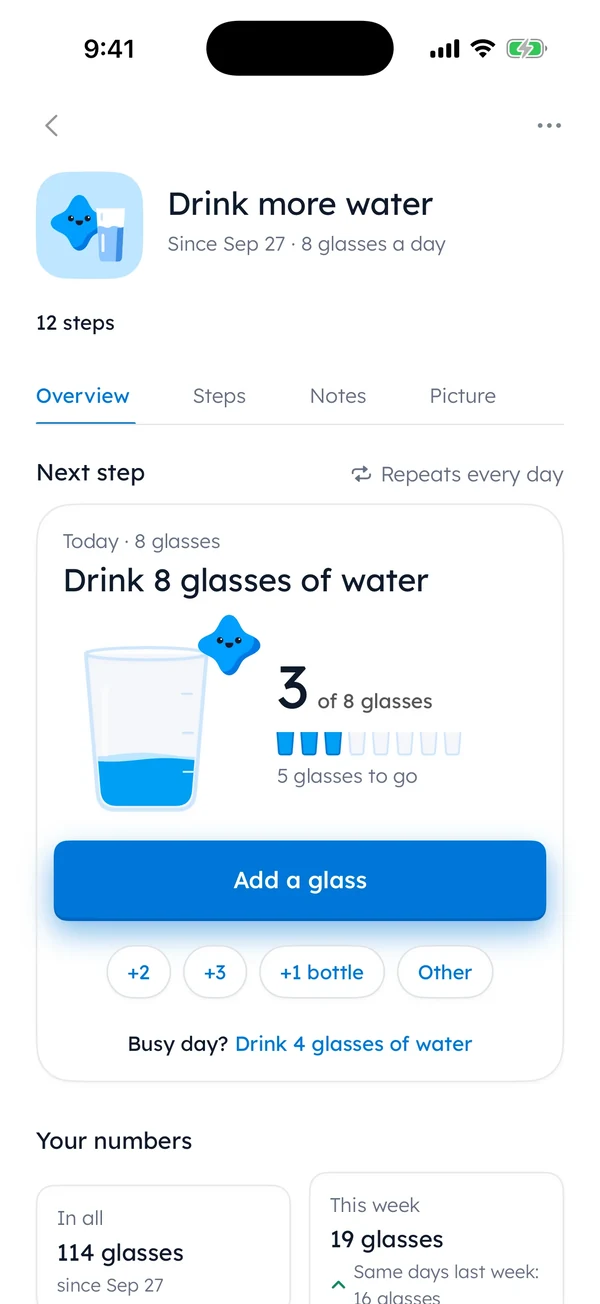
You can start from the 26 ready goals or make your own. The goal screen puts today’s step above a Mark done button, with the busy-day version right under it.
On the reading goal, that line says “Busy day? Read 2 pages.” The busy-day step counts in full, and reminders stay off until you turn them on.
After a step, you can write one line about how it went. Lines like that are how a goal journal starts.
It’s much easier to write about something you did ten minutes ago than about a whole year.
On paper, the trick works the same way: tick the step on the sticky note, then write one line on the back.
Big goal, small step, six examples
Here’s the whole method in one table. Read across a row and watch a big goal turn into something you could start before bed.
The first five rows use the starting and busy-day steps from goals in our app. The last row is a goal you’d make yourself.
| Big goal | Shrunk goal | Today’s step | Busy-day step |
|---|---|---|---|
| Read more | Read most days | “Read 10 pages” | “Read 2 pages” |
| Get fit | Walk every day | “Walk for 20 minutes” | “Walk for 5 minutes” |
| Drink more water | 8 glasses a day | “Drink 8 glasses” | “Drink 4 glasses” |
| Save money | Save $10 a week | “Put aside $10 this week” | “Put aside $1” |
| Learn Spanish | Practise 10 minutes a day | “Practise for 10 minutes” | “Practise for 2 minutes” |
| Write a book | Write 15 minutes a day | “Write for 15 minutes” | “Write for 5 minutes” |
Look at the last column. It turns a bad day from “missed” into “small”.
Two pages is still reading.
And look at the second row. “Get fit” became “walk every day”, which you can do in shoes that are currently holding a door open.
Write the busy-day step before the busy day.
The same shrink works for daily goals of any kind, from a 10-minute tidy to a short hello to a friend twice a week.
How to set goals for yourself, not for a feed
Plenty of goals arrive from outside. A friend’s race photos, a list of what successful people do before 6 am, a coworker’s new hobby.
They’re fine as ideas. As goals, they’re hard to keep, because the reason belongs to someone else.
One question sorts them: would you still want it if nobody ever saw it?
| If the goal came from… | Ask yourself… |
|---|---|
| A photo someone posted | “Would I do this with no photo?” |
| A list of what others do | “Which one would I miss?” |
| A New Year feeling | “What would a normal Tuesday look like?” |
| Something you used to love | “What’s the smallest way back in?” |
| A big birthday coming up | “What’s one step I can do today?” |
If the answer is a shrug, pick a different row of the first table.
The goals that last often sound a bit dull out loud. Nobody posts “read 10 pages”. Dull is fine. Dull repeats.
Your goal tonight
A goal doesn’t need January. Any evening works, including this one.
Then leave it there. Tomorrow’s job is the step, not a new plan.
And the running shoes by the kitchen door can take the night off. Tomorrow, five minutes.
Questions people ask
What are the steps of goal setting?
Pick one goal. Write it as a daily step with a number in it. Add a smaller busy-day step that still counts. Decide when and where you’ll do it, tied to something you already do. Then put it somewhere you’ll see it every day.
How do I set my own goals?
Start with what you’d be glad to have kept a few months from now, not what looks good to others. Ask whether you’d still want it if nobody ever saw it. Then shrink it to a step you could do today.
How many goals should I set at once?
Start with one. One goal with a clear daily step is easier to fit into a busy week than five. When the first step feels routine, after a few weeks, you can add a second goal.
Should goals be daily or yearly?
Both, for different jobs. A yearly goal gives you the direction, like reading more books. A daily step is what you actually do, like 10 pages after dinner. Write the yearly one once, and the daily one where you’ll see it.
Sources
TopicSmall goals

You earned the Shoes Back On badge
You read the whole guide. Now write one goal and its busy-day step.
0 XP

Yumemira is an iPhone app (iOS 18 or later).
See the 26 goalsYumemira is free to start. iPhone, iOS 18 or later.