
Goal ideas
Areas of life for goal setting: an 8-area worksheet to pick one goal

The short answer
A practical set of eight areas of life for goal setting is body, calm mind, learning, work, money, people, home, and fun and making. Score each from 1 to 5 in about two minutes. Then pick one area, give it one goal and a first step you can do today. The other seven can wait their turn.
In 30 seconds
- Score eight areas from 1 to 5, in whole numbers, in two minutes.
- Circle one low score. Give it a goal and today’s first step.
- Leave the other seven on the paper for now.
A life-areas worksheet takes two minutes to fill in. Then it hands you eight things to fix. Eight. At once.
So this one ends differently: score all eight, then pick one, with one first step for today.
Fair warning: we make an iPhone app that holds one goal like this (who we are). A pencil does the job too.

Reading XP0 XP
The 8 areas of life for goal setting
Lists of life areas change from site to site, in names and in number.
Most of them circle the same ground, though: health, career, finances, relationships, growth, spirituality, recreation and the place you live.
We use plainer names.
And if you’ve seen the longer lists, here’s how they line up:
| Our area | What goes in it | Other lists call it |
|---|---|---|
| Body | Walking, stretching, water, bedtime | Health, fitness |
| Calm mind | Breathers and time off the phone | Mindset, spirituality |
| Learning | Reading or that course from March | Growth, education |
| Work | Study and the project that keeps slipping | Career |
| Money | Saving, spending less on small things | Finances |
| People | Family, friends, the text you owe someone | Relationships, social |
| Home | Tidying and the drawer that won’t close | Environment |
| Fun and making | Drawing, music, writing for yourself | Recreation, hobbies, creativity |
Rename any row that doesn’t fit. Faith, a garden, a side business: if you care about it, it can have a line.
Need ready ideas for each area? There’s a longer list of examples of goals, each with a first step.
Score each area in two minutes
Give each area a number from 1 to 5, where 1 means it gets almost no time from you right now and 5 means it can be left alone for a while.
Whole numbers only.
No 3.5. The pencil will want one anyway.
Score this week.
How things are right now, before any plans or promises.
First number wins.
If you argue with it for more than a few seconds, the first one wins.
Skip the total.
Nobody needs an average. The scores are only there to point at a row.
Picture the Home row. It might score a 2 because of the coat hook by the door, which has somehow ended up holding four coats and an umbrella that isn’t even yours.
Fine. Write the 2.
A low score only marks where to look first.
It’s a pointer for this week and nothing more, and by next month half the numbers on the page will probably have shifted on their own anyway.
Life areas for goal setting, as a worksheet
Copy this onto paper. Or screenshot it and scribble on the screenshot, which counts.
Each first step is small on purpose: 2 to 10 minutes, doable between two other things you were going to do anyway.
| Area | Score 1-5 | One possible goal | First step today |
|---|---|---|---|
| Body | Your score | Walk 20 minutes a day | Walk for 5 minutes |
| Calm mind | Your score | Take 3 breathers a day | Take 1 breather |
| Learning | Your score | Read 10 pages a day | Read 2 pages |
| Work | Your score | Focus blocks on weekdays | Focus for 10 minutes |
| Money | Your score | Save $10 a week | Put aside $1 |
| People | Your score | Call family twice a week | Send a short hello |
| Home | Your score | Tidy 10 minutes a day | Tidy for 2 minutes |
| Fun and making | Your score | Draw 15 minutes a day | Draw for 5 minutes |
The goals are only examples. Does one of ours feel like somebody else’s life? Swap in your own goal, and keep the first step just as tiny.
Pick one area, one goal, one step
Now the hard part. It’s mostly leaving things alone.
Circle one row.
Pick a low score, usually the lowest, unless this month makes it impossible to move.
Choose its goal.
Take the one from the table or write your own in plain words.
Shrink it.
Cut it down until the first step fits in a few minutes. “Read 10 pages a day” becomes “read 2 pages tonight”.
Once there’s one goal, the rest is one step a day. So do one small thing, then write a line about it while it’s still fresh.
That’s also the shape our app is built on. In Yumemira, the small-steps goal journal for iPhone, each day shows one step for your goal.
You tap Mark done when it’s finished. Then tap Say how it went and answer one question: “How did it go?”
So paper works the same way: the step goes in the circled row, and a short line goes under it at night, even if the line is only four words long.
What if the scores don’t point anywhere?
Scores rarely come out neat. These are the common shapes, and where each one says to start.
| If your scores look like… | Start with | A first line it might get |
|---|---|---|
| All about the same | The one you’d enjoy most | “Drew a terrible cat for 5 minutes. Good cat.” |
| One 1, the rest fine | That 1 | “Sent my brother a short hello.” |
| Lots of 1s and 2s | The one with the smallest first step | “Cleared one coat off the hook. Progress.” |
| Lowest is stuck this month | The next-lowest you can move | “Work is what it is. Read 2 pages.” |
| All 4s and 5s | Nothing new, or one fun row | “Nothing new this month. Fair enough.” |
Leave the other seven rows on the paper. They’re not lost.
And if three areas still feel equally urgent? Give two of them a start date and park them.
The guide to too many goals does the same with a longer list.
Where each area lives in Yumemira
The app’s goal library groups these areas into five sections, plus a sixth for anything you name yourself.
Above them sit Make your own and a short Start here row. Our Work row lives under Learn and make, as Study or focus.
- Body: Drink water, Walk, Run, Work out, Stretch or yoga, and more
- Calm mind: Take breathers, Meditate, Gratitude, Less phone time, Go outside
- Learn and make: Read, Learn a language, Practise an instrument, Study or focus, Write, Draw or create
- Money: Save money, No-spend days, Save for a trip
- People and home: Call family or friends, Tidy up, Cook at home
- Your own: any goal you name yourself
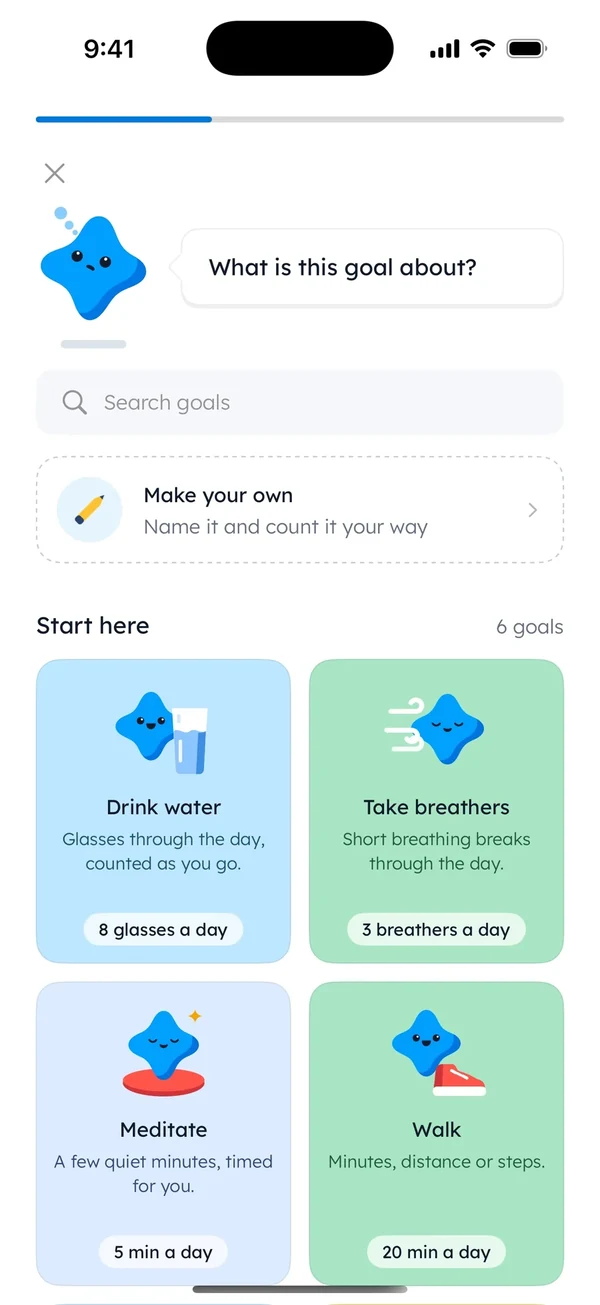
A few of the app’s goals, each counted its own way, are on our home page.
The free version holds one goal at a time, which sounds like a limit until you notice it’s exactly what this worksheet has been asking for since the first row.
Back on paper, the rule doesn’t change: one circled row and one step under it.
Is the circled area holding a big goal, like a language or a trip? Life goals examples shows how to cut it down to this week.
Circle one row tonight
The worksheet gave you eight numbers. You only need one of them.
Pick the row. Then pick a first step you can do from where you’re sitting: put aside $1, send a short hello, read 2 pages or tidy for 2 minutes.
But the other seven rows can wait.
That’s the whole job for now.
Questions people ask
What are the different areas of life to set goals in?
Lists differ from site to site. A practical set of eight is body, calm mind, learning, work, money, people, home, and fun and making. They match the usual health, career, finances and relationships headings, in plainer words.
Are there 10 or 12 areas of life?
There’s no fixed number. Some lists split health or work into several rows and reach 10 or 12. Eight is enough to score in two minutes, and you can add a row for anything that matters to you.
How many life areas should I set goals in?
Score all of them, then start with one. Add a second goal only once the first step happens without much thought. Eight goals at once leaves each one very little of your time.
Which area of life should I focus on first?
Start with a low-scoring area you can move this week. If the lowest one is stuck, like work during a busy month, take the next-lowest instead. A small step you’ll take beats a big one you won’t.
TopicGoal ideas

You earned the One Circle badge
You scored eight areas. Now circle one row and take its first step.
0 XP

Yumemira is an iPhone app (iOS 18 or later).
How Yumemira worksYumemira is free to start. iPhone, iOS 18 or later.