
Goal ideas
Personal SMART Goals Examples, With a Small Daily Step for Each

The short answer
Personal SMART goals examples work best when each goal comes with a step you can do today. “Finish 6 books by March 31” becomes 10 pages a day, at a time you already stop, like after dinner. Pick one goal below and keep its step that small for a week.
In 30 seconds
- SMART means specific, measurable, achievable, relevant and time-bound.
- Divide the total by the days left, then make it smaller.
- Write a busy-day step for every goal before the busy day comes.
- After a missed week, move the date and keep the step.
SMART goals started in a management magazine. In November 1981, George T. Doran wrote that the A should mean “Assignable”: specify who will do it.
At home, that meeting is short. It’s you.
We make an iPhone app for small daily steps, so we’re biased. A pen and a wall calendar work too.

Reading XP0 XP
What SMART means for a personal goal
A personal SMART goal says what and by when, in words you could check on a Sunday night.
Most versions you’ll find online use these five letters:
- Specific: one thing, named plainly.
- Measurable: a number you can count.
- Achievable: possible with the evenings you really have.
- Relevant: something you want for yourself.
- Time-bound: a date on the calendar.
For the wider list this sits inside, there are 100 examples of goals for every part of life, each with a first step.
Doran’s own list was a little different. We opened the 1981 article (opens in a new tab), and his R meant Realistic, “given available resources”.
He also wrote that a good objective doesn’t need all five. So if your goal has a number and a date but no grand plan, it’s in good company.
But the line that matters most for a personal goal sits near the end of his page.
“It is the combination of the objective and its action plan that is really important.”
He was writing for managers, so his action plans came with budgets and work hours.
At home, the action plan can be ten pages after dinner, on the couch while the dishes wait in the sink and the phone charges in another room.
It’s a plan all the same.
A goal with a date still needs tonight’s step.
Personal SMART goals examples with a daily step
Here are eight goals from ordinary life. Each has a normal-day step and a smaller one for full days.
| SMART goal | Daily step | Busy-day step |
|---|---|---|
| “Finish 6 books of about 300 pages by March 31” | “Read 10 pages after dinner” | “Read 2 pages” |
| “Save $500 for a laptop by March 31” | “Put aside $20 every Sunday” | “Put aside $1” |
| “Learn 300 new Spanish words in 60 days” | “Learn 5 new words on the bus” | “Learn 1 word” |
| “Walk 600 minutes in November” | “Walk for 20 minutes” | “Walk for 5 minutes” |
| “Call family or a friend 8 times by November 30” | “Call someone on Tuesday and Friday” | “Send a short hello” |
| “Clear out the spare room by December 15” | “Tidy it for 10 minutes” | “Tidy for 2 minutes” |
| “Write 10,000 words of a story by January 31” | “Write 100 words before bed” | “Write one sentence” |
| “Phone in another room 30 minutes each evening, 4 weeks” | “Leave it in the hall for 30 minutes” | “Leave it there for 10 minutes” |
The math in each row is plain division. Six books of 300 pages is 1,800 pages, and early October to the end of March is about 175 days.
So it comes to about 10 pages a day.
That’s the whole trick, and it works for dollars and minutes too.
The busy-day column is the one that gets skipped. And it’s the column that saves a goal in the week your washing machine picks the night before a big deadline to leak across the kitchen floor.
It’s easier on a calm day.
Write the busy-day step before you need it.
If you’d like goals you can count with no date on them, there are growth goals with a number too.
Tracking a SMART goal one step at a time
A dated goal needs two things each day: the step itself, and some way to watch the total move, whether that’s a pencil mark on a calendar or a number on a screen.
A notebook does both. One column for the date and one for the number.
Most of the lines worth keeping are about something you did, so our app starts there.
In Yumemira, the small-steps journal for iPhone, a money goal can have a total to reach, and a date if you like. Each amount goes in with a quick button, and the screen shows what’s left.
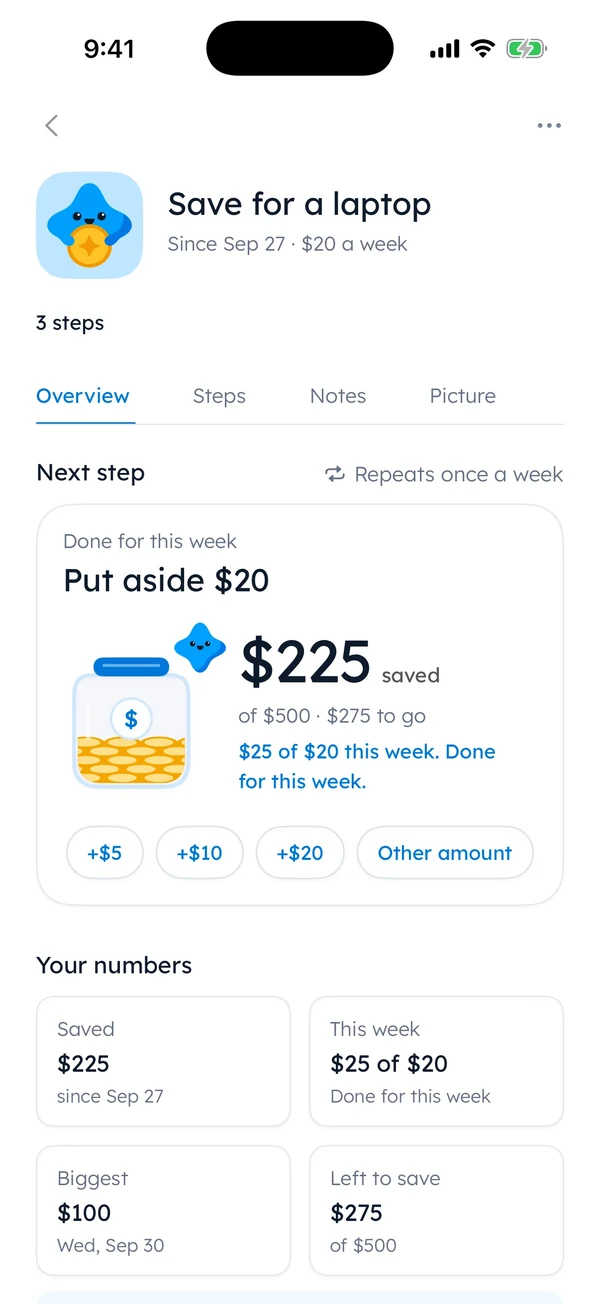
Reading works the same way, in pages, chapters, minutes or books. On a full day, the goal screen offers Busy day? Read 2 pages, and that smaller step counts in full.
After you tap Mark done, Mira, the app’s star, cheers “Nice. That counts.”
Then Say how it went opens one question, “How did it go?”, for a single line.
It’s hard to have nothing to say about something you did four minutes ago. “Read 10 pages. The detective finally found the boat.”
On paper, the same line goes next to the number in your column. Either way, you end up with the goal’s numbers and a few words about each day of it.
12 more SMART goals to set for yourself
These follow the same pattern, with the busy-day step at the end of each. Swap the numbers for ones that fit your real week.
Learning and making
- Learn one full song on the guitar in 6 weeks. Daily step: practise 15 minutes. Busy day: practise 5 minutes.
- Finish a free online course of 12 lessons by December 15. Daily step: 20 minutes of the course. Busy day: watch 5 minutes.
- Fill a 60-page sketchbook by the end of January. Daily step: draw one page. Busy day: draw one spoon.
- Cook 8 recipes you’ve never made by December 31. Weekly step: one new recipe on Saturday. Busy week: read the next recipe once.
Money and home
- Save $300 for a trip by February 28. Weekly step: put $15 in the trip fund. Busy week: put in $1.
- Keep 3 no-spend days a week for 8 weeks. Daily step: skip one small buy. Busy day: write down what you nearly bought.
- Cook dinner at home 4 nights a week through November. Daily step: cook a simple dinner. Busy day: make a simple snack at home.
- Empty one kitchen drawer a week until all 6 are done. Daily step: sort it for 10 minutes. Busy day: throw out 2 things.
People and time outside
- Write 10 thank-you notes by the end of the year. Weekly step: one note on Sunday. Busy week: one line in a text.
- Go outside for 20 minutes every day for 30 days. Daily step: 20 minutes in daylight. Busy day: 5 minutes at the door.
- Write down 3 good things a day for 30 days. Daily step: 3 lines before bed. Busy day: 1 line.
- Be up by 6:30 am on weekdays for 4 weeks. Daily step: get up when the alarm rings. Busy day: set the alarm before 10 pm.
That’s 20 in all. A list like this is a menu, and nobody walks into a restaurant and orders every dish from the soup to the second dessert just because it’s printed there.
The right one is the one you’d still want on a wet Thursday.
If more than one is calling, our post on having too many goals is worth a look before you start three at once. In Yumemira, Free gives you one goal at a time, which suits this list fine.
How to fix a SMART goal that feels too big
As far as we can tell, a stuck goal is often missing one letter. Find it, and change that letter only.
| If your goal sounds like… | Try something like… |
|---|---|
| “Read more” | “Read 10 pages a day until March 31” |
| “Get my life together” | “Clear the kitchen table by Sunday” |
| “Run a marathon next month” | “Walk or jog 20 minutes, 3 times a week, until December” |
| “Save money” | “Save $300 by February 28” |
| “Call Mom more” | “Call Mom every Sunday in November” |
The first one needed a number and a date. And the second needed one specific thing you can see.
The marathon in a month fails Doran’s realistic test. So it’s fair to give it a later date or a smaller first rung, and it’s still the same goal.
To be fair to “Get my life together”, it’s a real feeling, and nobody can tick it off on a Sunday night, but a clear kitchen table is the part you can photograph.
After a missed week, move the date. Keep the step.
For the part between “I want this” and a goal with a date, there’s our guide on how to set goals. And if even the busy-day step feels heavy, small goals go smaller still.
Set one tonight
Tonight’s job is small: one goal from the table, or the one you’ve carried since January, with a date on it. Then the calendar divide gives you the step.
Tomorrow, write one line about how it went. “Read 10 pages. Fell asleep on page 9.” is a fine line.
Doran asked who will do it. You, after dinner, ten pages in.
Questions people ask
What is an example of a personal SMART goal?
“Finish 6 books of about 300 pages by March 31” is one. It names the thing, gives a number and sets a date. The daily step is about 10 pages, and a busy-day step of 2 pages keeps it going on full days.
What do the 5 letters of SMART stand for?
Today they usually mean specific, measurable, achievable, relevant and time-bound. In George T. Doran’s original 1981 article, A stood for assignable and R for realistic, and he wrote that an objective doesn’t need all five.
How do you write a SMART goal for yourself?
Name one thing you want, add a number you can count and pick a date. Then divide the total by the days left to get a daily step, and write a smaller step for busy days before you need it.
What is a SMART goal for personal development?
It’s a skill or habit you want more of, with a count and a date. For example, learn 300 new words in 60 days, or practise an instrument 15 minutes a day for 6 weeks.
Do SMART goals work for personal life?
They can, if each goal also has a daily step. A date and a number tell you where you’re going. The small step for today, and a smaller one for busy days, is what you actually do each evening.
Sources
TopicGoal ideas

You earned the Goal With a Date badge
You read all 20. Now give one goal a date and a step for tonight.
0 XP

Yumemira is an iPhone app (iOS 18 or later).
See the 26 goalsYumemira is free to start. iPhone, iOS 18 or later.