
Keep journaling
Why do people journal? What they say they get from it

The short answer
Is journaling worth it? It is when your journal gives you one of five plain things: a record, small memories, patterns, a private place to think, or a log of progress. None needs long entries. One line at a time you already stop, like plugging in your phone, feeds all five. Keep it that small for a week.
In 30 seconds
- People journal for a record, memories, patterns, privacy and progress.
- Two of those pay off the night you write.
- Test yours: read back 30 lines and mark the keepers.
- Stopping after an honest test is a fair result.
Say you’ve kept a journal for 200 days and reread it twice. Was that a waste of 200 evenings?
Probably not. And below are the reasons people give, and a ten-minute way to check what yours is giving you.
We make a small-steps journal for iPhone, so we’re not neutral here. A pen works just as well.

Reading XP0 XP
Why do people journal? Five reasons that keep coming up
Ask people why they keep a journal and the same five answers tend to come back. We haven’t counted them, so the order isn’t a ranking.
| What people say they get | What it asks of you | A line that feeds it |
|---|---|---|
| A record of what happened | A date and one fact | “Paid the gas bill. Fixed the shelf, badly.” |
| Small memories they’d have lost | One detail nobody else noticed | “Grandma called just to read out the cricket score.” |
| Patterns they only spot later | The same small thing, many nights | “Bus late again. Third Thursday in a row.” |
| A private place to think | A page nobody else reads | “Annoyed about the meeting. Not saying it out loud.” |
| Progress on something they’re trying | One small step, then one line | “Read 10 pages. Chapter 3 finally made sense.” |
Look at the middle column. Every reason runs on one line a night, which is good news if your evenings are already full.
If you’re still working out how to keep any of this going, the pillar on how to journal every day covers the habit side.
A record, and the small memories in it
The oldest reason is the plainest: write it down before it’s gone. Dates, facts, who said what.
In 1803, Thomas Jefferson drafted instructions for Meriwether Lewis, including how to keep the expedition’s notes.
“To be entered distinctly & intelligibly for others, as well as yourself”
He also wanted several copies, with one on birch bark, since it handled damp better than common paper (Library of Congress (opens in a new tab)).
That was an expedition log for a government, not a diary about feelings. Still, the first reason is the same: a record that outlasts memory.
Your backup plan can be less leafy. A photo of each full page will do.
Write the date and one fact before anything else.
The small days
Weddings, moves and first jobs get photos, and people who retell them for years. The small days get nothing.
Say the rice cooker broke on a Tuesday, and the shop that gave you the wrong change ran after you down the street to fix it.
By spring, that’s gone.
One small detail is what a journal keeps and a camera roll often doesn’t. A photo shows the shop. The line remembers who ran after you.
If your days feel too ordinary for this, they’re the right size for it. There’s more in journaling when life is boring.
Patterns you only spot later
One line about the bus is just a line about the bus. Thirty lines about the bus are a pattern.
This is the reason that needs a reread to pay off.
Picture your last month of lines on one phone screen. The good Saturdays all start at the market, the bus is late on Thursdays, and calling your cousin “this weekend” has been the plan for six weekends.
A pattern needs the same small question, asked many nights.
So keep the question boring. “What took longest today?” asked for a month tells you more than thirty clever questions.
- Thirty one-line entries fit on one phone screen.
- Thirty full pages fill a notebook and an afternoon.
That’s the plain case for a one line a day journal if patterns are your reason.
A private place to think it through
Some people say the point is the page itself: a place to say it without anyone answering back.
Anne Frank wrote that she wanted “to correspond with someone”, and invented friends to write to. Kitty became her favorite, according to the Anne Frank House (opens in a new tab).
Her diary was written in hiding, and her life can’t be compared to an ordinary week. We mention it only for the reason she gave: someone to write to.
This reason pays off the night you write. You don’t need to reread a single line for it to have done its job.
Proof that you did the thing
The fifth reason is the most practical. People trying something, like reading more or saving a little each week, use a journal as a log of small steps.
Most of the lines worth keeping are about something you did, so our app starts there. In Yumemira, the small-steps journal for iPhone, you pick a goal and get one small step a day.
Say, 10 pages. Or 2 on a busy day.
When you finish, Mira, the app’s star, cheers “Nice. That counts.” Then Say how it went asks “How did it go?”, and your answer is the line.
On paper, it’s the same move minus the star. A tick, then a line. After a few weeks, the ticks become a way to track your progress you can flip through.
Is journaling worth it if you never reread it?
Partly, yes. Two of the five reasons pay out the night you write: the private place and progress.
The other three wait for a reread. So the 200 days still did something. But most of the record is sitting there, unread, like a library book under the bed.
Reread once a month, for ten minutes, then stop.
It doesn’t need to be an event. A cup of tea and last month’s pages, on a night when the TV has nothing good on, does the job.
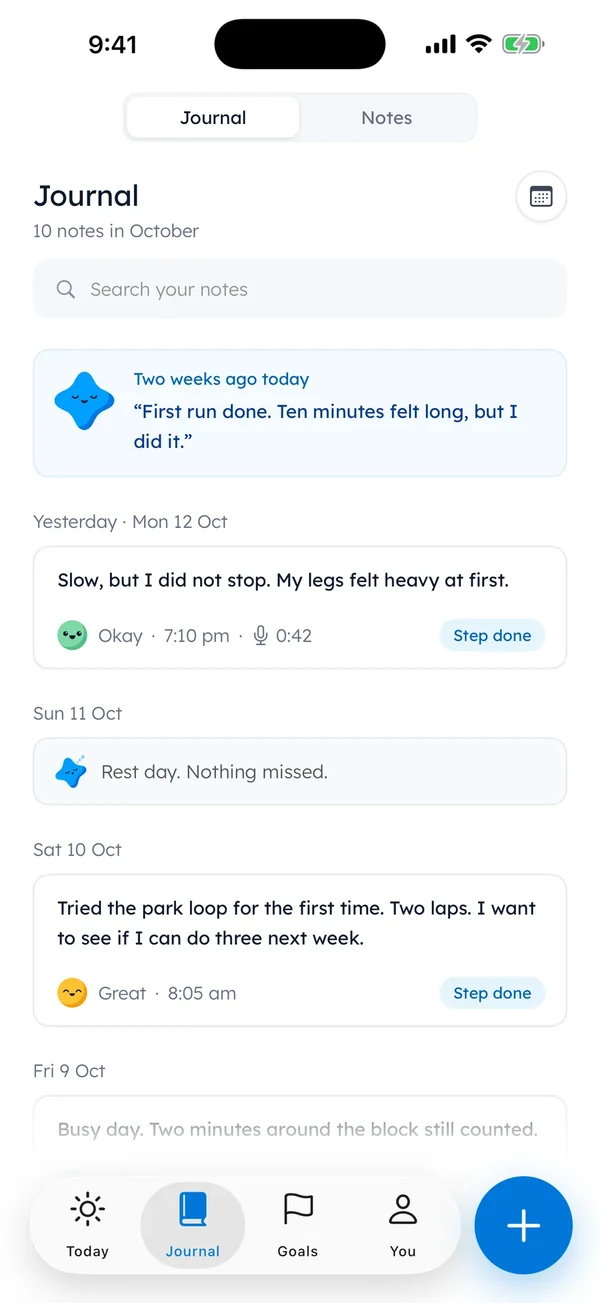
In the Yumemira journal, the Journal tab does some rereading for you. A card shows an old line, labelled Two weeks ago today, a month ago or a year ago.
And the search bar finds the day the shelf fell down.
How to check if journaling is worth it for you
Opinions, including this page’s, only go so far. Your own pages can answer the question in about ten minutes.
Read back 30 lines.
Start from tonight and go backwards. Or the last month, whichever is shorter. No editing allowed.
Mark the keepers.
Put a dot next to every line you’re glad exists.
Name the reason.
For each dot, pick a row from the first table: record, memory, pattern, private place or progress.
Look for one repeat.
Anything that shows up three times or more is your first pattern.
Then hold what you found up against this sheet.
| If the reread showed… | Try a line like… |
|---|---|
| Mostly facts, few details | “Fixed the shelf. Used the wrong screws, again.” |
| Lots of venting, nothing else | “Annoyed at work. Good lunch though.” |
| Skipped nights where nothing happened | “Nothing happened today, except the bus came early.” |
| One goal you kept mentioning | “Put a little in the jar. It’s a quarter full.” |
| Lines you already love | “Same as before: one fact, one detail.” |
Three dots means the journal is doing something for you. Zero dots means change the question before you change anything else.
When stopping is a fair answer
Some people run the check, find nothing they’d miss, and stop. That’s a real result, and it was worth ten minutes to learn it.
A journal is a tool, like a shopping list or the good scissors that leave the kitchen drawer and somehow never come back. If it isn’t holding anything you want, shelve it.
That’s allowed.
If you come back in a year, skip the catching up. Getting back into journaling takes one line, on whatever night it happens to be.
Tonight, before the phone goes on its charger, write one line that nobody else would write down.
Line 201 can be about the bus.
Questions people ask
Is journaling worth it?
It is when it gives you something you’d miss: a record of what happened, small memories, patterns over time, a private place to think or a log of progress. One line a night feeds all five. Test it by rereading your last 30 lines.
Why do people journal every day?
Daily is easier to remember when the line is tied to something you already do, like charging the phone. Short daily lines also add up into patterns you can see on one screen, which long weekly entries rarely give you.
What’s the purpose of journaling if I never reread it?
Two reasons pay off as you write: a private place to put a thought, and a line about something you did. The other three, records, memories and patterns, pay off when you reread. Ten minutes once a month does it.
Is it normal to stop journaling?
Yes. A journal can stop for weeks and start again with one line. If you reread your pages and find nothing you’d miss, stopping is a fair choice. If you come back, write tonight’s line and skip the catching up.
Sources
TopicKeep journaling

You earned the Curious Reader badge
You read to the end. Tonight, write the line future you will be glad exists.
0 XP

Yumemira is an iPhone app (iOS 18 or later).
How Yumemira worksYumemira is free to start. iPhone, iOS 18 or later.