
One line a day
One line a day journal: paper five-year book or an app?

The short answer
A one line a day journal holds one sentence per day, usually in a book where each page is one date with room for five years. Write the line at a time you already stop, like setting tomorrow’s alarm. A paper book and a phone both work. Keep it that small for a week, then pick.
In 30 seconds
- One sentence per day is the whole format.
- The paper book stacks five years of one date on a page.
- A phone adds search and photos, and loses the stacked page.
- After a gap, write today’s line and leave the blanks.
- Pick whichever is closer to your hand at bedtime.
The paper version of this idea has been in shops since 2 September 2009, which is long enough for someone, somewhere, to have filled two books and started a third.
That’s a lot of Tuesdays.
We make an iPhone app with a one-line journal, so we’re on one side of the table below. But paper wins two of its rows.

Reading XP0 XP
What is a one line a day journal?
It’s a diary with a strict word limit: one sentence per day.
It’s the smallest kind of one sentence a day journaling, with a calendar attached. You get one line per date, and you don’t get a second.
The classic paper version is a five-year memory book. In Chronicle Books’ One Line a Day (opens in a new tab), each page is one calendar date with space for five successive years.
A single page takes five years to fill.
- Year one: write today’s line at the top.
- Year two: read last year’s line, then write yours under it.
- Year three: the page starts talking back.
- Year five: one date, five lines, one small history.
Say it’s 3 March and last year’s line on that page reads “Snow again, and the bus driver had a new hat that looked exactly like his old hat.” You’ll laugh.
That’s the whole appeal.
Write the small thing you’d forget by Friday.
You’ll also see it called a one line a day diary or a memory book. On a phone it’s the same habit with a face or a word for how the day felt.
What to write each day
Write one plain fact from today, the kind you won’t find in your photos or messages next year.
Weddings and moves get photographed. So the line is for the Wednesday when the new soap smelled like oranges and the rice came out perfect for once, because a week later that day is gone.
Here are twelve lines in the right size. Copy the shape and keep your own details.
On a good day
- “First cold mango of the year, eaten over the sink.”
- “Fixed the wobbly chair with a folded bus ticket.”
- “Long call with my sister. We laughed about the cake.”
- “Finished the library book two days before it was due.”
On an ordinary day
- “Rain. The umbrella opened on the second try.”
- “Tea, emails, more tea. The plant has a new leaf.”
- “Took the slower train and got a window seat.”
- “Laundry on the chair for the third day. It lives there now.”
On a hard day
- “Hard day.”
- “Long shift. Home late. Bed.”
- “Worried about the results. Waiting till Monday.”
- “Didn’t want to write. Wrote this.”
The hard-day lines are short on purpose. A word for how it felt does the job, and nobody’s grading this.
For more starting points, our guide on what to write in a journal has questions for any kind of night.
Paper book or phone?
Pick whichever is near you at bedtime. The table has the facts, and your nightstand has the answer.
| Paper five-year book | Phone journal (Yumemira) | |
|---|---|---|
| Cost | One book | Free to start; Pro is optional |
| Always with you | Only if it’s in your bag | Usually in your hand |
| Five years of one date on a page | Yes, the whole point | No, you look back by date |
| Skipped days | A blank line stays on the page | Nothing to fill in |
| Privacy | Wherever you keep the book | Stays on your iPhone; app lock is Pro |
| Photos and voice | No | Up to 6 photos, or say it aloud |
| Screen at bedtime | None | Yes, a bright one |
The paper book wins the two rows its fans care about. The same-date stack has no real match on a screen, and a book doesn’t light up your face at 11 pm.
The phone wins on nights the book is in another room. And a line comes easier when it’s about something you just did.
So Yumemira, the small-steps journal for iPhone, starts with one small step toward something you want, like 10 pages of a book. After the step, Mira cheers and a button says Say how it went.
You write one line and tap one of five faces, from Great to Hard.
Either way, the line is the same size. One true sentence, on today’s date, before the light goes off.
When the paper book is the better pick
Choose paper if the stacked page is the part you want. Last year’s line sits right above this year’s, with no tap.
It’s also a good pick if your phone already gets plenty of your evening. A book never sends a notification, and that’s part of its charm.
And it makes a kind gift, because a dated page asks for nothing but a pen.
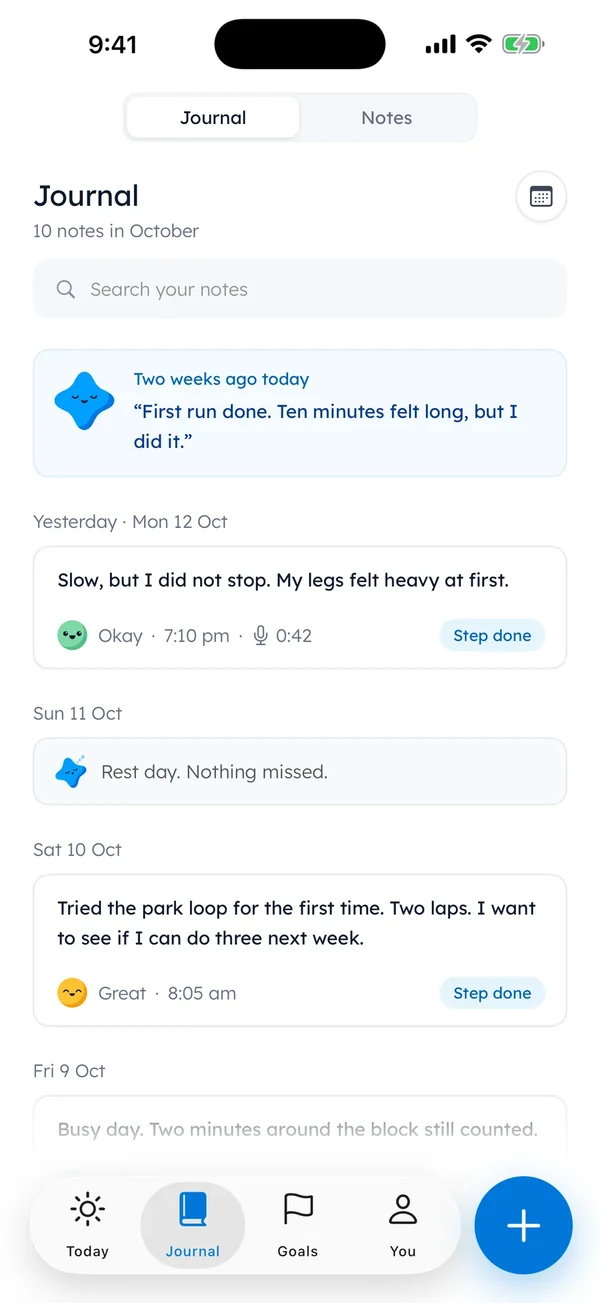
A phone fits better if you want photos with the line. Or if you’d rather say it out loud on the bus home.
It also wins when you need to find the evening the car broke down, three winters ago, and you’d rather type two words than turn 372 small pages one by one.
Fair enough.
In Yumemira, search and the month calendar are free, and the year view comes with Pro. There’s more on the phone side on our daily journal page.
If you skip a few days
Say the first week goes well. Then a cousin visits, work runs late twice, and the book ends up under a stack of mail you’re also avoiding.
You open it on a Sunday night, with the fan going and a cold cup of tea beside you, and find six blank lines in a row.
It happens.
You can fill the gaps from memory if you want to. But six guessed lines take longer than one true one, and tonight only needs the true one.
Today’s line is the only one due.
In a five-year book, a blank line even has an upside. Next year it sits right under the new one, and you’ll know exactly how that week went.
Other one-line formats worth knowing
The five-year book is one shape. But a few others suit a busy week better.
- A five year journal you print yourself, to try the format before you buy one.
- A journaling calendar, where each square on a wall calendar gets a few words.
- A small wins journal, where the line is something you finished.
- A paper vs digital journal setup, if you’re torn about screens in general.
The iPhone app page shows the step side of Yumemira.
As far as we can tell, the format matters less than the moment you pick. Tie the line to something you already do every night.
Start yours tonight
You don’t have to wait for the book to arrive, or for a fresh month. Today has a date, and that’s all the format asks for.
Next year, on this date, it’ll be waiting for you. Tonight’s line goes at the top of the page.
Questions people ask
What should I write in a one line a day journal?
Write one plain fact from today, something you’d forget within a week, like what you ate, who called or what broke. Add a word for how the day felt if you like. On a hard day, “Hard day.” is enough.
What is a one-sentence-a-day journal?
It’s a journal where each day gets one sentence and nothing more. Some people use a five-year book with one page per date. Others use a notebook or a phone. The size stays the same.
What happens if I skip a day?
Nothing bad. The line for that date stays blank, and you write today’s line on today’s date. You can fill a missed day from memory, but you don’t have to.
Can I keep a one-line journal on my phone?
Yes. A notes app works, and journal apps add things paper can’t, like search, photos or voice. You lose the page where five years of one date sit together, so pick the one you’ll actually open.
Sources
TopicOne line a day
You earned the Good Picker badge
You read the whole comparison. Now write tonight’s one line.
0 XP

Yumemira is an iPhone app (iOS 18 or later).
More about the daily journalYumemira is free to start. iPhone, iOS 18 or later.