
Five year journal
5 year journal: make your own with a free printable page

The short answer
A 5 year journal gives each date one page with five short lines, one per year. Today you write one sentence on this year’s line. On the same date next year, you write under it and read what you said. Do it at a time you already stop, and keep it that small for a week.
In 30 seconds
- One page per date, with one line for each of five years.
- Print the free page, or draw it in a few minutes.
- You can start on any date, not only January 1.
- Skipped days stay blank, and the page still works.
A five year journal gets interesting in year two. You write your October 9 line, glance up, and find last year’s October 9 complaining about the same coworker.
That small rerun is the appeal: micro journaling with a memory stacked on top.
We make an iPhone app for this, so we’re biased. Paper does all of it.

Reading XP0 XP
How a 5 year journal works
Each page is a date, not a day. The page for March 3 waits for five March 3rds in a row, one line each.
The format is older than most phones. Chronicle Books first published One Line a Day (opens in a new tab), a five-year memory book built on this layout, in 2009.
Find today’s date.
Turn to the page for the date, not to the next empty page.
Write on this year’s line.
One sentence, the way you’d text a friend. Add a face if you like.
Read the lines above.
In year one there are none. From year two on, read them after you write, so last year doesn’t choose today’s words.
Year one feels a bit like filling in a form for someone who isn’t there yet, with five neat rows on every page and only the top one holding any words.
But year two is where it pays off.
You’ll find the bus that was late on both mornings and the birthday you nearly forgot twice. And maybe that coworker again, still talking through lunch.
Write your line first, then read the lines above.
A free printable page to try it
Before you buy a book, try the format for a week on paper. One printed page per date is enough to find out if you like it.
Make the page on any lined sheet, or type it up and print a week of them. Top to bottom:
- The date at the top, written large, with no year: “October 9”
- Five rows under it, each starting with a blank year: “20__”
- About two lines of space per row, and no more
- A small square at the end of each row, for a face
So the short rows are on purpose. Two lines fit one real sentence, while a full page would turn a one-minute habit into an evening of homework with a deadline.
Short rows get written.
The year stays off the date at the top. The page belongs to every October 9, and each row adds its own year.
If 365 pages sounds like a lot of paper for a test, calendar journaling fits a whole month on one sheet.
5 year journal prompts for the first year
Year one has nothing above your line yet. A prompt helps you write lines that will be fun to find next year.
Use the prompt for the month, or skip it and write what happened. Both fill the row.
| Months | Prompt | Example line |
|---|---|---|
| Jan-Feb | What’s one small thing you’re starting? | “Walking after lunch.” |
| Mar-Apr | What did you notice outside today? | “First warm evening.” |
| May-Jun | Who made you laugh? | “Dad’s joke about the umbrella.” |
| Jul-Aug | What did you eat that you’ll remember? | “Mango on the steps.” |
| Sep-Oct | What are you worried about, in five words? | “The car. Rent. That email.” |
| Nov-Dec | What went better than you expected? | “The move.” |
Look at the September line. Five words is a full row here, and next September you get to read it again and find out how that whole list of worries turned out.
Starting in January? The new year journal prompts give the first page a little more to say.
Most of the lines worth finding next year are about something you did.
That’s where Yumemira, the small-steps journal for iPhone, starts. You take one small step toward a goal, then write a line about it and pick a face.
On paper, the same trick works: do one small thing, then write the row about it.
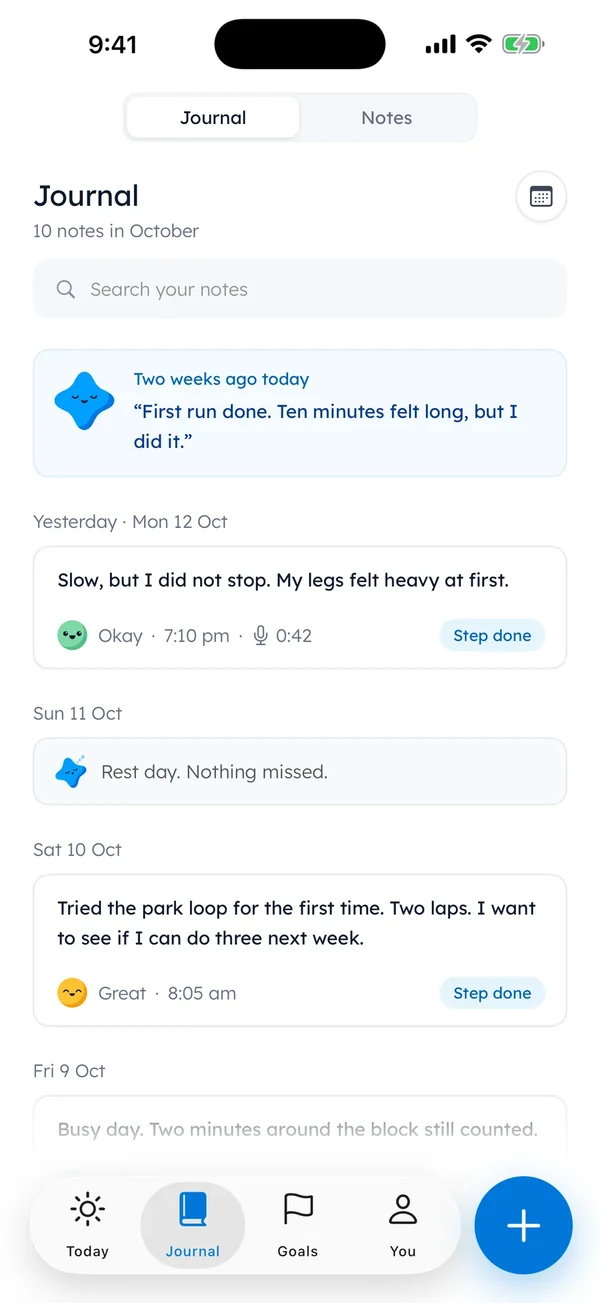
The app has a look-back of its own. In the Journal tab, the “Search your notes” box and the month calendar are free.
And if you wrote a note on today’s date in an earlier year, a card at the top shows it as A year ago today.
Which is the five year page, more or less, minus the hole punch.
If you skip days, weeks or a year
A skipped day in a five year journal is an empty row with a date on it. Nothing else happens.
Say March disappears into a move, and the binder sits under a pile of boxes until the middle of April, still open to a page from February. Next March, those rows are still waiting.
The gap is just a gap.
| If you missed… | Write something like… |
|---|---|
| A day | “Rain again. Found the umbrella.” |
| A week | “Busy week. Back on the right page.” |
| A whole month | “Moved in March. Starting again on April 3.” |
| Most of a year | “Year 2 starts here, on August 14.” |
| The January start | “Started in October. January can wait.” |
But it’s best not to fill in missed days from memory. A guess dated March 4 looks exactly like a real March 4 when you read it four years from now.
Future you can’t tell them apart.
Leave missed rows empty, and write today’s row.
Starting late works the same way. A binder that begins in October fills its January pages a few months later.
Book, printable or phone?
Each has something going for it:
- A bound book is lovely to hold.
- A printable lets you test the format for a few sheets.
- A phone keeps every line searchable.
The fair side-by-side lives in our one line a day journal guide. The bigger question gets its own page in paper vs digital journal.
Whichever you pick, page one is the same: today’s date and one line. You can keep that one going in a phone journal or on the back of an envelope.
Tonight, write today’s date at the top of any page and give this year its row.
Next October, see if the coworker shows up again.
Questions people ask
How does a five year journal work?
Each page is one date of the year, split into five short rows. You write one line in this year’s row. On the same date next year, you write in the next row and can read last year’s line above it.
What do you write in a five year journal?
One true sentence about today: something you did, saw, ate or worried about. Add a face or a word for how the day felt if you like. Short is the point, because five years need to fit on one page.
Can you start a five year journal any time of year?
Yes. Turn to today’s date and start there. Your first year ends on the day before your start date next year, and the pages you skipped at the front fill in as their dates come round.
What if I miss days in my five year journal?
Leave those rows empty and write today’s line. Don’t fill in missed days from memory. The empty rows don’t change the pages you’ve written, and next year those dates get a fresh row.
Sources
TopicOne line a day

You earned the Five Rows badge
You read the whole guide. Now give today’s date one line on any page.
0 XP

Yumemira is an iPhone app (iOS 18 or later).
More about the daily journalYumemira is free to start. iPhone, iOS 18 or later.