
Done lists
Try a done list: write what you did, not what you didn’t

The short answer
A done list is a short list of what you actually did today, written at a time you already stop, like plugging in your phone at night. Write three to five plain lines in the past tense, any size: “Paid the bill. Found the other sock.” Keep it that small for a week.
In 30 seconds
- It records what you did today, however small.
- Three to five past-tense lines are enough.
- Keep your to-do list too. They do different jobs.
- Once a week, read the lines back in five minutes.
Say your to-do list has 31 items and a coffee ring. By tonight you’ve done 6 of them, plus four things that were never on it.
Nobody wrote those down.
So the list only remembers the 25 you didn’t do. A second, shorter list fixes the bookkeeping, and it fits neatly beside micro journaling.

Reading XP0 XP
What is a done list?
It’s the other page of a to-do list. You write down what you finished today, after it happened, in short plain lines.
There’s no planning on it and no boxes to tick. Every line is already true.
Some people call it a small wins journal. The wins can be tiny: you replied to the message, or you found the charger cable that only works at one angle.
And you left it at that angle.
That was office teams, and it doesn’t promise anything about your notebook. But it’s a fair reason to write the progress down.
Done list vs to-do list
There’s no need to pick one. One list looks forward and the other looks back, so they can share a notebook, on facing pages if you like.
| To-do list | Done list | |
|---|---|---|
| What it shows | What’s still left | What you already did |
| How it looks at night | Long, with most boxes empty | Short, and every line finished |
| Example line | “Call the bank, fix the shelf” | “Called the bank. On hold 20 minutes.” |
| When to use it | Mornings, to plan the day | Evenings, to close the day |
Plan with one list. Close the day with the other.
The to-do list will always be longer. That’s its job.
Examples for three kinds of day
These three lists are made up, to show the shape. Yours will be odder.
A work day
- “Answered the email from Monday. Finally.”
- “Fixed the shared spreadsheet. Nobody noticed.”
- “Ate lunch away from the desk, for once.”
- “Left on time and caught the earlier bus.”
A day with kids
- “Two school runs, both on time.”
- “Packed three lunchboxes. One came back empty.”
- “Laundry washed. Not folded, but washed.”
- “Read the dinosaur book twice, with the voices.”
A flat day
- “Got up.”
- “Had rice and tea.”
- “Watered the plant.”
- “Replied to one message.”
The flat-day list matters most. On a day like that, four short lines are a full record.
How to keep one in two minutes
It takes about two minutes. If you already like lists, there are more shapes in these list journal ideas.
Pick a time you already stop.
Right after you plug in your phone, or when you take off your work shoes, whatever time that is.
Write what you did.
Short lines in the past tense. “Paid the electric bill” sits next to “Found the other sock.”
Count the small stuff.
Replies, dishes, one phone call. If you did it, it goes on.
Stop at three to five lines.
Nobody’s grading this. Close the notebook.
Any notebook works, and so does the back of an envelope.
So does a notes app, on nights when the notebook is in the other room and the bed has already won.
A line about today’s step works too
Most of what’s worth writing down is something you did.
That’s the idea behind Yumemira, the small-steps journal for iPhone, so we’re not neutral here. A pen works too.
In the app you pick something you want, like reading, and each day has one small step, such as 10 pages. When you tap Mark done, Mira cheers “Nice. That counts.”
Then a button says Say how it went.
Tap it and write one line. It lands in your journal with a Step done tag, and a week of those lines is a list of wins nobody had to plan.
Each line is about something you did a few minutes earlier, while the details are still fresh and the page that made you laugh is still warm under your thumb.
So the writing comes easy.
On paper, the same trick works with a pencil. Do one small thing first, then write the line.
The Sunday look-back
Once a week, read the lines back. Five minutes will do, and Sunday evening is an easy time to tie it to.
- Read the week’s lines in order, without fixing anything.
- Mark the one you’d tell a friend about.
- Write one line for the whole week: “Short lines, two good walks.”
Some of it will be news to you. By Wednesday, Monday’s small wins are usually gone, and that’s exactly why they went on the list.
And a few will make you smile.
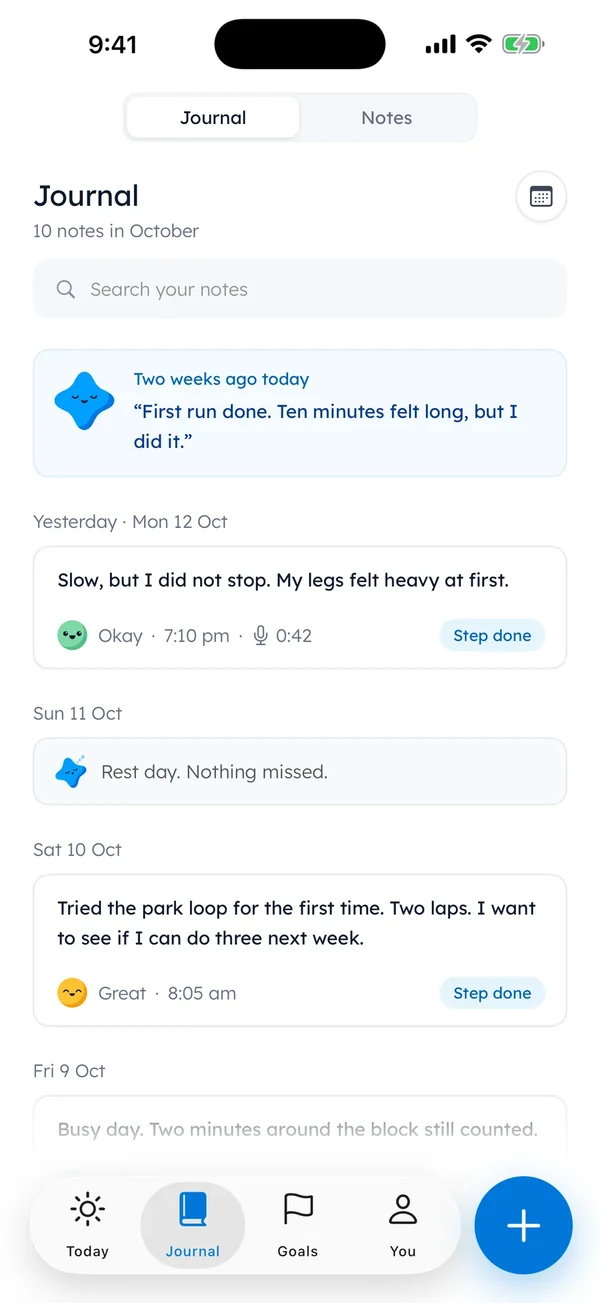
If the look-back turns into something you enjoy, it can grow into a weekly reflection with a question or two.
A phone journal you keep one line a day makes the rereading easier, since the lines are already in order.
When nothing happened
Some days the list looks empty at bedtime. Look again, smaller.
You ate something, answered someone, and got from the start of the day to the end of it, which on some days is the hardest item on any list.
On a slow day, write the smallest thing you did.
For the ordinary in-between days, there are more ideas in what to write when nothing happened.
Tonight, turn the to-do list over and write three things you did on the back.
The coffee ring can stay.
Questions people ask
What is a done list?
It’s a short list of things you finished today, written after they happened. It looks back at the day, while a to-do list looks ahead. Three to five plain lines are enough.
Is it better than a to-do list?
Neither is better, because they do different jobs. A to-do list helps you plan what’s next, and the other one shows what you already did. Keeping both works well: one for the morning, one for the night.
What counts as done?
Anything you did, however small. A sent message, a cooked meal, a short walk or a paid bill all go on the list. On a slow day, one small thing you did is enough.
How do I start a small wins journal?
Pick a time you already stop each evening, like plugging in your phone. Write three things you did today in the past tense. Do it for a week, then read the lines back on Sunday.
Sources
TopicOne line a day
You earned the Done List badge
You read to the end. Tonight, write three things you did today and stop.
0 XP

Yumemira is an iPhone app (iOS 18 or later).
How Yumemira worksYumemira is free to start. iPhone, iOS 18 or later.