
Quiet days
How to journal when your life is boring (and nothing happened)

The short answer
To journal when your life is boring, skip the summary and write one small, true detail from today, like a sound or the best ten minutes. Add one word or a face for how it felt. On days that feel completely empty, do one small thing first, then write a line about that.
In 30 seconds
- A quiet day still has one detail you can write down.
- Pick one sense and write what it caught.
- Do one small thing, then write about it.
- Plain lines about ordinary days are the ones that come back later.
Say your day went like this: work, dinner, the same podcast as yesterday, bed.
You open the journal and the pen just hovers. Writing it down feels like filing a report on a parking space.
We make an iPhone app built around small steps, so we’re biased here. A notebook and a cheap pen work just as well.

Reading XP0 XP
How to journal when your life is boring
“Nothing happened” usually means nothing big happened. Plenty of small things did, but they weren’t loud enough to remember at 10 pm.
So the job changes. You go looking for one piece of the day, the way you’d pick one photo out of a full camera roll and leave the other 200 where they are.
A few pieces that turn up on almost any day:
- The first sip of something hot
- A song that stayed in your head
- Somebody else’s dog
- The last thing that made you laugh, even a little
A quiet day still has one detail worth writing.
It’s the same idea behind how to start journaling with one line a day.
And it works best on the days you’d swear had nothing in them, the ones that ran from alarm to toothbrush without a single thing you’d tell a friend about.
Nobody’s grading this.
Journal ideas for boring days
Boring days come in a few flavours. Each one has a spot where a line usually hides, so you can look in one place.
| The kind of day | A line it might give you |
|---|---|
| The same commute (look out the window) | “Someone on the platform was reading a cookbook. Now I’m hungry.” |
| Work and nothing else (the best ten minutes) | “Best ten minutes: tea after the 3 o’clock meeting got cancelled.” |
| Stayed home (what you ate, who you talked to) | “Noodles twice. Talked to the courier about the rain.” |
| Rain all day (a sound or a smell) | “Rain on the window all afternoon. The towels still won’t dry.” |
| Too tired to think (the small thing you did anyway) | “Washed the lunchbox before bed. That’s all.” |
None of those lines would surprise anybody. That’s fine.
The point is to have a line at all, written in the same plain words you’d use to tell someone at the door that the towels are still wet.
The one-detail method
When the table doesn’t fit your day, use this. It takes about a minute.
You can do all of it lying down, lamp off, phone held a little too close to your face.
Pick one sense.
Sight, sound, smell, taste or touch. Take the first one that comes to mind.
Find one moment.
Think back to when that sense noticed anything at all, at the sink or in the lunch queue.
Write it plainly.
One line, the way you’d say it to a friend on the phone.
Add the feeling.
One word or a face: great, okay, so-so, worried or hard.
The sense does the choosing for you. That’s handy on a tired night, because choosing is the slow part.
But you don’t have to like the sense you picked.
Pick one sense and write what it caught.
Do one small thing, then write about it
Some days give you nothing to notice because nothing new got done. That one is easy to fix, and the fix is small: do one small thing first, then write a line about it.
It can happen in one room:
- Water the plant on the windowsill
- Read two pages of the book on your nightstand
- Reply to the message you’ve left on “seen” since Sunday
- Put the clean laundry away, or at least the socks
Then the line has a subject.
Do something small first. Then write about it.
Yumemira, the small-steps journal for iPhone, is built around that idea.
You pick something you want, like running your first 5K, and the Today screen gives you one small step a day: 10 minutes of running, or 2 on a busy day.
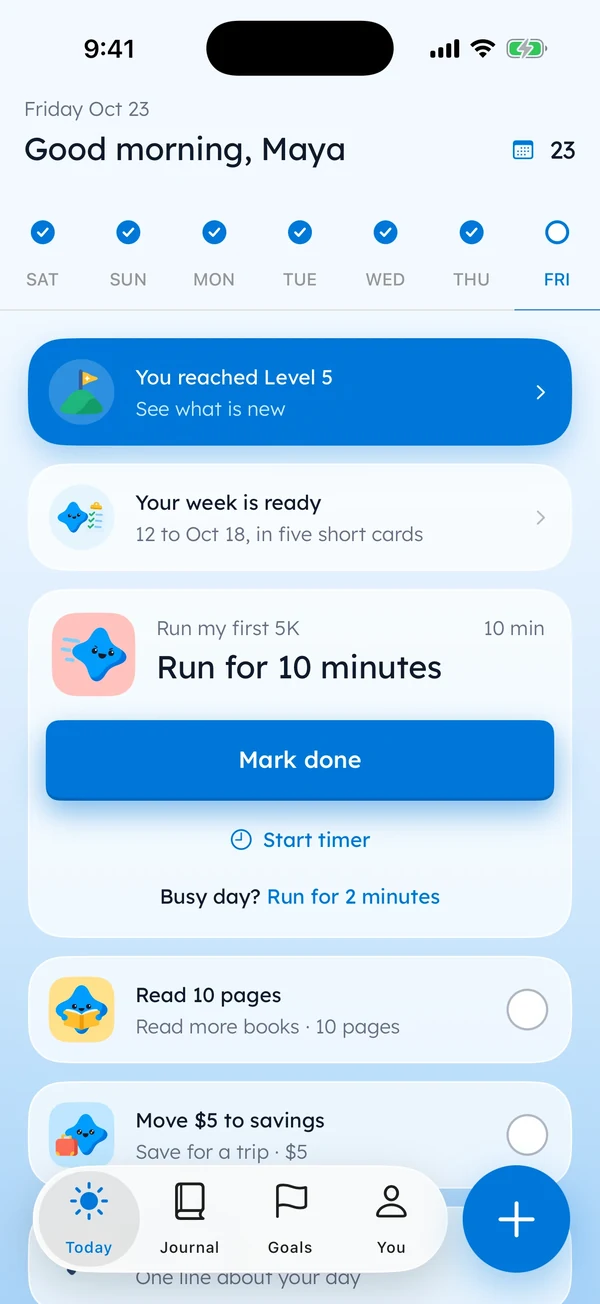
When you tap Mark done, Mira cheers. Then Say how it went asks “How did it go?” while the answer is still fresh.
It’s hard to have nothing to say about something you finished four minutes ago.
On paper it works the same way, minus the cheering star. So a notebook by the bed and a plant that needs water will get you there too.
When boring turns into flat
Some days feel heavy as well as quiet. Hunting for a fun detail feels wrong on those days, and you don’t have to.
On days like that, micro journaling is the right size: one sentence and nothing more.
If you’d like a question to lean on, the list in what to write in a journal has gentle ones.
In the app, a new entry opens with a question from Mira. Another question swaps it, or Write without one leaves a blank page for your two words.
It’s a journal with a question waiting, and you can skip the question.
What boring entries look like a year later
Here’s the odd part. The lines that feel too dull to write may be the ones you enjoy finding again.
In 2014, Harvard Business School researchers led by Ting Zhang had volunteers fill a small time capsule (opens in a new tab) of everyday notes at the start of summer.
When they opened it at the end of summer, they were more curious than they’d predicted.
It does match what a journal feels like when you scroll back. The big days stay with you anyway.
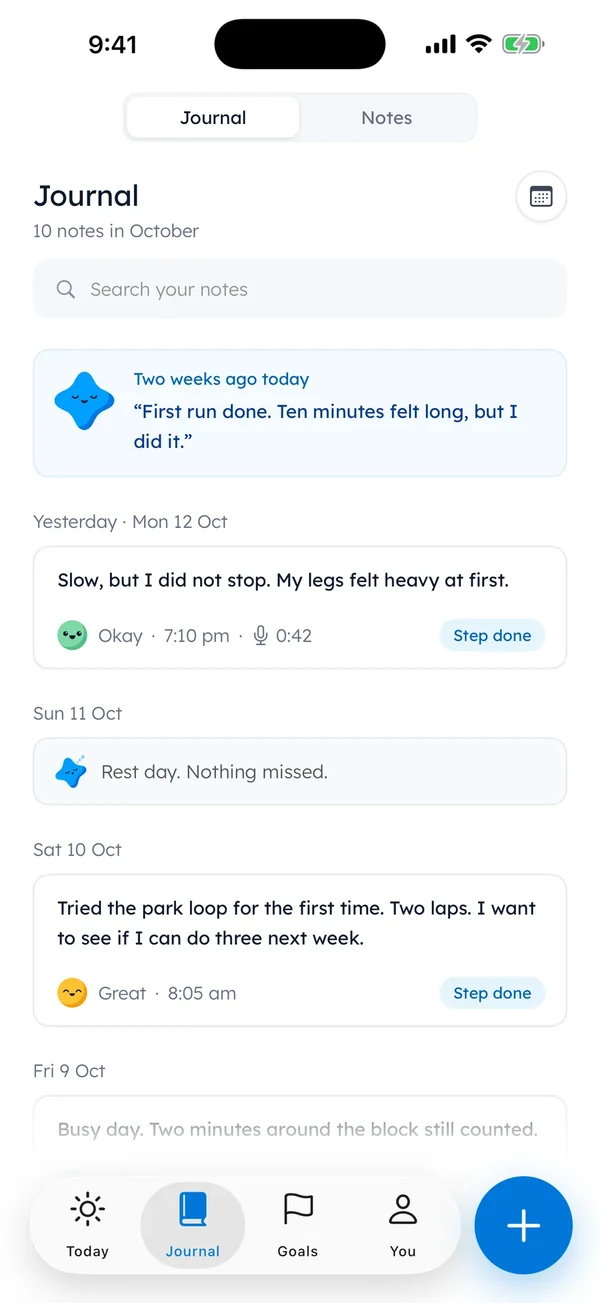
The noodles and the cookbook on the platform don’t, unless somebody wrote them down on the night they happened, half asleep and slightly annoyed about the towels.
Write it now. Let next year decide if it mattered.
If you’d like to see how short entries can look side by side, these journal entry examples go from one sentence to a full page.
Tonight, before the phone goes on its charger, write one line about the parking space. Worst case, it was empty, and now you know.
Questions people ask
What should I write in my journal if nothing happened?
Write one small detail from the day, like something you heard or saw on the way home. Then add one word for how the day felt. “Rain on the window all afternoon. So-so.” is a complete entry.
How do I journal if my life is boring?
Pick one sense, think back to one moment when it noticed something, and write that in one plain line. On days that feel empty, do one small thing first, like reading two pages, and write about that.
Is it worth journaling ordinary days?
Yes, if you enjoy reading them back. Ordinary days are most of any year, and they’re the ones you forget first. A big day stays in memory without help, while a plain Wednesday usually needs one written line.
What are journal ideas for boring days?
Try the best ten minutes of the day, or what you ate and who you talked to. One sound or smell works too, and so does a small job you did while tired.
Sources
TopicStart journaling

You earned the Small Detail badge
You read the whole guide. Now write one small, true detail about today.
0 XP

Yumemira is an iPhone app (iOS 18 or later).
More about the daily journalYumemira is free to start. iPhone, iOS 18 or later.