
Seeing your progress
How to track your progress when it feels invisible
The short answer
To track your progress when it feels invisible, count what you do each day: pages read, minutes practiced, days you showed up. Write the number and one line about it at a time you already stop, like brushing your teeth. Once a week, compare with last week. Keep it that small for a week.
In 30 seconds
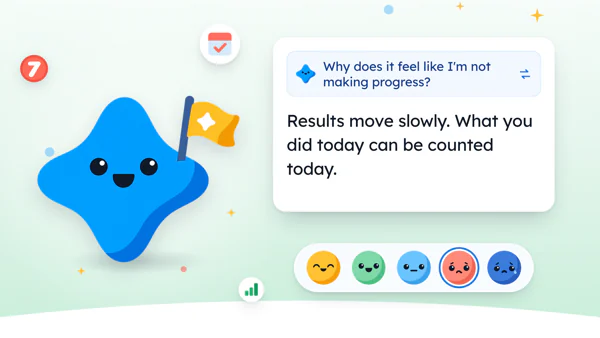
- Results move slowly. What you did today can be counted today.
- A number and one plain line a day turn a blur into a record.
- Keep a running total. It only goes up.
- Once a week, put this week next to last week.
The guitar has been on its stand for six weeks. To anyone walking past, it still sounds like a guitar owned by someone who’s had it for six weeks.
Your fingers know three new chords. Nothing in the room says so.
We make an iPhone app for this, so we’re biased. A pencil counts just as well.

Reading XP0 XP
Why progress feels invisible
You see yourself every day.
And a change that arrives a few pages or a few minutes at a time is too small to notice from inside any one of those days.
Also, results move slower than effort. The book isn’t finished, and the language you’ve practiced every night since summer still freezes when the person at the bakery counter asks a second question.
So stop measuring only the result, and start counting the thing you actually did. Count the step, then let the result catch up.
Those experiments covered lots of different goals and ways of recording, from paper logs to telling other people, so it’s a good sign for a notebook and it isn’t a guarantee.
It’s also how staying consistent gets easier. On a flat week, a number on the page proves the week wasn’t empty.
What to count when nothing seems to change
Every slow goal has one number that moves daily while the big result sits still. Pick that number.
| Goal | Why it looks like nothing | Count this | A line it might give you |
|---|---|---|---|
| Reading more | The pile of books looks the same | Pages, not books | “14 pages. The detective finally has a name.” |
| Learning a language | You still freeze when ordering tea | Minutes, plus new words | “12 minutes. Learned ‘umbrella’. It’s raining.” |
| Practicing guitar | It sounds the same to everyone else | Minutes, plus one thing easier | “15 minutes. The G to C change is less ugly.” |
| Tidying up | The house is messy again by Friday | Drawers or shelves done | “Cleared one drawer. Four chargers, none of them work.” |
| Writing | The draft still isn’t finished | Words or minutes | “300 words. Most of them will stay.” |
Look at the right-hand column. Each line has a number and one small true detail. That’s it.
If your goal isn’t on the list, ask what you could count tonight without opening a spreadsheet. Done or not done works too, for goals like calling a friend.
How to track your progress in a notebook
You’ll need a page and a pencil. It takes about a minute a day.
Pick one number.
Pages, minutes, words or simply “did it”. One goal, one number.
Tie it to a stop.
Write it right after something you do daily, like brushing your teeth.
Add one line.
What happened, in plain words: “10 pages. Fell asleep on page 9.”
Keep a running total.
Add today’s number to the total in the corner of the page.
The running total is the step that’s easy to skip. It’s also the one that makes progress visible.
Ten pages a night is forgettable. 183 pages since the 27th is something you can point at.
A running total can only go up. A bad day adds a small number or nothing, and the total waits.
Where Yumemira fits
Most progress worth counting comes from a step you took. So the app starts with the step.
In Yumemira, the small-steps journal for iPhone, you pick a goal like reading more. Each day brings one step: 10 pages, or 2 on a busy day.
When you tap Mark done, Mira cheers, and Say how it went asks for your line. The goal’s page keeps the running total for you.
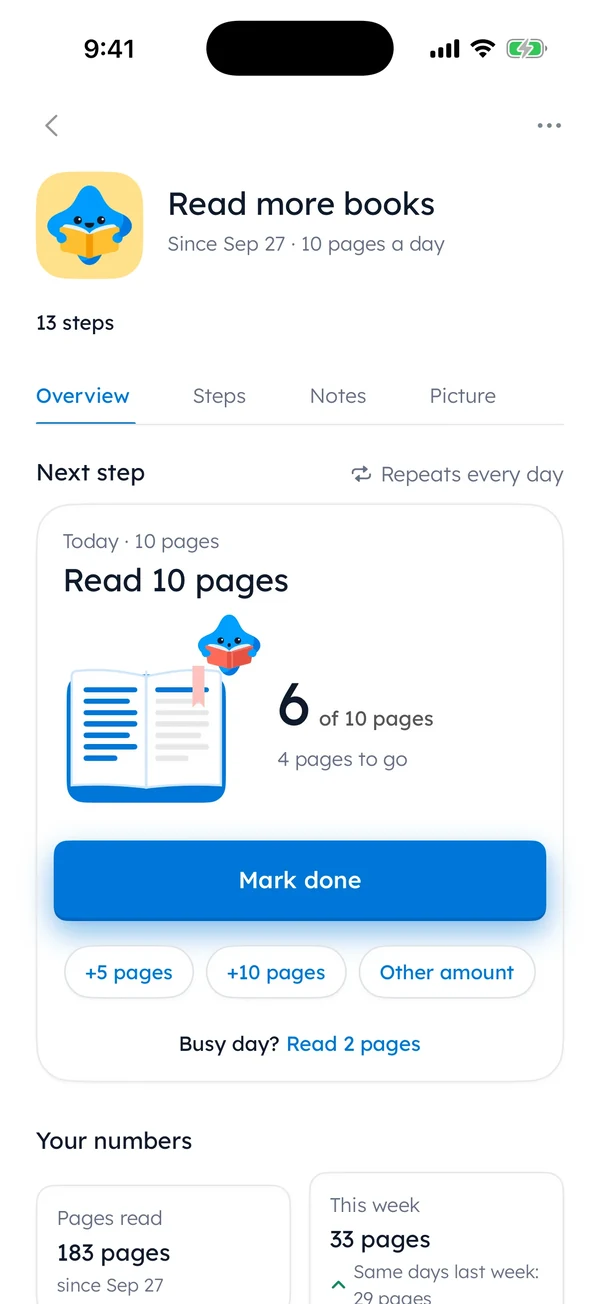
On paper, the corner of the page does the same job.
For a fuller layout, with prompts and a month of example rows, a goal journal gives the idea more room.
Compare this week with last week
Daily numbers bounce around. Tuesday was 20 pages because the train stopped for half an hour, and Wednesday was 2 because you fell asleep with the lamp still on.
On its own, Wednesday looks like failure.
A week smooths that out. On Sunday, add up the seven days and write one sentence: “This week: 61 pages on 5 nights. Last week: 48.”
Mark the round numbers too, like your first 100 pages or the first song you could play from start to end. Those are the days the slow change finally shows.
In the app, every Sunday your week comes back in five short cards. With Pro, Insights adds your steps each week.
But a pencil and two minutes on Sunday will show you the same thing. For a few more questions to ask, the guide to achieving goals has a five-minute look-back.
When a week goes backwards
Some weeks the number drops. Work ate the evenings, a cousin got married, the book stayed in the bag on the bus.
The total from the good weeks is still there.
Nothing you wrote down disappears because this week was thin.
If the step keeps losing to your evenings, shrink it and keep going. Two pages counted beats ten pages planned.
So does a plain list of what got done, like a done list, on the days the number is zero.
Your first week of counting
Keep the first week tiny, so the counting never becomes the goal.
| Day | Tonight | A line it might get |
|---|---|---|
| 1 | Pick the number, write today’s | “Guitar, 10 minutes. Day 1.” |
| 2 | Number plus one line | “8 minutes. Fingers protested.” |
| 3 | Add the running total | “12 minutes. Total: 30.” |
| 4 | A busy night: the small size | “3 minutes. Busy night. Total: 33.” |
| 5 | Note one thing that got easier | “C chord without looking, once.” |
| 6 | Number and line, nothing more | “15 minutes. Neighbors silent.” |
| 7 | Add up the week, write one sentence | “This week: 63 minutes on 7 nights.” |
On day 7, read the seven lines back. One of them will surprise you, because you’d already forgotten it happened.
Tonight, write one number from today on a fresh page. In six weeks the guitar still won’t say much, but the page will.
Questions people ask
How do I track my progress?
Pick one thing you can count, like pages, minutes or days you did your step. Write the number and one line at a time you already stop each day, and keep a running total. Once a week, compare it with last week.
What is a progress journal?
A progress journal is a notebook or app where you log what you did toward a goal each day, usually a number and a short line. It turns small, slow changes into a record you can read back.
Why does it feel like I’m not making progress?
Slow change is hard to see from inside each day, and results often lag behind the work. Counting what you did, like pages or minutes, gives you something that moves every day while the result catches up.
How often should I check my progress?
Write the number daily and look back once a week. A single day’s number bounces around, while one week next to the week before makes small changes easier to spot.
Sources
TopicStaying consistent

You earned the Progress Spotter badge
You read to the end. Tonight, write one number from today on a fresh page.
0 XP

Yumemira is an iPhone app (iOS 18 or later).
What Pro addsYumemira is free to start. iPhone, iOS 18 or later.