
Small goals
How to achieve goals: keep the goal, change the size of the step

The short answer
To achieve goals, keep the goal and change the size of the step. Give it a full step, a busy-day step and a time you already stop, like after dinner. On hard weeks, use the small size so the step still happens. Every Sunday, look back for five minutes. Keep it that small for a week.
In 30 seconds
- Decide the goal once. After that, only the step size changes.
- Give every step a size you’d manage on your worst Wednesday.
- After a gap, start again at the small size, today.
- Five minutes on Sunday shows you what moved.
You know exactly what you want. You’ve known since March, when you circled a date on the fridge calendar and felt very organised about it.
What you don’t have is a Wednesday plan.
And the calendar, for the record, is still on March.

Reading XP0 XP
Why goals stall in week two
Week one runs on the new-plan feeling. You wrote the plan on a calm evening, after a good dinner, with the nice pen that usually lives in a drawer.
Then week two brought a late meeting, a cousin’s birthday and a lunchbox left on the bus, and a plan written for a calm evening met an evening that wasn’t calm at all.
So the step didn’t happen. And one skipped day became three.
The goal didn’t change that week. The step was just the wrong size for it.
The same goal at today’s size
That’s the idea behind micro goals. You keep the big goal and cut it down to a piece today can hold:
- “Learn Spanish” becomes 10 minutes a day, or 2 on a full day.
- “Read more” becomes 10 pages, or 2.
- “Get fit” becomes a 20-minute walk, or 5.
- “Drink more water” becomes 8 glasses, or 4.
Change the step size, and leave the goal alone.
If the goal itself still feels foggy, how to set goals for yourself is the place to pick it. Then come back for the Wednesday part.
How to achieve goals when they stall
A goal can stall in five places. Each one has a fix you can decide in under a minute, and you’ll probably spot last week’s in one of the rows.
| Where it stalls | The small fix | A line it might get |
|---|---|---|
| A missed day | Start again at the busy-day size | “Skipped Monday. 2 minutes of Spanish today.” |
| A hard week | Use the busy-day size all week | “Long week. 5-minute walk after dinner, every night.” |
| Boredom | Same step, one new thing around it | “Same 10 pages, new chair by the window.” |
| A step that’s too big | Halve it for one week | “20 minutes kept slipping. Trying 10.” |
| No proof it’s moving | A 5-minute look-back on Sunday | “Step done 5 of 7 days. Wednesday was hard.” |
So the middle column is the useful one. Every fix there changes something small around the goal.
The goal stays put.
Why Wednesday? It stands in for the fullest day of your week, whichever day that happens to be for you.
But a Wednesday size only helps if it’s small enough to feel slightly silly.
If it still sounds like work at the end of a long day, it’s too big. Cut it again.
If the step slips twice in a week, halve it.
The Sunday look-back
A goal feels stuck when you can’t see it move.
Small steps are easy to forget by Saturday, the same way nobody remembers what they had for lunch on Tuesday, even when it was a perfectly good lunch.
So once a week, look back. It takes about five minutes.
The Sunday look-back
Ticks stay in this browser. Nothing is sent.
The last question does the real work.
If the step happened on most days, the size is right. If it kept slipping, next week gets a smaller step. That’s all.
There’s research behind checking progress at all. A 2016 review in Psychological Bulletin pooled 138 experiments with 19,951 people (opens in a new tab).
On average, people who were prompted to monitor their progress reached their goals more often.
End every look-back by choosing next week’s step size.
A look-back works fine on paper: four lines on the back of a receipt, done before the rice is ready.
We make an iPhone app around small steps, so count us as biased. Paper does the job too.
The look-back comes to you in Yumemira, the small-steps journal for iPhone. Every Sunday, your week comes back in five short cards.
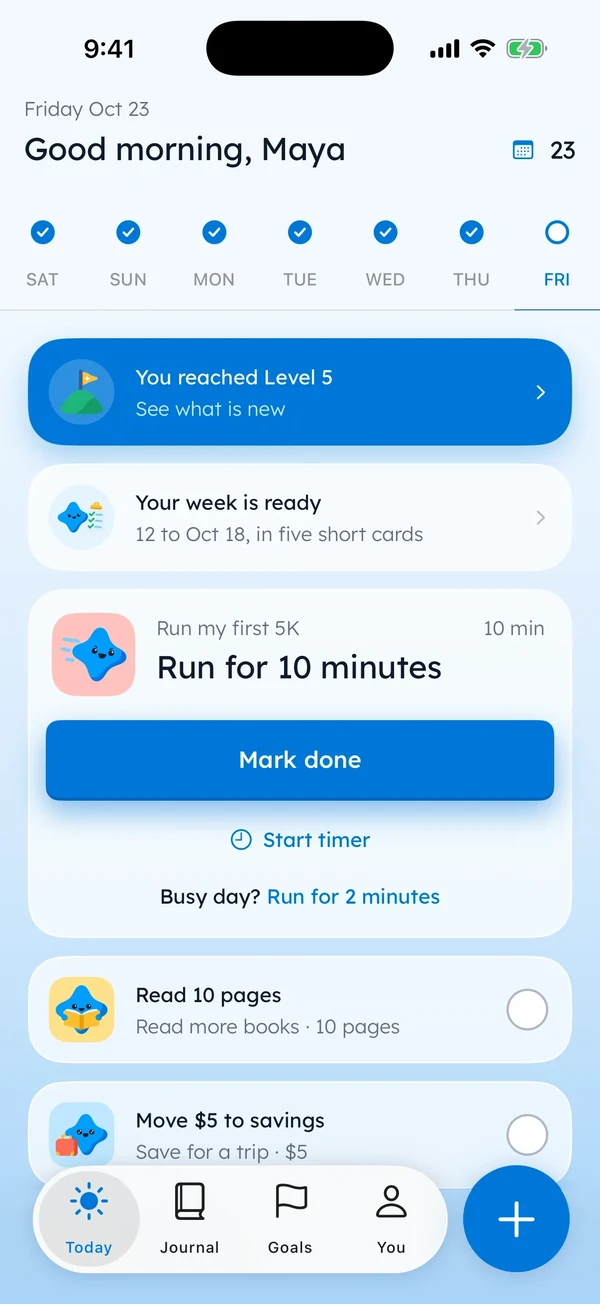
Each day holds one step from your goal, plus a busy-day size that counts in full. You can start from the 26 ready goals or write your own.
And the You tab adds up your days shown up, a number that never goes down.
Rest days are built in, and you can mend a missed day once every 30 days.
On paper, keep every look-back on one page.
Then next Sunday you’ll read last Sunday’s four lines before you write new ones, and that’s often the moment a slow month starts to look like progress.
How to stick to goals on a hard week
Hard weeks arrive the way rain does, without asking, and often in the exact week you’d planned to finally get going on the goal.
The goal can wait them out at a smaller size.
Say your goal is Spanish, 10 minutes a day. This week has two late shifts, and a school play needs a costume by Friday.
| Day | Step size | The line |
|---|---|---|
| Mon | Full, 10 minutes | “10 minutes of verbs. Easier than last week.” |
| Tue | Busy-day, 2 minutes | “Late shift. 2 minutes on the bus home.” |
| Wed | Busy-day, 2 minutes | “Costume glue everywhere. 5 new words anyway.” |
| Thu | Day off | “Rest day. Film with the kids.” |
| Fri | Busy-day, 2 minutes | “2 minutes in the hall before the play.” |
| Sat | Full, 10 minutes | “Full 10 minutes. Felt long, in a good way.” |
| Sun | Look-back | “5 steps this week. Next week stays at 10.” |
Nothing in that week looks impressive.
Still, the goal is alive on Sunday, with five steps behind it and a size picked for next week, and that’s the whole job of the small size.
Shrink it early.
Switch to the busy-day size the moment the week looks full. Don’t wait for a skipped day.
Keep the time.
Do the small step at the usual moment, so the slot stays yours.
A chosen day off.
A rest day you picked on Monday is easier to come back from than one that just happened.
On a full week, shrink the step on day one.
Start again without starting over
After a gap, the pull is to restart big. A new plan, a new notebook, maybe a new Monday to wait for.
You can skip all of that. Pick up the same goal at the busy-day size, today, whatever day today is.
The days you already did are still done. A gap of one week doesn’t erase the fourteen days before it, any more than one rainy afternoon erases a summer you spent mostly outside.
After a gap of a month or more
It works the same way: same goal, busy-day size, today. But if the goal no longer fits your life, you’re allowed to set it down and pick a new one.
If restarting is the part that keeps going wrong, how to be consistent has a plan for the days you don’t feel like it.
For a wider look at your whole week, beyond one goal, there’s a five-question weekly reflection too.
Your Wednesday plan
You don’t need a new goal tonight. The one from March is fine.
Tomorrow, flip the fridge calendar past March. Wednesday’s already planned.
Questions people ask
How do you achieve your goals step by step?
Pick one goal and give it a daily step with a number, plus a smaller busy-day step. Do it at a time you already stop. Shrink the step on hard weeks, and once a week look back at how many days it happened.
How do I stick to my goals when I lose motivation?
Make the step small enough that motivation barely matters, like 2 pages or 2 minutes. Keep doing it at the same moment each day. When the week gets lighter, go back to the full size.
What if I miss a day?
Start again the next day at the busy-day size, without catching up. One gap doesn’t undo the days before it. If gaps keep happening, the step is probably too big, so halve it for a week.
How often should I review my goals?
Once a week suits small daily goals: five minutes and four short questions. That timing is our suggestion. Once a month, read the weekly notes back in one go to see the longer picture.
Sources
TopicSmall goals

You earned the Wednesday Plan badge
You read the whole guide. Now write your step’s Wednesday size.
0 XP

Yumemira is an iPhone app (iOS 18 or later).
How Yumemira worksYumemira is free to start. iPhone, iOS 18 or later.