
Small habits
Small habits that changed people’s lives, from public threads

The short answer
The small habits that change your life, going by 52 public answers we counted, are plain ones: a short walk, a steady bedtime, ten minutes of tidying, the phone in a drawer. Pick one. Tie a tiny version of it to something you already do every day, and don’t grow it until it bores you.
In 30 seconds
- Moving more was the most named habit: 12 of 52 answers.
- Many were small and dull, like ten minutes of tidying or one drawer.
- Not one answer mentioned money.
- Every habit below has a first step you can do today.
In October 2025, someone on Hacker News asked: what’s one small habit you started that surprisingly changed your life?
We read every answer, plus three similar threads: 52 answers, counted by hand. Walking came up five times. Money, zero. A bidet, once.
We make a small-steps app, so weigh our tally with that in mind. Nothing below needs it.

Reading XP0 XP
Small habits that change your life, by the numbers
First where the answers came from, then how they added up.
Where these habits come from
All four threads are public, and every habit below links to the answer it came from.
Here they are, newest first:
- One small habit that surprisingly changed your life (opens in a new tab) (2025)
- Small changes, big impacts (opens in a new tab) (2022)
- The smallest change with the most benefit (opens in a new tab) (2021)
- The one habit you adopted (opens in a new tab) (2018)
The askers wanted small habits that changed your life. Most replies came back as small habits that changed my life, told in a line or two by the person who kept them.
Read it as people describing their own lives.
And it’s one crowd, a fairly tech-heavy one. Small sample. No promises. Two big Reddit threads on the same question are missing too, because we couldn’t open them to count.
Every answer here is also a lesson in how to stay consistent: the habits people kept were the ones small enough to survive a bad week.
The tally
Here’s the tally, with the matching ready goal and the first step that goal starts with on a busy day.
| Habit | Times named (our count) | First step | Ready goal |
|---|---|---|---|
| Moving more: walks, workouts, rides, a sport | 12 | “Walk for 5 minutes” | Walk |
| Sleep and wake-up times | 7 | “Wind down for 2 minutes” | Sleep on time |
| Tidying and resetting | 4 | “Tidy for 2 minutes” | Tidy up |
| Meditation or a quiet minute | 4 | “Meditate for 2 minutes” | Meditate |
| Writing things down | 3 | “Write for 5 minutes” | Write |
| Time with people | 3 | “Send a short hello” | Call family or friends |
| The phone, kept further away | 2 | “Put the phone away for 10 minutes” | Less phone time |
| Reading and learning | 2 | “Read 2 pages” | Read |
Nine more answers were about food, fasting, drinking or smoking. We left them out on purpose. A doctor who knows you is the right person for those.
Borrow the size first, then the habit.
Some answers were big: two hours of walking a day, or years of a martial art. The small ones are easier to borrow on a Wednesday.
Sleep habits and a quiet minute
Sleep was the second biggest group, with 7 answers. We’ll only say what people did, since what it did for them isn’t ours to check.
Early to bed, early up
One person goes to bed around 9 and gets up around 5 (opens in a new tab), every day. That’s the whole answer.
No alarm at all
Another stopped setting an alarm (opens in a new tab) because they kept hitting snooze. Without it, they got out of bed earlier than they had with all that snoozing. They still set one for early flights.
Eight hours in bed
A third gives themselves an eight-hour window in bed (opens in a new tab), aiming for at least seven of sleep.
None of these is small on day one.
Going to bed at nine is a big shift for most people, especially anyone whose evening only starts once the dishes are done and the house goes quiet.
But the Sleep on time goal starts much lower, with “Wind down for 2 minutes.”
A quiet minute to start the day
Four answers were about meditation or sitting still. One person keeps a short morning meditation (opens in a new tab) to think about being kind and useful to other people.
Short is the word doing the work. So two minutes will do, even if you spend both of them wondering whether you left the oven on and whether that’s meditating or just worrying with your eyes shut.
Tidying habits that set up the next round
Four answers were about keeping a home or a desk in order. None of them was about a big weekend clean.
Ten minutes after work
One person cleans for 10 minutes after getting home (opens in a new tab): a quick sweep and the dishwasher loaded. They said it shrank the chores left for the weekend.
Ten minutes is short enough to start with your coat still on and long enough to clear the counter, and on some days that’s all the kitchen gets.
Ten minutes is the bar. Some days it runs longer, and that’s fine.
Reset at the end
As far as we can tell, this is the most useful idea in all four threads. One answer sees every task as a loop, and the last step is setting up the next round (opens in a new tab).
And their examples are wonderfully ordinary. Refill the water right after making a coffee. Put the new toilet roll on now.
And before you leave the desk for the night, clear it and set out tomorrow’s first papers.
We’ll call it the reset-at-the-end trick. The next start is ready before you need it.
Take something away
Another answer asks what you can take away (opens in a new tab) before asking what to add. A cluttered corner doesn’t get a new shelf. It gets emptied.
Usually into a bag by the front door, where it sits for a week before anyone admits the stuff is really leaving the house.
Make the bed first
And one person said making the bed first thing (opens in a new tab) became the cue for the rest of their morning, starting with a glass of water.
Phone habits that put some distance in
Only two answers were about the phone. Both used distance to do the work.
The drawer in the other room
One person’s phone now charges in a drawer in another room (opens in a new tab), sits in focus mode most of the day, and doesn’t get email at all.
It wasn’t one move. They also took email off the phone and hid their feeds. With each step, they said, they got a little more focused.
Weekends left behind
The other answer leaves the phone behind on weekends (opens in a new tab), mostly outdoors, until Monday. That’s a big version. The small version is one evening, or ten minutes.
Put the phone where reaching it takes a walk.
Movement habits, the most common answer
Moving more came up 12 times out of 52, more than anything else. We’ll stick to what people did, and skip what it did to their bodies.
A walk when you’re stuck
One answer uses a short walk when stuck on a problem (opens in a new tab), about 15 minutes. The next idea to try often turned up on the way, they said.
A bar, ten minutes and a calendar
Another person keeps a pull-up bar in the bedroom (opens in a new tab) and does ten minutes every morning. Each day gets a mark on a wall calendar. They’ve kept it up for years.
Swap the order
And this one costs nothing. One person used to see friends first and exercise after, if at all. Then they swapped the order and started putting the workout first (opens in a new tab).
They still miss a day or two most weeks, and they said so.
That last part is the useful bit. A habit can have gaps and still be a habit. Gaps allowed.
Walks with a book in your ears
Walks can carry a second habit, too. One person started listening to audiobooks on walks (opens in a new tab), and that slowly turned into reading more.
For more habits cut this small, see these micro habits.
Money habits, the group nobody named
Out of 52 answers, zero were about money. No saving, no budgets, no spending rules.
We can’t tell you why. It may say more about who answers on Hacker News, or about how rarely people file money under habits at all, than about money itself.
The smallest money step
A money habit can be as small as the others here. The Save money goal starts a busy week with “Put aside $1”.
Picture a jar by the door with one folded dollar at the bottom, and next week a second one beside it, and nobody else in the house knowing why. It’s small. That’s fine, because the amount can grow later.
A habit can start at one dollar.
Writing habits for people who don’t write
Three answers were about writing things down. None of them was about writing well.
Tomorrow’s list, started tonight
One person keeps a cascading daily log (opens in a new tab). Each evening they check what got done, then start the next day’s list with whatever didn’t.
It’s the reset-at-the-end trick again, on paper.
Write it down, whatever it is
Another answer put writing things down on a short list of best changes, next to walking more. A third was about documenting work so new people could find things.
So far, nobody needed a nice notebook or a quiet hour at dawn, which is good news for anyone whose best writing surface is the back of a supermarket receipt.
One line about the step
One version joins writing to every habit above: one small thing, then a line. Do the step, then write a line about it, like these:
- “Tidied the desk for two minutes. Found a pen I’d lost.”
- “Walked five minutes. The rain held off for once.”
- “Phone in the drawer for ten minutes. Read the cereal box instead.”
That’s the idea behind micro journaling, and behind our app too.
In Yumemira, after you mark a step done, tap Say how it went and write that line while it’s fresh.
How to start one small habit this week
Pick from the table, then shrink the step until it fits your worst day.
Which one would you still do with a cold coming on? Start there.
| If you have | Start with |
|---|---|
| Two minutes | “Tidy for 2 minutes” |
| Five minutes | “Walk for 5 minutes” |
| Ten minutes | “Put the phone away for 10 minutes” |
| One message | “Send a short hello” |
| A book nearby | “Read 2 pages” |
| A dollar | “Put aside $1” |
One answer said it plainly: just do something each day (opens in a new tab), like one page, one push-up, or one message to a friend asking how they’re doing.
And another answer said the best habit was to stop hoping one habit would change everything (opens in a new tab).
So pick the one small enough to repeat.
Pick one row.
The one you’d still do on a tired day.
Busy-day size.
Two pages, or one short hello.
One anchor.
Tie it to getting home, or to the last coffee.
Leave it small.
Grow it only when it feels too easy.
If you’d rather keep a light record of a few good small habits to have, try good habits to track.
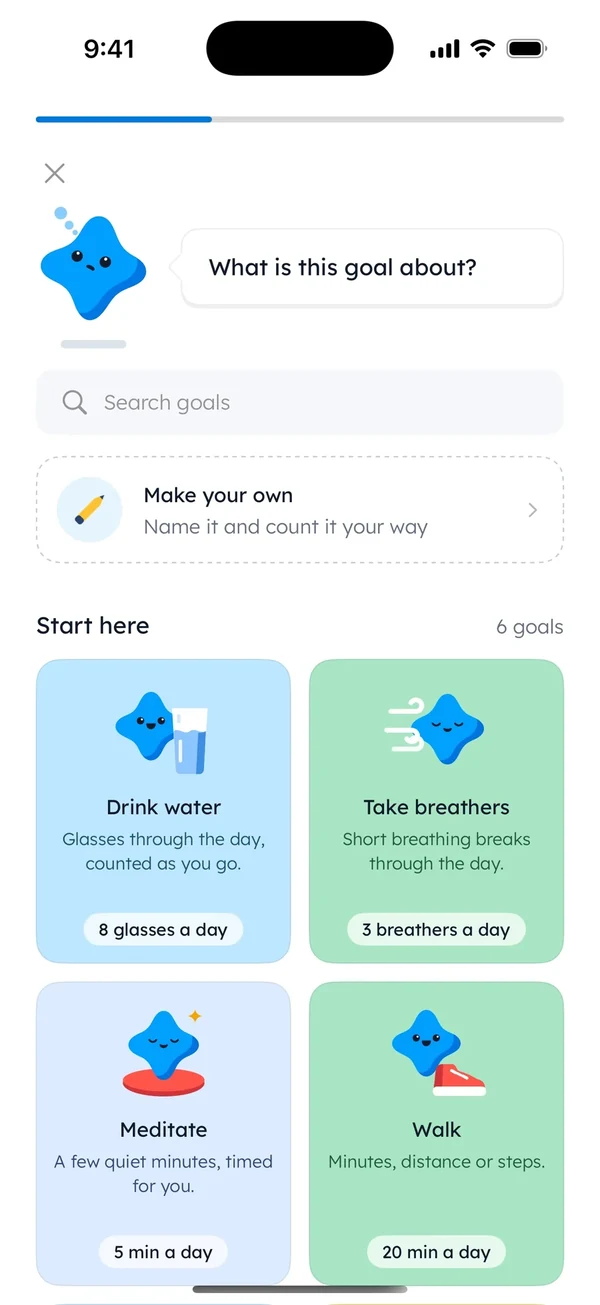
There’s a ready goal for each of these in the app, each with a busy-day step. If you’d like the step waiting for you tomorrow,  try it in Yumemira.
Questions people ask
What small habits can change your life?
In the 52 public answers we counted, the most named were moving more (12), sleep and wake-up times (7), tidying (4), a quiet minute or meditation (4) and writing things down (3). These are people’s own reports. They promise nothing.
How do small habits lead to big changes?
Mostly by being repeated. A small step is easy to do on a bad day, so it keeps happening. A couple of answers said one habit led to another, like audiobooks on walks that turned into reading more.
What are good small habits to have?
One you’d still do on your worst day. Two minutes of tidying, two pages of a book, a short hello to a friend, or the phone in a drawer for ten minutes are all good starts.
How do I start a small habit?
Pick one and cut it to its busy-day size. Then tie it to something you already do every day, like getting home or plugging in your phone. Leave it that size until it feels too easy, then decide whether to grow it.
Somebody asked one small question on a public forum, and 14 answers came back full of ordinary things. Yours can be just as ordinary.
Tonight, before you plug in your phone, do one small thing.
Sources
- Ask HN: What's one small habit you started that surprisingly changed your life? (opens in a new tab)
- Ask HN: What is the one habit that you adopted and it changed your life? (opens in a new tab)
- Ask HN: What small lifestyle changes have made the biggest impacts on your life? (opens in a new tab)
- Ask HN: Smallest/simplest change possible with maximum benefits (opens in a new tab)
- Answer: cleaning for 10 minutes after work (opens in a new tab)
- Answer: end every cycle by setting up the next one (opens in a new tab)
- Answer: ask what you can take away (opens in a new tab)
- Answer: making the bed first thing (opens in a new tab)
- Answer: the phone charges in a drawer in another room (opens in a new tab)
- Answer: weekends with the phone left behind (opens in a new tab)
- Answer: walking when stuck on a problem (opens in a new tab)
- Answer: a pull-up bar and a wall calendar (opens in a new tab)
- Answer: friends after the workout, not before (opens in a new tab)
- Answer: a cascading daily log (opens in a new tab)
- Answer: early to bed, early up (opens in a new tab)
- Answer: no alarm clock (opens in a new tab)
- Answer: an eight-hour window in bed (opens in a new tab)
- Answer: a short morning meditation (opens in a new tab)
- Answer: audiobooks on walks, then reading (opens in a new tab)
- Answer: just do something each day (opens in a new tab)
- Answer: stop hoping for one life changer (opens in a new tab)
TopicStaying consistent

You earned the Small Step badge
You read all 52 answers with us. Now pick one and do its first step tonight.
0 XP

Yumemira is an iPhone app (iOS 18 or later).
How Yumemira worksYumemira is free to start. iPhone, iOS 18 or later.