
Habit ideas
Habits to track: 60 small ideas and a printable page

The short answer
Good habits to track are small and countable: glasses of water, pages read, minutes walked, or simply done or not done. Give each one a unit and a size you can hit on a bad day. Then track two or three, not twenty, at a time you already stop. Keep it that small for a week.
In 30 seconds
- Track two or three habits at once, not twenty.
- Give every habit a unit: glasses, pages, minutes, or done.
- Pick the size you can manage on your worst day.
- Mark what you did. A blank box is just a blank box.
You made a beautiful tracker. Twenty-two habits, four colors of pen, a little drawing of a plant in the corner.
By day 5, it was a beautiful grid of guilt.
The fix is smaller than it sounds: fewer rows, and a number in every row. Below are 60 ideas, each already sized. There’s a month page to print, too.

Reading XP0 XP
How many habits should you track at once?
Track two or three, and one is fine too.
Twenty-two is a hobby of its own, and the hobby is mostly drawing boxes. A short list means that on a long day, you can fill in the whole page standing in the kitchen with your coat still on.
What Franklin’s little book got right
Benjamin Franklin built the big version. In his autobiography (opens in a new tab), he describes “a little book” with a page for each of 13 virtues, each page ruled in red ink into seven day columns.
He didn’t try to fix all 13 at once, though. He gave one virtue a week what he called “strict attention” and left the rest to chance.
To be fair, his 13 rows stayed on the page every day. But his effort went to one row, and that’s the part worth copying.
Add a third habit only after two feel boring.
Picking which two is the hard part. If you’re stuck, start from the thing you’d most like to say you did by Friday, and let the rest wait for next month. Next month isn’t going anywhere.
If the bigger question is how to keep going once the first week’s excitement fades, that’s the whole subject of how to stay consistent.
Give every habit a unit and a small number
A habit you can track has a unit and a size: glasses, pages, minutes, dollars, or just done.
“Read more” can’t be ticked. But “Read 10 pages” can, and so can “read 2 pages” on the night the book falls on your face.
The table uses the starting sizes from the goals in our app, which are small on purpose. Change any number to fit your life.
| Habit | Unit | A small amount |
|---|---|---|
| Drink water | Glasses | 8 a day |
| Read | Pages | 10 a day |
| Walk | Minutes | 20 a day |
| Stretch | Minutes | 10 a day |
| Meditate | Minutes | 5 a day |
| Fruit and veg | Portions | 5 a day |
| Phone in another room | Minutes | 30 a day |
| Practise an instrument | Minutes | 15 a day |
| Save money | Dollars | $10 a week |
| Tidy up | Minutes | 10 a day |
Some habits don’t need a number at all. Making the bed, putting the dishes away before bed, calling your sister: those are done or not done, and that’s a perfectly good unit.
Then pick a busy-day size too. Walk 20 minutes on a normal day and 5 on a packed one, and both get a mark.
60 habits to track, each with a unit and a size
Every idea comes with a size you can do on an ordinary day, so steal freely and change the numbers.
And skip any that sound like homework.
Move a little
- Walk: 20 minutes a day
- Stretch: 10 minutes a day
- Go outside: 20 minutes a day
- Take the stairs: done or not, once a day
- Push-ups: 5 a day
- Run: 10 minutes, 3 times a week
- Work out: 20 minutes, 3 times a week
- Dance in the kitchen: 1 song a day
Eat and drink
- Drink water: 8 glasses a day
- Fruit and veg: 5 portions a day
- Cook at home: 4 meals a week
- Pack a lunch: done or not, weekdays
- Swap one sweet thing: days kept
- Eat breakfast sitting down: done or not
- One meal without a screen: 1 a day
Rest and quiet
- In bed by a time you pick: done or not
- Up by a time you pick: done or not, weekdays
- Take a breather: 3 a day
- Meditate: 5 minutes a day
- Phone in another room: 30 minutes a day
- No phone in bed: done or not
- Sit by a window with tea: 5 minutes a day
Learn and make
- Read: 10 pages a day
- Learn a language: 10 minutes a day
- Practise an instrument: 15 minutes a day
- Focus on one task: one 25-minute block a day
- Write: 100 words a day
- Draw: 1 sketch a day
- Look up one new word: 1 a day
- A talk or podcast on something new: 2 a week
Money
- Save: $10 a week
- No-spend days: 3 a week
- Trip fund: $10 a week
- Write down what you spent: done or not, daily
- Look at your balance: done or not, once a week
- Coffee made at home: cups, weekdays
- Check one subscription you pay for: 1 a month
Home
- Tidy up: 10 minutes a day
- Make the bed: done or not
- Dishes done before bed: done or not
- Clear one surface: 1 a day
- Ten things back where they belong: 10 a day
- Water the plants: done or not, twice a week
- One load of laundry: 2 a week
- Tomorrow’s clothes laid out: done or not
People
- Call family or friends: 2 calls a week
- Send a short hello: 1 message a day
- Thank someone by name: 1 a day
- Eat with someone: 3 meals a week
- Play with the kids or the dog, phone away: 15 minutes a day
- Answer one message you’ve been putting off: 1 a day
- Plan one thing with a friend: 1 a month
Write it down
- One line about today: 1 line a day
- Three good things: 3 a day
- A word for how the day felt: done or not
- Tomorrow’s one task, written tonight: done or not
- One photo of today: 1 a day
- A done list: 3 things a day
- One thing you learned: 1 line a day
- Read back last week’s lines: done or not, Sundays
The last group is a journal in disguise. A tracker says whether you did it. One line says how it went, which is the part you’ll want to read next March.
If the list makes everything look tempting, that’s the moment to remember the two-habit rule. Circle two now. The other 58 will still be here.
Many of these are micro habits already, small enough to fit between other things. Several also work as daily goals, the kind you set in the morning and tick by dinner.
If you’d rather track it on your phone
Paper is fine, and the printable grid is just below. A grid on the fridge has one big advantage: it’s on the fridge.
We make an iPhone app for this, so we’re not neutral here. In Yumemira, the small-steps journal for iPhone, each goal counts its own way: glasses for water, pages for reading, minutes for a walk, or plain done.
Start from the library, where every goal shows its size before you pick it.
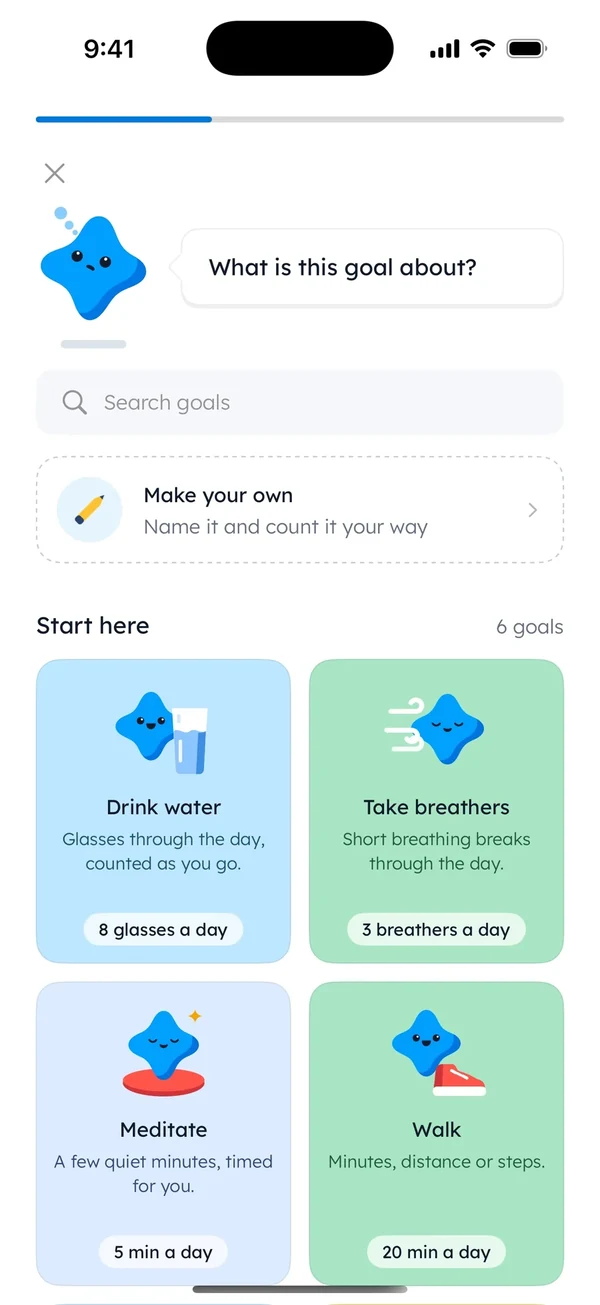
You can also tap Make your own and count a habit your way. That covers “dance in the kitchen”, which isn’t on any list but ours.
After a step, you can write one line about how it went, with a face for how it felt. So the tracker and the journal live in one place.
There are more goals that count in their own units on the home page. But whichever you choose, the grid’s rule still holds: two habits, with a number for each.
Your printable monthly habit tracker
The month grid has three rows and 31 columns: a row per habit and a column per day.
A narrow column on the left holds the unit, so “8 glasses” sits right next to its boxes.
Draw it on any blank page: with a ruler and a pencil, it takes about ten minutes. The third row is for later. Leave it empty until the first two feel easy.
Then decide how you’ll mark the boxes before day 1, so a half day never turns into a debate with yourself.
| If today… | Mark the box like this |
|---|---|
| You did the full amount | A full dot, or the number: “8” |
| You did the busy-day size | The number you did: “4” |
| You did a little | The little number: “1” |
| It was a planned rest day | An “R”, with no apology |
| It was a hard day | A dot, and “hard” in the margin |
| You forgot | Nothing. Leave it blank. |
Write the number you did, never the number you missed.
Why habit trackers turn into a grid of guilt
Your tracker starts to sting at one exact moment: the first blank box. One empty square in a neat row looks like a crack in a window.
Franklin hit a version of this too. He marked his faults with “a little black spot”, then scraped old marks off to reuse the pages, until the paper was full of holes.
So he moved the whole chart onto ivory leaves and wiped the pencil marks off with a wet sponge. It’s a fine solution if you happen to own ivory.
The cheaper fix is to track what you did. Spots and crosses for failures turn a month page into a list of complaints, and that’s a hard notebook to open at night.
A few more ways to keep the page friendly:
- Count the total at the end of the month, not the longest run.
- Let the busy-day size get the same mark as the full one.
- Start a fresh grid on any day, not only the 1st.
- If a habit stays blank for two weeks, shrink it or swap it.
In the app, it works the same way. Days shown up never go down, and a busy-day step gets a full mark.
Back to the twenty-two habits for a second. The pens were never the problem, and neither was the plant drawing. There were just twenty more rows than one person needs in a month.
So tonight, keep it to two. Write them on any scrap of paper, with a number next to each.
Then tick today’s box, even if all you did was read this.
Questions people ask
What habits should I track?
Track two or three small habits you can count: glasses of water, pages read, minutes walked, or done or not done. Choose the ones you’d most like to say you did this week, and give each a size you can manage on a busy day.
What are good habits to track daily?
Good daily habits to track are short and countable: walk 20 minutes, read 10 pages, drink 8 glasses of water, tidy for 10 minutes, or write one line about today. Pick the ones that fit your days, not someone else’s list.
How many habits should you track at once?
Two or three is plenty for a start. Add another only when the first ones feel easy, even a little boring. A page with twenty rows takes longer to fill in than most of the habits on it take to do.
How do you make a monthly habit tracker?
Draw a grid with one row per habit and one column for each day of the month. Add a narrow column for the unit, like glasses or pages. Each day, write the number you did. Leave the box blank if you didn’t.
Is it bad to skip a day of a habit?
No. One skipped day changes nothing about the days you already marked. Leave the box blank and do the small version tomorrow. Two skipped days in a row is the signal to make the habit smaller.
Sources
TopicStaying consistent

You earned the Idea Keeper badge
You read the whole list. Now write two habits on a scrap of paper.
0 XP

Yumemira is an iPhone app (iOS 18 or later).
See the 26 goalsYumemira is free to start. iPhone, iOS 18 or later.