
Staying consistent
Stuck restarting every Monday? How to keep going instead

The short answer
If you’re stuck restarting every Monday, stop waiting for the next one and keep going today with a smaller step. Do the busy-day version, like 2 pages instead of 10, at a time you already stop, such as after dinner. Then write one line about it. Keep it that small for a week.
In 30 seconds
- Goal sign-ups really do jump at the start of a week.
- A perfect-week plan has no row for an imperfect day.
- Shrink the step and keep going today. Monday can wait.
- Make no new plan until the weekend. Wednesday only gets a step.
Every Sunday night you plan the perfect week. Every Wednesday you plan the perfect next Monday.
Somewhere there’s a notebook with nine neat pages of Mondays in it, each plan a little more ambitious than the last, and not a single Thursday.
That loop has a name, the start-over cycle. And the way out starts on a weekday.

Reading XP0 XP
Why you keep restarting every Monday
Partly because Monday really does feel different. Researchers have measured that pull.
In 2014, three Wharton researchers published a paper on what they called the fresh start effect (opens in a new tab). They tracked Google searches, gym visits and sign-ups on a goal-setting website.
All three rose after dates that mark a fresh stretch of time: a new week, a new month, a birthday, a holiday.
The goal sign-ups are the part that fits here. At the start of a new week, people were 62.9% more likely to commit to a goal than their usual rate in that data.
The authors’ explanation is a tidy one. A new week opens a new period in your head, and last week’s slips stay behind in the old one. Their phrase for it:
“relegate past imperfections to a previous period”
So the pull is real, and it’s fine to use it.
But the waiting costs something. Thursday, Friday, Saturday and Sunday all go by while the goal sits in that box, and four days is a lot of pages.
Don’t wait for Monday to start again.
It’s one of the loops that how to stay consistent is built around breaking.
Why the perfect-week plan breaks by Wednesday
The plan usually gets made at the calmest moment of the week.
Sunday, 9:40 pm
Say the plan is on a fresh page. Read 10 pages every night, walk 20 minutes every morning, phone in the other room by ten. Each line gets a small box. The pen is new too.
Monday goes fine. Tuesday has one long meeting in it.
On Wednesday a cousin calls, dinner runs late, and at 11 pm the book is still on the chair, under a jacket, exactly where it was on Tuesday morning.
One box stays empty.
So what does the plan say about that? Nothing. It has no row for a long day, so the first imperfect day reads as a failed week.
- A clean page starts to look good.
- So does a new pen, or a new app.
- Next Monday starts to look like the fix.
All of it feels like doing something. And planning is easy on a Sunday, while the reading and the walking happen on Wednesdays.
Restart thinking vs continue thinking
The loop runs on a few sentences you say to yourself around the middle of the week. Each one has a quieter twin that keeps the week going.
| Restart thinking | Continue thinking | A line it might get |
|---|---|---|
| “I’ll start fresh on Monday.” | “I’ll do the small version today.” | “Read 2 pages before bed. Back on.” |
| “The week is ruined.” | “The week has 4 days left.” | “Walked 5 minutes on Thursday. Rain held off.” |
| “I need a better plan.” | “Same goal, smaller step.” | “Same book. 2 pages instead of 10.” |
| “I have to catch up first.” | “I start from today.” | “Skipped the backlog. One line for tonight.” |
| “This week has to be perfect.” | “This week gets a busy-day step.” | “Wednesday was the 2-page day. Planned it.” |
The middle column is a little boring.
Nobody is going to frame it, stick it on the fridge or buy a new notebook in its honor, which is exactly why it still works on a Thursday.
It keeps the same goal and changes only one thing, the size of the step.
Change the size of the step, never the start date.
How to keep going on a Wednesday
When a box stays empty in the middle of the week, four moves keep the week alive. They take a few minutes, and none of them needs a calendar.
Shrink the step.
Take the busy-day size: 2 pages instead of 10, 5 minutes instead of 20.
Do it today.
At a stop you already make, like after dinner or after a shift. Today is the restart.
Write one line.
“Read 2 pages. Wednesday, still going.” One line will do.
No new plan until Sunday.
Planning can wait for the weekend. Wednesday only gets a step.
Step 4 is the hard one. Mid-week planning feels useful, and it’s mostly a polite way of moving the start date.
We make an iPhone app built on this idea, so we’re not neutral here. A pen and the back of an envelope work just as well.
A line about something you did is easier to write than a line about a plan. So the app starts with the step.
In Yumemira, the small-steps journal for iPhone, each goal has a busy-day step under the normal one, and doing it is a full day.
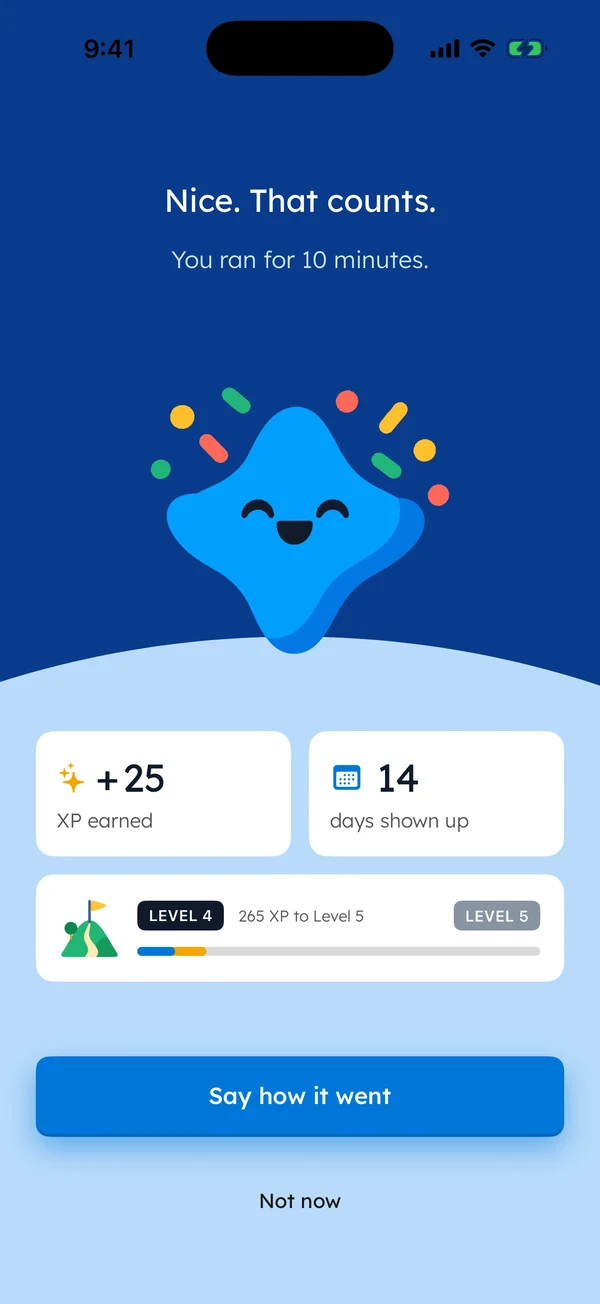
After Mark done, Mira, the app’s star, says “Nice. That counts.”
Then Say how it went asks one question, “How did it go?”, while the day is still fresh.
There’s no restart button, because nothing resets.
In a small-steps goal journal where days never go down, a goal can be paused for a while, and one missed day can be mended once every 30 days.
On paper, the same idea fits at the top of the page: “10 pages, or 2.” Then Wednesday already knows what to do.
If you fell back into old habits
Say it’s been more than a Wednesday. A deadline took two weeks, the walking shoes went back in the cupboard, and the old evening of scrolling until midnight came back without asking.
That’s the start-over cycle seen from the inside. The way back is the same move: today’s busy-day step, then one line.
And you can skip the catching up. The missed pages stay missed, and today doesn’t have to carry them.
Where to go next depends on what slipped:
- One missed day turned into two: never miss twice has a plan for the day after a skip.
- An old habit crept back in: examples of bad habits pairs each one with a small swap.
- The journal was the thing that stopped: getting back into journaling starts with one line tonight.
What to do this Sunday instead
The Sunday plan can stay. It just needs to be for a real week, one with a long day somewhere in the middle.
So the long day gets picked ahead, with its busy-day step decided before the week starts. Then the first late dinner has somewhere to go.
| Day | Step | A line it might get |
|---|---|---|
| Monday | 10 pages | “10 pages. Good start, no fuss.” |
| Tuesday | 10 pages | “10 pages on the bus home.” |
| Wednesday | 2 pages, planned on Sunday | “2 pages. Late dinner, still on.” |
| Thursday | 10 pages | “Back to 10. Chapter 6 got good.” |
| Weekend | 1 rest day, picked ahead | “Rest day. Nothing to fix.” |
Plan the busy day on Sunday, while it’s still easy.
By Friday the table has one small row in it, and the week is still a week.
No Monday had to rescue it.
After that, the plan notebook can go back in its drawer.
Next Monday can be an ordinary day. It won’t have to start anything.
Questions people ask
Why do I always restart on Monday?
A new week feels like a clean slate. A 2014 study of a goal-setting website found people were more likely to commit to goals at the start of a week. The pull is real, but waiting for it costs you the days in between.
How do I stop the start-over cycle?
Keep going on the day the plan breaks. Shrink the step to its busy-day size, do it today at a time you already stop, and write one line about it. Leave new plans for the weekend.
How do I restart a habit after falling off?
Restart with the smallest true version of it, today, with no catching up. Read 2 pages instead of 10, or walk 5 minutes instead of 20. Do that small version for a week before you go back to the full step.
I fell back into old habits. What do I do now?
Pick one habit and do its busy-day step today. The old routine coming back doesn’t erase the days you already did. Write one line about today’s step and keep it that small for a week.
Sources
TopicStaying consistent

You earned the Kept Going badge
You read the whole thing. Now do today’s busy-day step before you plan anything.
0 XP

Yumemira is an iPhone app (iOS 18 or later).
How Yumemira worksYumemira is free to start. iPhone, iOS 18 or later.