
Staying consistent
Never miss twice: what to do on day two after a missed day

The short answer
Never miss twice means one skipped day is fine, but two in a row start a pattern. So on day two, do the smallest true version of your step at a time you already stop, like after dinner. Read 2 pages instead of 10. If it still feels heavy, keep it that small for a week.
In 30 seconds
- One skipped day is an outlier. Two in a row start a pattern.
- Day two gets the busy-day size of your step.
- Do it at a stop you already make, then write one line.
- Skip the catching up. Yesterday doesn’t need paying back.
Yesterday the step didn’t happen. This morning a small voice already has its verdict ready: well, that’s ruined now.
Is it, though? Yesterday is closed. Today is the only day still open, and today is where the rule lives.

Reading XP0 XP
What never miss twice means
The rule fits on a sticky note. You can skip a day, just never two days in a row.
Skip once if you must. Never twice in a row.
The idea comes from James Clear, who wrote about it as avoiding the second mistake (opens in a new tab). On that page he puts it like this:
“One mistake is just an outlier. Two mistakes is the beginning of a pattern.”
“Never miss twice” is the short version that travels.
It works for any goal with a regular step, from reading to calling home, and it’s one of the main moves in how to stay consistent.
Why the day after a skip is the risky one
The first skip is usually an accident. A long shift, a visiting cousin, a train that sat outside the station for forty minutes while your evening went with it.
You didn’t choose it.
Day two is different, because now the skip comes with a story. The voice says it’s already broken, so why not start fresh on Monday?
Clear warns against seeing good habits as an all-or-nothing game. That’s the voice’s whole scorecard, and on it, one gap makes every next day look pointless.
| “It’s ruined” | “Small step today” | |
|---|---|---|
| What you tell yourself | “I’ll start fresh on Monday.” | “Yesterday’s done. Today’s small.” |
| What you do | Nothing, again | “Read 2 pages before bed.” |
| Day three | “Three days now. Why bother?” | “Back to 10 pages.” |
| A week later | “Started over. Again.” | “6 days of 7. Fine by me.” |
On day two, shrink the step before you skip it.
Your day-two plan
Day two needs four moves, and none of them takes long.
Name the skip.
Once, plainly: “Skipped yesterday. Long shift.” No essay needed.
Pick the busy-day size.
The version you could do on your worst day: 2 pages, 5 minutes, 4 glasses.
Use a stop you already make.
After dinner, after the bus, at the end of a shift. Do it there.
Write one line about it.
“Read 2 pages. Back on.” Tomorrow, that line is your proof.
Step 1 sounds a little silly. But it gives the skip a size.
One day.
Step 2 is where most of the work happens.
If the full step felt too big yesterday, it’ll feel even bigger today, with a skip sitting on top of it.
| Day | What happens | A line it might get |
|---|---|---|
| 1 | Skipped. Nothing to fix. | “Didn’t read. Long shift.” |
| 2 | Busy-day step: 2 pages | “Read 2 pages. Back on.” |
| 3 | Normal step: 10 pages | “10 pages. Chapter 4 finally got good.” |
| 4 | Normal step again | “10 pages on the bus home.” |
Day two is small on purpose. So day three can take the normal step back, and by the end of the week the skip is just one quiet row in the middle of the table.
Day-two steps for common goals
Small enough means small enough for the day that made you skip. These are the busy-day steps for six of the goals in our app.
| If your goal is… | Day two looks like… |
|---|---|
| Read 10 pages a day | “Read 2 pages.” |
| Walk 20 minutes a day | “Walked for 5 minutes.” |
| Drink 8 glasses of water | “4 glasses today.” |
| Tidy for 10 minutes | “Tidied for 2 minutes. One shelf.” |
| Call family twice a week | “Sent my sister a short hello.” |
| Practice an instrument | “5 minutes of scales.” |
We make a small-steps goal journal on your iPhone, so we’re not neutral here. A pen and a sticky note work just as well.
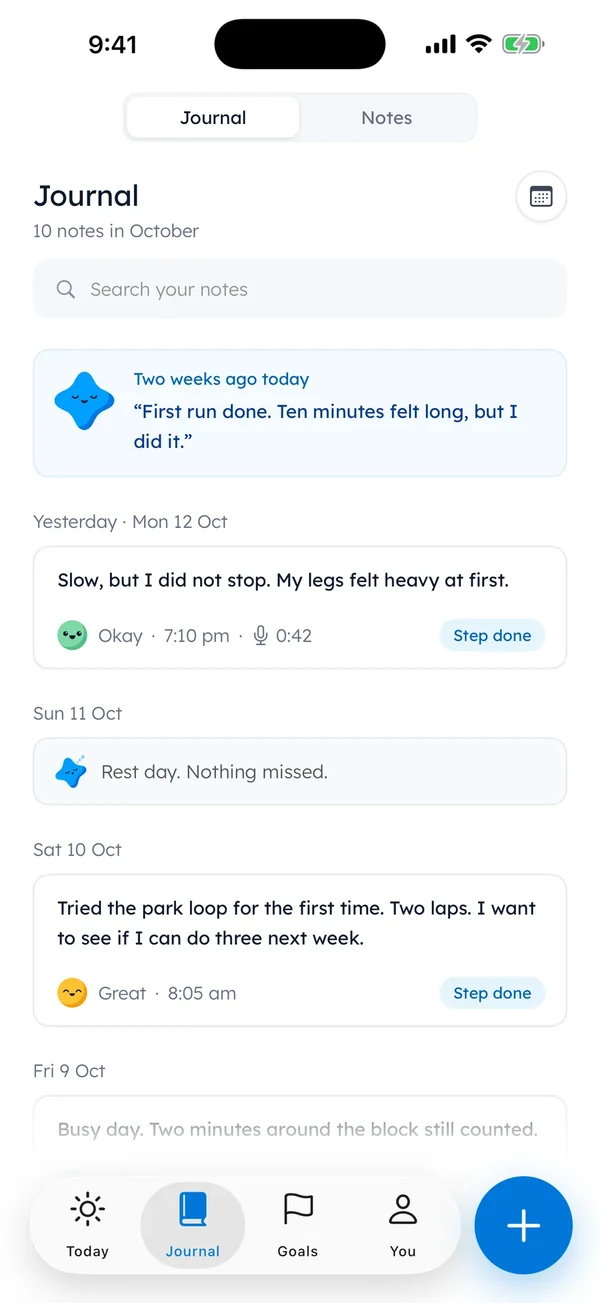
In Yumemira, the small-steps journal for iPhone, each goal has a busy-day step sitting under the normal one. Doing it is a full day, not half of one.
There are busy-day steps for 26 goals, plus room for your own.
After a step, Mira, the app’s star, cheers “Nice. That counts.” Then Say how it went asks one question while the day is still fresh.
On paper, the table above fits inside the front cover of a notebook, so copy the row for your goal there and day two is decided before you need it.
When you’ve skipped more than two days
Say it’s been a week: work took every evening, the weekend went to errands, and the book went back on the shelf with the bookmark still in chapter 3.
The rule doesn’t expire. Today is still day two of whatever comes next, and it gets the same small step.
Don’t pay back missed days. Just do today’s.
Doubling up feels fair, like settling a bill.
But 70 pages tonight makes today the biggest day of the week. And today needs to be the smallest.
In the app, days shown up never go down, and you can mend one missed day once every 30 days. A gap stays a gap. It doesn’t take anything back.
If the thing that stopped was writing, how to get back into journaling walks through the first night back.
Make day two easier before it comes
The easiest day two is the one you planned on a good day.
So pick your busy-day step tonight, while you’re not tired of the goal.
- Write the small version next to the normal one: “10 pages, or 2.”
- Put the book or the shoes where the stop happens.
- Decide the stop now, so day two has a place to happen.
- Keep the line short: “Busy day. 2 pages.”
It’s the same idea behind how to build a good habit in the first place: a step small enough to fit inside a bad day.
Tomorrow the voice might come back with its verdict. Let it talk.
The sticky note already has the answer.
Questions people ask
What does “never miss twice” mean?
It means one skipped day is allowed, but you don’t let it become two. On the day after a skip, you do a small version of your step, so the skip stays a one-off.
Who came up with never miss twice?
The idea is usually credited to James Clear, the author of Atomic Habits. On his blog he calls it avoiding the second mistake: one mistake is an outlier, and two mistakes start a pattern.
What should I do the day after I skip a habit?
Do the busy-day version of it, at a time you already stop, like after dinner. Read 2 pages instead of 10, or walk for 5 minutes instead of 20. Then write one line saying you did it.
Is one skipped day a problem for a habit?
One skipped day doesn’t undo the days you already did. What matters more is the next day. If you do a small version of the step then, the skip stays one day instead of becoming a gap.
Sources
TopicStaying consistent

You earned the Day Two badge
You read the whole thing. Now put tomorrow’s small step on a sticky note.
0 XP

Yumemira is an iPhone app (iOS 18 or later).
How Yumemira worksYumemira is free to start. iPhone, iOS 18 or later.