
Staying consistent
How long does it take to form a habit? What studies found

The short answer
How long does it take to form a habit? There’s no single number. In the best-known study, from 2010, the typical time was about 66 days, but people ranged from 18 days to an estimated 254. So skip the countdown and write one line instead: “After I ___, I ___.”
In 30 seconds
- The 21-day idea isn’t what habit studies measured.
- In one 2010 study, the middle result was about 66 days.
- Individual times ranged from a few weeks to most of a year.
- One skipped day made little difference in that study.
- A small step tied to a fixed moment beats a countdown.
“21 days to a new you,” says the poster by the bus stop.
Day 22 arrives. You’re still you, slightly annoyed. So who wrote the poster?
Here’s what researchers actually measured, and why staying consistent has little to do with a date.
Fair warning: we make an iPhone app that counts days. A pencil tally works too.

Reading XP0 XP
How long does it take to form a habit, really?
The 66-day number comes from one study. In 2010, Phillippa Lally and her colleagues asked 96 people to pick one new behavior and do it every day after something they already did.
The picks were ordinary: fruit with lunch, a 15-minute run before dinner, 50 sit-ups after the morning coffee. Nobody picked anything heroic, and that’s the point.
For 84 days, they reported whether they’d done it the day before. They also rated how automatic it felt, with statements like “I do it without thinking.”
Of the 96, 82 finished, according to the BPS Research Digest summary (opens in a new tab) of the 2010 paper (opens in a new tab).
The typical time to reach the point where it felt about as automatic as it was going to get was about 66 days, which a 2024 review by Singh and colleagues (opens in a new tab) calls a median.
But the spread is the bigger news:
- The fastest person got there in 18 days.
- The slowest was projected to need about 254 days.
- That projection runs 170 days past the study’s end at day 84.
A median of 66 still leaves half the people slower.
After 84 days, about half the group still hadn’t scored high enough for the behavior to count as a habit, the BPS summary adds.
People who picked an exercise behavior also took about one and a half times as long as people who picked something to eat or drink.
Where the 21-day idea comes from
The 2024 review traces the 21-day idea to Psycho-Cybernetics (opens in a new tab), a 1960 self-help book by Maxwell Maltz, a plastic surgeon. It also says the timeline “has been questioned”.
We haven’t read the book’s own wording, so we won’t quote it.
What we can say is simple: the habit studies above didn’t find 21 days, and somewhere between a surgeon’s book and a bus-stop poster, the number picked up a lot of confidence. Posters are like that.
It isn’t the only old guess, and it won’t be the last. In 1890, the psychologist William James wrote that a new behavior had to be repeated without a single miss. The Lally team tested that one too.
Habit timelines, claim by claim
Six numbers and rules float around this topic. Each one sits next to what a source we opened says.
| Claim you’ve heard | Where it comes from | What the source says |
|---|---|---|
| “Three weeks and it sticks” | Psycho-Cybernetics, 1960, per a 2024 review | Not what the habit studies measured |
| “66 days and it sticks” | Lally and colleagues, 2010 | The middle result; people ranged from 18 to about 254 days |
| “About 2 months for everyone” | Singh and colleagues, 2024 review | Only 4 studies timed it; the medians were 59 and 66 days |
| “Everyone lands near the middle” | Keller and colleagues, in the 2024 review | In one healthy-eating study, people took 4 to 335 days |
| “Miss once and start over” | William James, 1890 | One skipped day had little effect in the 2010 study |
| “Does time of day matter?” | Fournier and colleagues, in the 2024 review | Stretching averaged 106 days in the morning, 154 in the evening |
Read the fourth row twice.
In a healthy-eating study included in the 2024 review, individual times ran from 4 days to 335. That’s the gap between a long weekend and most of a year.
And only 23% of that group reached the habit threshold at all.
So any page that hands you one exact number, this one included, is rounding off a lot of people.
Does skipping a day reset a habit?
Not in the 2010 study. The BPS summary says a single skipped day had little effect on later gains, whether it came early in the study or near the end.
So William James was probably too strict. There was a catch, though: lots of skipped days, even spread out over weeks, seemed to add up and lower how automatic the behavior finally felt.
After one skipped day, do a small version the next.
That’s the rule people call never miss twice, and it fits the data better than starting again from zero.
What to do instead of counting to 66
If nobody can tell you your number, a countdown isn’t much use. You’d be counting toward a date nobody can set.
What the studies do share is the setup: one small behavior, done after the same daily moment, as often as you can manage.
So size the step for a bad day. Ten pages of a book can shrink to 2 pages on a rough evening, and a 20-minute walk can shrink to 5 minutes and still be the same habit.
For the longer how-to, see how to build a good habit. For steps so small they feel silly, try these micro habits.
Then stop counting down and count up.
A tally on the inside of a cupboard door does it:
- One mark for each day you did the step, at either size.
- No mark for the days you didn’t.
Nothing to cross out.
That’s more or less the idea behind Yumemira, the small-steps journal for iPhone: a goal journal where days add up.
It counts days shown up, and the total never goes down.
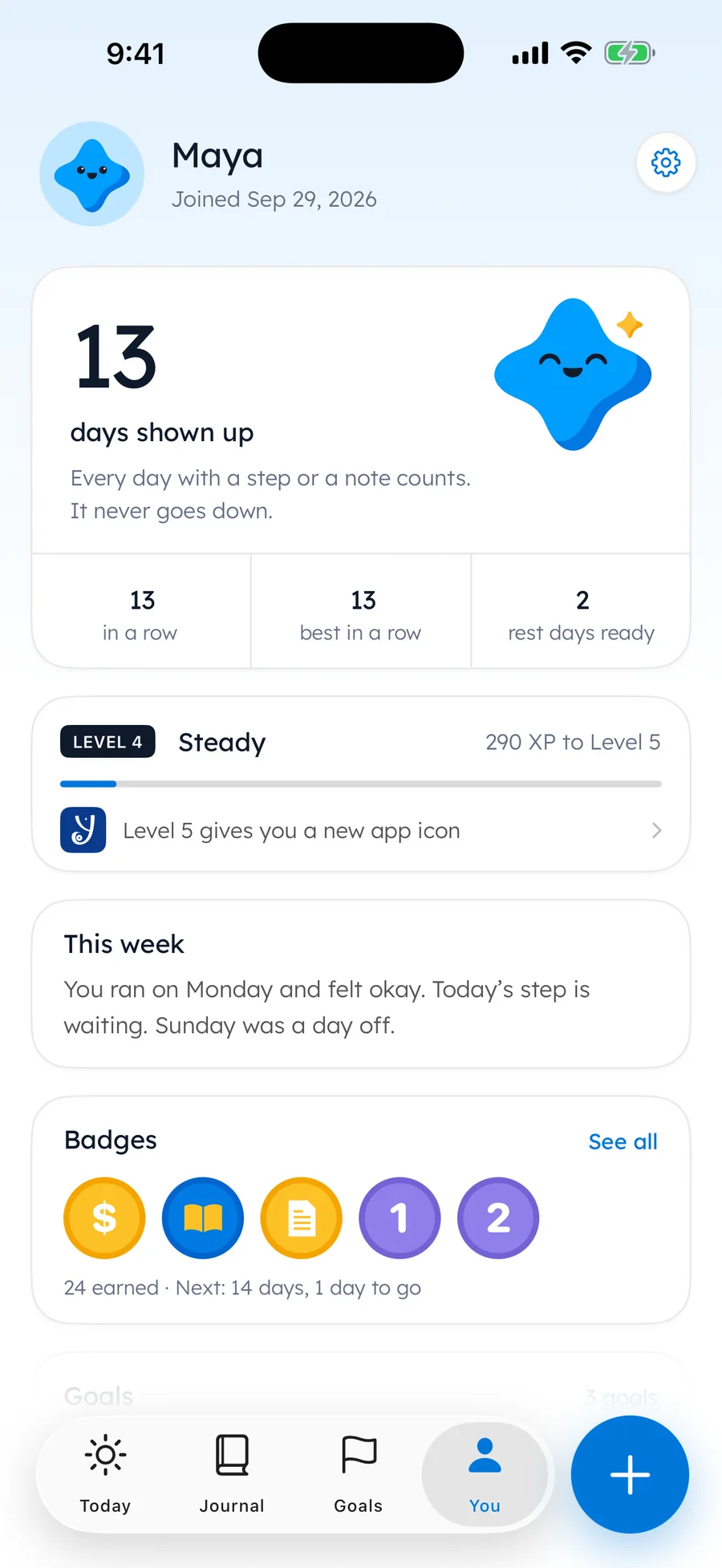
The app also has challenges of 7, 21, 30 or 66 days. They’re lengths you choose for a goal, and none of them promises a finished habit at the end.
After you mark a step done, there’s a button to write one line about it. Two pages on the bus will do.
The poster at the bus stop will still say three weeks next month. Let it. Write your line on the cupboard door, above the tally: “After I ___, I ___.”
Questions people ask
Is the 21-day habit rule true?
The 21-day idea is popular, but it isn’t what habit studies measured. A 2024 review traces it to a 1960 self-help book. In a 2010 study, people took anywhere from 18 days to an estimated 254, with a middle result of about 66.
Where does the 66-day habit number come from?
It comes from a 2010 study by Phillippa Lally and colleagues. 66 days was the median among people who finished the study, so half of them took longer. Exercise behaviors took about one and a half times as long as eating or drinking ones.
Does skipping one day break a habit?
In the 2010 study, a single skipped day had little effect on how automatic the behavior later became. Many skipped days, even spread out, seemed to lower the final level. So after a skip, do a small version the next day.
What’s the fastest way to form a habit?
No method is promised to be fast, and times vary a lot between people. What the studies share is a small behavior tied to the same daily moment and repeated often. Size the step for a bad day and keep the moment fixed.
Sources
- How to form a habit (opens in a new tab)
- How are habits formed: Modelling habit formation in the real world (opens in a new tab)
- Time to Form a Habit: A Systematic Review and Meta-Analysis of Health Behaviour Habit Formation and Its Determinants (opens in a new tab)
- Psycho-Cybernetics (opens in a new tab)
TopicStaying consistent

You earned the Curious Reader badge
You read the whole thing. Now pick tomorrow’s step and the moment it follows.
0 XP

Yumemira is an iPhone app (iOS 18 or later).
How Yumemira worksYumemira is free to start. iPhone, iOS 18 or later.