
Tracking a habit
Days in a row or days in total? Two ways to track a habit

The short answer
A habit tracker can count your days in two ways. A count in a row goes back to zero when you skip a day, while a total adds every day you showed up and never goes down. Pick the count in a row if a chain keeps you going. Pick the total if one skip usually ends the habit.
In 30 seconds
- A count in a row resets after one skip. A total never goes down.
- A chain you can see keeps some people going, and that’s fine.
- In one 2010 study, a single missed day had little effect.
- If a reset has ended your habits before, try the total.
Day 211. Your flight is delayed, the airport Wi-Fi wants your email first, and today’s step isn’t done.
You’re not tired. You’re guarding a number.
We make an iPhone app that leans one way here, so we’re biased. A wall calendar works just as well.

Reading XP0 XP
How a count of days in a row works
Each day you do the thing, the number goes up by one. Skip a day, and it goes back to zero.
And that simplicity is the whole appeal. You always know what today asks of you: one more.
The number also makes a vague wish feel solid. “Read more” is hard to picture, but day 9 is right there on the screen.
On paper and on a phone
On paper, it’s a row of Xs on a wall calendar, which is hard to argue with when you’re standing in the kitchen in your socks deciding whether to skip today.
On a phone, it’s the number at the top of a tracker, or a mark beside each entry if you’re journaling on your iPhone.
The hard part comes later. After a long run, the number can become the goal, and you find yourself doing 30 seconds of the thing just before midnight, mostly to keep it alive.
Sometimes that’s fine. Decide what a skipped day means before it happens.
A planned rest, a night shift or a family wedding shouldn’t feel like a small disaster.
How a running total works
A total adds every day you showed up. Skipped days don’t subtract anything.
So after 211 days, one skipped day at an airport and one more ordinary evening at home, the number on the screen says 212.
Nothing was lost at the gate.
And the feeling changes too. A skip reads as a pause, and there’s nothing to protect except today.
Where a total falls short
To be fair to the other side, a total has its own weak spots:
- It feels less urgent, so it pulls less on an ordinary evening.
- It hides gaps. A total of 40 could be 40 days in a row, or 40 days scattered across a year.
That’s why a total works best with a second look now and then, at a calendar or a journal, where the gaps show up.
Two ways a habit tracker can count, side by side
The same days, measured both ways, look like this. Each row describes a style of counting.
| Days in a row | Days in total | |
|---|---|---|
| What it adds up | Days in a row | Every day you showed up |
| After a skipped day | Back to zero | Stays where it was |
| How a skip feels | Like losing something | Like a pause |
| Who it suits | People a chain keeps going | People who quit after one skip |
| Rest days | Often break the count | Planned in (in Yumemira, built in) |
Yumemira, the small-steps goal journal for iPhone, leads with the total. A day goes on the total when you do your step or write a note.
Those are days that never go down, and they’re the big number on your profile.
Rest days are built in. You can pause a goal, and you can mend a missed day once every 30 days. Rest days are never for sale. Not in Pro either.
But whatever you use, what happens after one skip matters more than the number.
What one skipped day actually does
There’s some real data on this. In 2010, Phillippa Lally’s team at University College London asked volunteers to repeat one new behaviour every day.
The behaviours were small, like fruit with lunch or a run before dinner, and each day the volunteers rated how automatic the new behaviour had started to feel.
The BPS Research Digest summary (opens in a new tab) puts the missed-day finding plainly:
“a single missed day had little impact on later automaticity gains”
The same summary also adds the other half. Many missed days, even spread out, lowered how automatic the behaviour became in the end.
But it’s one study about how automatic a habit feels, and it can’t promise anything about yours. Still, it fits the common rule to never miss twice.
After a skip, the next day matters most.
And a line in a journal helps here, because a line remembers what a number forgets. These are the kinds of lines that fit the days around a skip.
| If today is… | Write something like… |
|---|---|
| A planned rest day | “Rest day. Laundry, rice, early night.” |
| A travel day | “Gate 14. Did 2 pages on the floor by the charger.” |
| The day after a skip | “Back at it. Read 2 pages on the bus.” |
| A tiny-version day | “Walked 5 minutes. Rain. Went anyway.” |
| A day you skipped on purpose | “Skipped it. Sat with the family instead.” |
If the gap is weeks long, the same idea holds. Skip the catching up and write tonight’s line, the way getting back into journaling works after a long break.
Which way of counting suits you?
Neither count is right for everyone. Five questions sort it out faster than a feature list.
Five questions before you pick
Ticks stay in this browser. Nothing is sent.
If a reset to zero has ended a habit before, count the total.
If the chain pulls you forward and your weeks rarely need a rest day, a night shift or a trip, the count in a row may suit you for now.
Try it and see.
And you can always keep both. On paper, write the total in the margin of the calendar, beside the Xs.
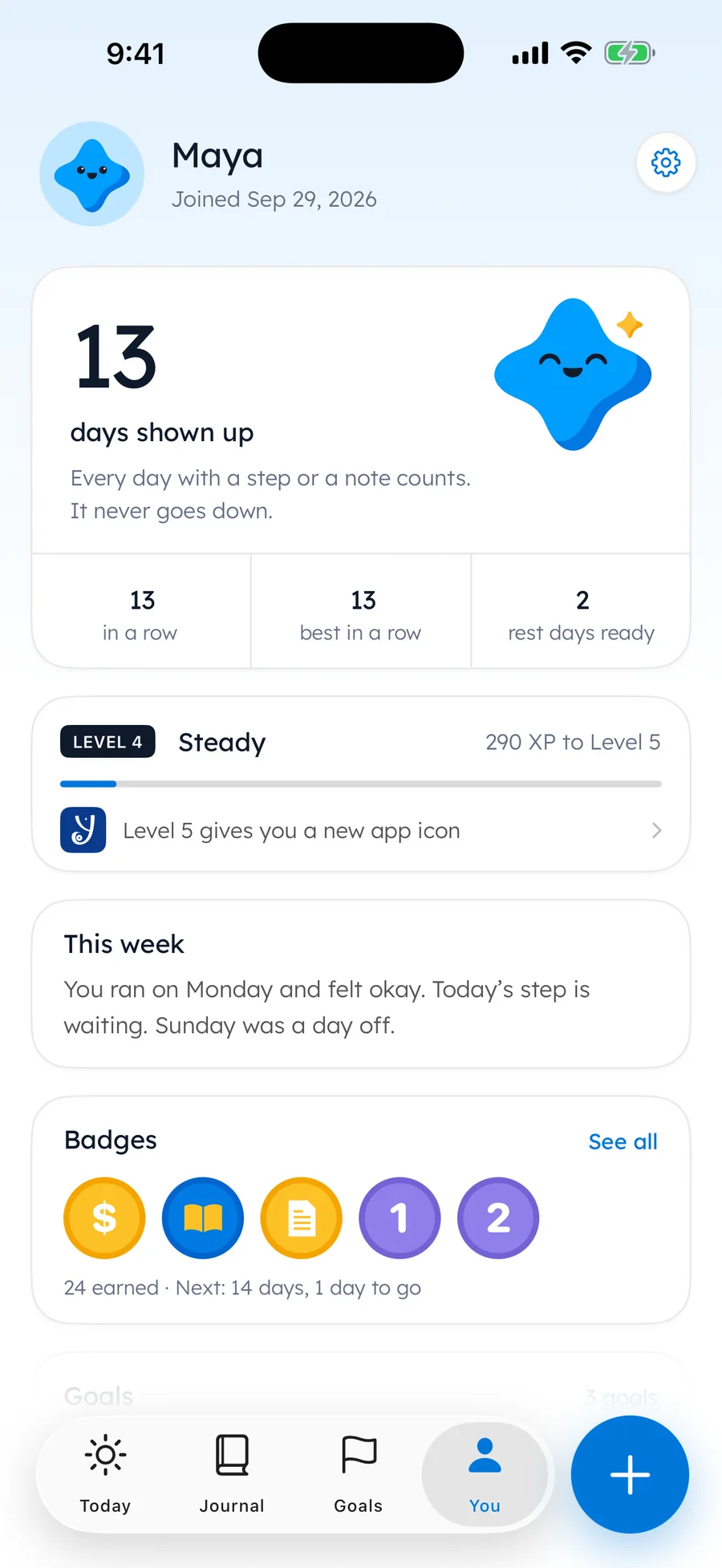
The app shows both as well, and it’s fair to say so. The big number is days shown up, with “It never goes down” under it.
A smaller “in a row” number sits below, beside your rest days.
If you’d like the total to be the number you see first,  try it in Yumemira.
What to do tonight, whichever you pick
Count the days you’ve already done, roughly, including the ones your old tracker wiped out and the ones in a notebook you stopped using in March.
Then write the total on one line: “Days shown up: 211.”
So a rough guess is good enough. Nobody’s grading this, and the number only goes one way from here.
Back at Gate 14, the flight’s still delayed. Two pages on the floor will do.
Questions people ask
Is counting days in a row good or bad for a habit?
It depends on you. A count in a row gives a clear daily target, and some people love the chain. If one reset to zero usually makes you quit, a total that never goes down is the kinder choice.
What happens to my count if I skip a day?
A count in a row goes back to zero. A total stays where it was and grows again the next day you show up. In one 2010 study, a single missed day had little effect on later habit gains.
Is there a habit tracker that doesn’t reset to zero?
Yes. Some trackers lead with a total of days instead of days in a row. Yumemira shows days shown up, which never go down, with rest days, pause and mending built in. A paper calendar works too.
Do I have to start over if I skip a day?
No. The days you did still happened. Do the smallest version of your step the next day, and write one line about it. Many missed days add up, so try not to miss two in a row.
Sources
TopicJournal apps

You earned the Fair Count badge
You read the whole comparison. Now write today’s total on one line.
0 XP

Yumemira is an iPhone app (iOS 18 or later).
How Yumemira worksYumemira is free to start. iPhone, iOS 18 or later.