
Journaling without writing
Journaling for people who hate writing: 7 ways with barely any words
The short answer
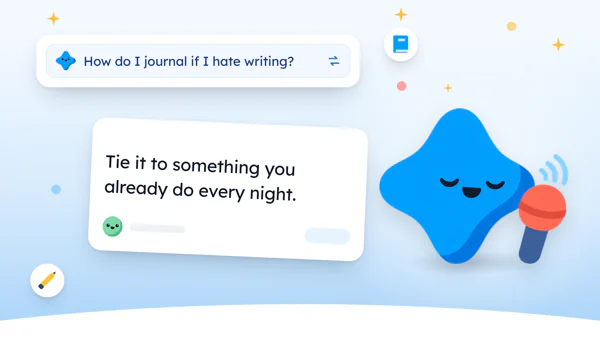
To journal when you hate journaling, drop most of the writing. Pick one face or one word, or a photo, for today. Do it at a time you already stop, like plugging in your phone at night, and let that be the whole entry. Keep it that small for a week, then add a word only if you want to.
In 30 seconds
- A face with no words is still an entry.
- Choose a format by the time you have tonight.
- Saying it out loud skips the keyboard and the handwriting.
- When it feels like homework, shrink it again.
- Tie it to something you already do every night.
Type “how to journal when you hate” into Google and it offers “how to journal when you hate your handwriting” (US, checked 2 Oct 2026). Start a new search with “i hate writing” and it offers “i hate writing essays”.
Fair enough. School writing came with a word count and a deadline. A journal has neither, and some days it can hold zero words.

Reading XP0 XP
How to journal when you hate journaling
A journal is a record of your days. It doesn’t have to be full sentences.
The usual advice on how to start journaling is one line a day, and that’s already small.
But if one line still feels like an essay with your name at the top and a grade waiting at the bottom, there’s a smaller step under it.
- A face holds how the day felt.
- A photo holds what happened.
Use the fewest words that still mark the day.
Seven ways to journal with barely any words
They run from a single face to one plain line. Start at the top, and only move down if you feel like it.
1. A face
Draw a circle in the corner of the page with a smile for a good day or a flat line for a so-so one. That’s the entry.
A face is honest in half a second. So a so-so day gets the so-so face, even when you’d like it to look better.
2. One word
One word for today, like “Rain” or “Dentist”.
Nobody’s grading this. And a single word has never failed a spelling test, which makes it the safest thing you’ll write all week.
3. A photo
One photo of something from today does the job, whether it’s the lunchbox you forgot to wash or the umbrella that wouldn’t open at the bus stop.
The photo is the entry, no caption needed.
On paper, a tiny sketch works the same way. (A rectangle labelled “bus” is art here.)
4. A voice note
You can say it instead of writing it: twenty seconds out loud, the way you’d tell a friend what happened at the shop.
And talking skips the keyboard and your handwriting at once. Most phones can record a voice memo, and many can turn what you say into text.
5. A tick
Some days the thing worth keeping is simply that you did the thing, like watering the plant or reading two pages before the light went off.
A tick on a calendar square does it, or a done button on your phone. Zero words, and the record still shows what you did.
6. A list
No sentences, just items: “rice” on one line, “fixed the squeaky door” on the next. Verbs are optional.
If lists suit you, borrow from these list journal ideas, sorted by how often you’d add to them.
7. One line
The longest format here is one plain sentence, about 5 to 15 words: “Bus was late, so I read two pages at the stop.”
If one line starts to feel easy, you’ve found micro journaling, and that’s as far as this list goes.
Saying it instead of typing it
We make an iPhone app built around small steps, so we’re not neutral here. A notebook with a few drawn faces works just as well.
In Yumemira, the small-steps journal for iPhone, a new entry has a microphone button beside the face button.
When you speak, the words appear on screen as you talk, and you can tap any word to fix it. The recording stays with the entry.
It needs a language your iPhone can recognise on the device, so not every language works.
You can also tap one of five faces, from Great to Hard, and add up to six photos without typing a word.
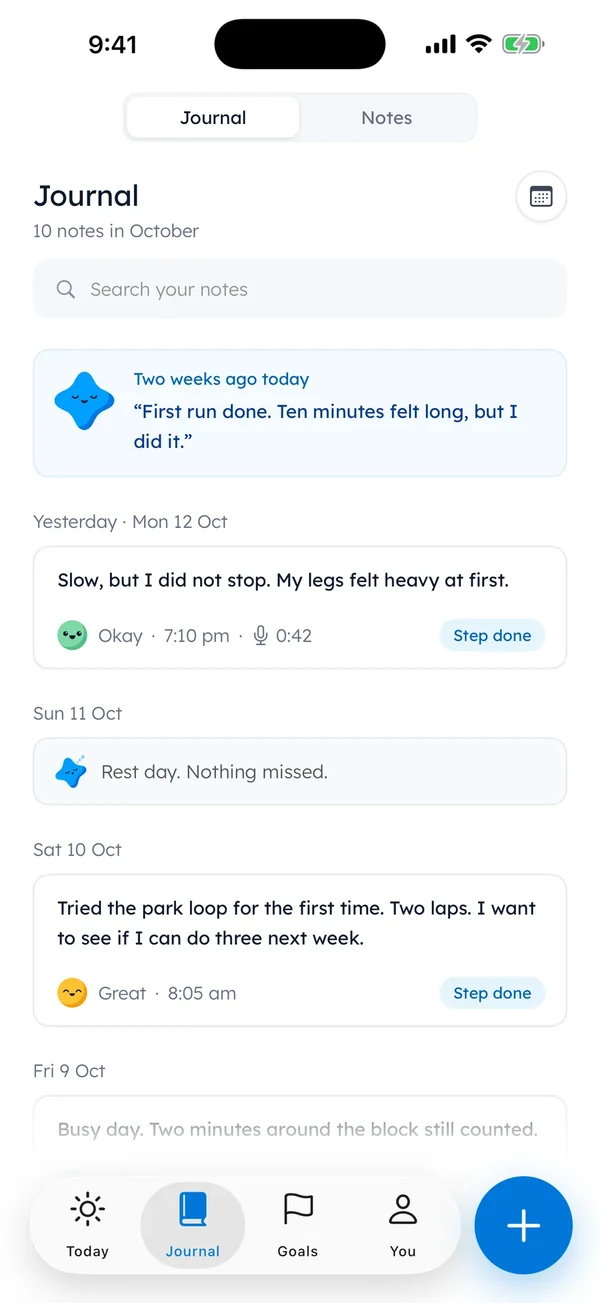
The app’s main idea is one small step a day toward something you want, like reading more. After a step, a button says Say how it went.
It’s hard to have nothing to say about something you did minutes ago.
On paper, the same habit works with a pencil: the face goes down first, and a word follows only if one turns up. The journal page shows the phone version.
Pick one by time
Choose by the time you really have tonight. After dinner and a last look at work messages, is it more than a minute?
On a long day, often not.
| Format | Words needed | Time | Paper or phone |
|---|---|---|---|
| A face: “so-so” | 0 | About 2 seconds | Both: drawn or tapped |
| One word: “Tired.” | 1 | About 5 seconds | Both |
| A photo: your lunchbox | 0 | About 10 seconds | Phone, or a tiny sketch |
| A voice note: “Long day, good soup.” | 0 written | About 20 seconds | Phone |
| A tick: “read 2 pages” | 0 | About 2 seconds | Wall calendar or phone |
| A list: “Rice. Rain. Door.” | 3 to 5 | About 30 seconds | Both |
| One line: “Bus late, read at the stop.” | 5 to 15 | About 1 minute | Both |
You can mix them. A face on Monday and a list on Friday still add up to a week you can look back on.
And if you’re still unsure where the line sits, here’s how long journal entries should be, answered without a word count.
When it still feels like homework
Say the face works for three nights, and on night four it feels like a chore.
Sound familiar? It happens.
Often a rule has crept in without you noticing, like it has to be a full line, or it has to look good. You don’t need more discipline. You need a smaller format.
So pick a smaller format. If the list feels heavy, try a tick, and if that still feels heavy, go back to the face.
When it feels heavy, make it smaller.
Tonight
Before the phone goes on its charger, pick a face for today.
If a word shows up, add it. If not, you’re done.
Nobody will see your handwriting tonight. A face doesn’t have any.
Questions people ask
How do I journal if I hate writing?
Pick a format with almost no words: a face, one word, a photo, a voice note, a tick, a short list or one line. Do it at the same moment each day, like when you turn off the light, and keep it that small.
Is it still journaling if I only use emojis or faces?
Yes. A journal is a record of your days, and a face drawn or tapped each day records how each one felt. Read a month back and you can see which days were good and which were hard.
Can I journal by talking instead of writing?
Yes. Record a short voice memo about your day, or use your phone’s speech-to-text to turn what you say into a line. Twenty seconds out loud keeps a record of the day just like a line on paper.
How short can a journal entry be?
As short as one word or a single face. There’s no minimum. Short entries are easier to repeat on busy days, and you can always write more on a night when the words come easily.
TopicStart journaling

You earned the Small Step badge
You read all seven. Tonight, pick a face and stop there.
0 XP

Yumemira is an iPhone app (iOS 18 or later).
More about the daily journalYumemira is free to start. iPhone, iOS 18 or later.