
How habits work
The habit loop, explained simply (cue, routine, reward)
The short answer
The habit loop is the three-part pattern behind a habit: a cue sets it off, you do the routine, and a reward makes it worth repeating. To start a new habit with it, put a tiny step right after a cue you already have, at a time you already stop. Keep it that small for a week.
In 30 seconds
- The loop is cue, routine, reward, repeated until it runs itself.
- James Clear splits it into four steps: cue, craving, response, reward.
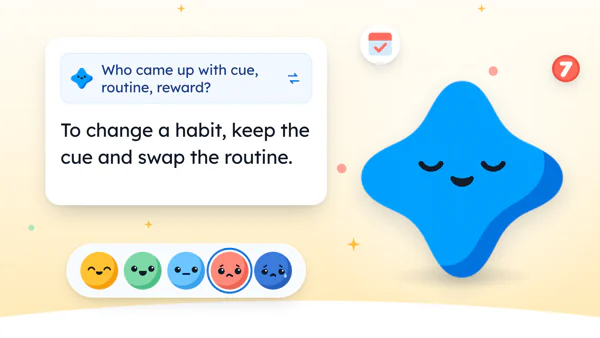
- To change a habit, keep the cue and swap the routine.
- To start one, put a tiny step right after a cue you already have.
The microwave says 90 seconds. Before it reaches 80, your phone is out.
You never decided to do that. The microwave did, a long time ago.
That small chain has a name. And once you can see it, you can borrow it for a habit you’d actually like to keep.

Reading XP0 XP
What is the habit loop?
The idea was made famous by journalist Charles Duhigg in his book about habits (opens in a new tab). In a 2012 NPR interview (opens in a new tab), he described a loop with three parts.
First comes the cue, the thing that tells you to switch to autopilot.
Then the part everyone pictures when they hear the word habit.
“Then there’s the routine, which is the behavior itself.”
Last comes the reward, a small payoff that makes the loop easier to run again when the cue turns up next time.
In plain words, something happens and you react the way you always have, because last time that reaction paid you back with something small but real.
That’s all a loop is, and it’s why a lot of how to stay consistent comes down to where a habit sits in your day.
Find the cue first, before you change anything else.
Cue, routine, reward vs cue, craving, response, reward
Writer James Clear uses four steps in his book Atomic Habits. His summary of the book (opens in a new tab) lists them as cue, craving, response and reward.
The new one is the craving: the wanting that sits between noticing the cue and acting on it.
And his response is close to Duhigg’s routine. It’s the thing you actually do.
| What happens | Duhigg’s word | Clear’s word |
|---|---|---|
| Something sets it off | Cue | Cue |
| You want the payoff | Not its own step | Craving |
| You do the usual thing | Routine | Response |
| You get something back | Reward | Reward |
So which one is right? Both describe the same loop, and Clear’s version just makes room for the moment you start wanting the thing before you’ve done anything at all.
It’s a small difference.
Clear also turns each step into a rule for building a good habit: make it obvious, attractive, easy and satisfying. To break a bad one, he flips all four.
Six everyday habit loops
Most loops are too small to notice, which is how they last for years. Each row keeps the cue and offers one small swap.
| Cue | Routine | Reward | Small swap |
|---|---|---|---|
| The microwave starts counting down | Check your phone | Something new to look at | Drink a glass of water |
| You sit on the sofa after work | Scroll | A rest for your head | Walk for 5 minutes first |
| You open the laptop | Check email | A quick win | Write one line of today’s plan |
| You see dishes in the sink | Leave them | No effort tonight | Tidy for 2 minutes |
| You get into bed | One more video | Something fun | Phone away for 10 minutes |
| Payday arrives | An impulse buy | Something new to own | Put $1 aside |
Every swap here is sized for a busy day.
We make Yumemira, the small-steps journal for iPhone, so we’re not neutral. A sticky note on the fridge can hold a swap too.
In the app, each of the goals with a tiny busy-day step starts at about this size.
The sofa row is the sneaky one. After a long day your head really does want a rest, and the swap doesn’t take that away from you.
It just puts 5 minutes of walking in front of the sofa. The sofa will wait (it’s had a lot of practice).
How to start a small habit with it
Building a habit means running the loop on purpose, and that’s easier than it sounds. You pick each part, and you pick it small.
Pick a cue you already have.
Something your day does without asking you, like getting home or brushing your teeth.
Make the routine tiny.
Two pages or a 5-minute walk, sized for your busiest day of the week.
Add a reward you can see.
Tick a box, or write one line about what you just did, while it’s still fresh.
Put the new step straight after an existing cue.
But the reward is the easy part to forget.
On paper, it might be “2 pages on the bus. It was late, so 4.” Nobody’s grading this.
In Yumemira, you tap Mark done and Mira cheers: “Nice. That counts.”
Under that sits a button that says Say how it went, which opens one line about the step you finished a minute ago, while you still remember how it felt.

The same screen shows the days you’ve shown up. That number doesn’t go down after a missed day.
A notebook on the bedside table works the same way, if you’d rather keep it on paper.
Swapping an old routine for a new one
Breaking a habit by force means fighting the cue every single day, and the cue never gets tired or takes a day off, however long your own day was.
It just turns up.
So the gentler move is to keep the cue and change only the routine. The sofa’s still there after work. You just walk for 5 minutes first.
Keep the cue. Change only what you do next.
If you’d like the swap and the line kept in one place,  try it in Yumemira.
For more ideas, see these examples of bad habits, each with one swap. And for a new habit from scratch, read how to build a good habit.
Tonight, pick one row from the table and say its cue and its swap out loud.
Tomorrow the microwave will count down again. Let it start a glass of water.
Questions people ask
What are the 3 parts of the habit loop?
Cue, routine and reward. The cue sets a habit off and the routine is what you do. The reward is the small payoff you get back, which makes it easier to repeat. Journalist Charles Duhigg described it this way in his book on habits.
What is cue craving response reward?
It’s James Clear’s four-step version of the loop, from his book Atomic Habits. He adds the craving, the wanting between the cue and the action, and calls the action the response. The reward stays at the end.
How do you create a habit loop?
Pick a cue that already happens every day, like getting home or brushing your teeth. Right after it, do a tiny step you could manage on a busy day. Then give yourself a payoff you can see, like a tick or one line about it.
Who came up with cue, routine, reward?
Charles Duhigg made the three-part loop of cue, routine and reward widely known through his book on habits, which he discussed on NPR in 2012. James Clear later added a fourth step, the craving, in Atomic Habits.
Sources
TopicStaying consistent

You earned the Curious Reader badge
You know the loop now. Tonight, pick one cue you already have.
0 XP

Yumemira is an iPhone app (iOS 18 or later).
How Yumemira worksYumemira is free to start. iPhone, iOS 18 or later.