
Staying consistent
Consistency Is Key: What It Really Means on a Bad Week
The short answer
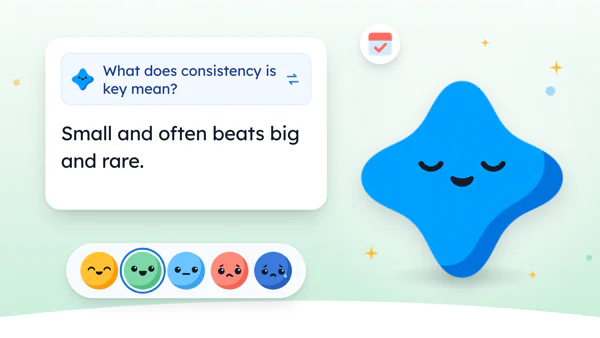
Consistency is key means small efforts repeated often add up to more than big efforts done once in a while. On a bad week, it means a minimum day: a tiny version of your step, picked in advance, that gets full credit.
In 30 seconds
- Small and often beats big and rare.
- The trap is all-or-nothing: one bad day seems to cancel the week.
- A minimum day is a tiny step you choose before you need it.
- A minimum day counts as a full day.
- After a skip, make the next day small, not perfect.
Consistency is key. It’s printed on mugs and painted on gym walls.
The saying is right. It just goes quiet on Thursday.
That’s the day the meeting runs long and the bus doesn’t come, so your evening plan shrinks to eating something and lying down. Nobody prints that part on a mug.

Reading XP0 XP
What does consistency is key mean?
It means small efforts, repeated often, add up to more than big efforts done once in a while.
Ten pages a night turns into a finished book. One heroic weekend of 200 pages tends to turn into a bookmark that sits in chapter 9 until spring.
So the key part isn’t how big any one day is. It’s how many days you show up for.
Is consistency the key to success?
People say that version too. It’s fair, with one limit: repeating a step carries it further, but it can’t choose the step for you.
So pick something small and useful, then let the repeats do the heavy lifting. There’s a full method in how to stay consistent.
A small step still fills the day.
Where people get it wrong
Say you planned to walk 20 minutes every evening, and Monday and Tuesday go fine.
Wednesday brings rain and a late call. And then the phone charger hides from you for half an hour.
By Thursday the week looks spoiled, like a form with one wrong box ticked, so you put the whole thing in a drawer until Monday. It wasn’t spoiled, though.
James Clear names the trap on his blog (opens in a new tab):
“So often, we make the mistake of believing that sticking to good habits is an all-or-nothing game.”
All-or-nothing turns a bad day into a lost week. The fix is a smaller definition of a good day.
| What people say | On a bad week | A line it might get |
|---|---|---|
| “Every day, no matter what.” | Most days, small on the bad ones | “Long day. Did 5 minutes anyway.” |
| “Do the full workout.” | The busy-day size | “Walked to the corner and back.” |
| “Never skip.” | Skip once, never twice | “Missed Tuesday. Back on Wednesday.” |
| “Big results, fast.” | Days that add up | “Day 31 shown up. Slow is fine.” |
| “A perfect week.” | A week with a minimum day in it | “Five full days, two small ones.” |
Count a small day as a full day.
And the right column is the one worth copying.
The minimum day
A minimum day is the smallest version of your step you’d still call done. You choose it ahead of time and give it full credit.
Decide it in advance.
On a good day, write both sizes side by side: “20 minutes, or 5.”
Make it tiny.
Small enough for your worst evening, like 2 pages of a book.
Count it.
Mark the day done, then write one line: “Minimum day. 5 minutes in the rain.”
We make Yumemira, the small-steps goal journal for iPhone, so we’re biased here. A pen and a notebook work just as well.
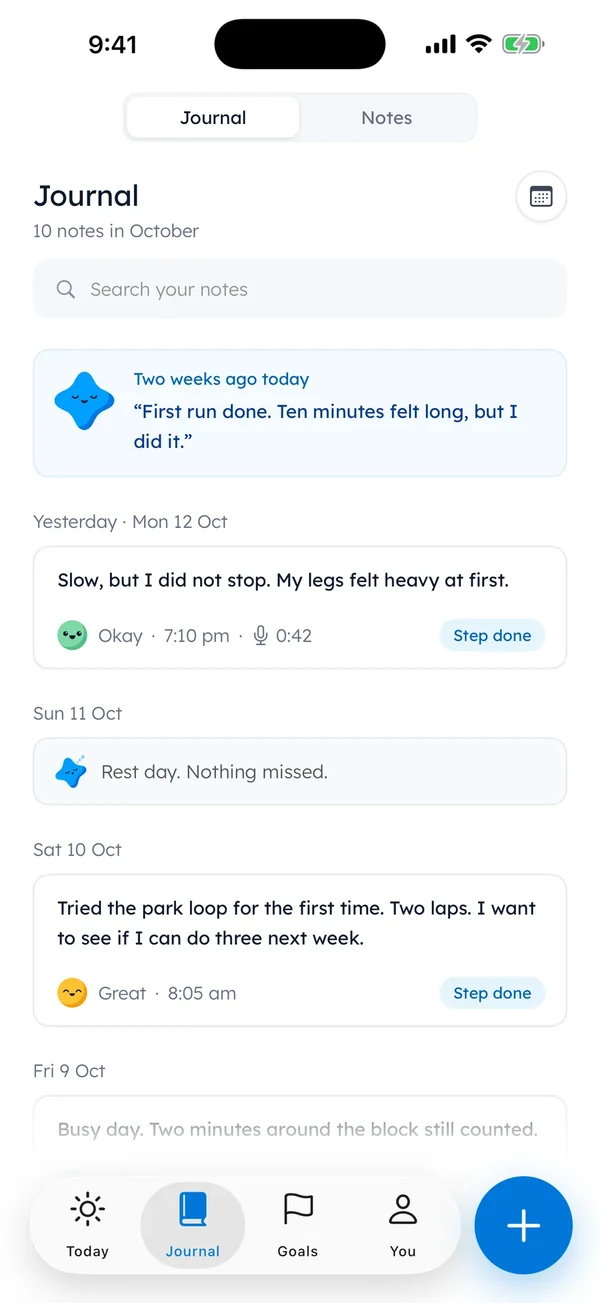
In the app, each goal has a busy-day step under the normal one. Under “Run for 10 minutes”, the Today screen says “Busy day? Run for 2 minutes.” Doing it is a full day.
Whichever you use, step 1 is the one people skip.
On a bad evening you’re tired and short on patience, which is the worst possible moment to sit down and negotiate with your own goal about what a reasonable amount would be.
Decide the small size on a calm day.
On paper, tape that note inside the front cover.
Consistency on a bad week
Picture a week where three days go sideways, starting with a late meeting on Monday and ending with a Friday where you fall asleep on the sofa with your shoes still on.
Four full days and three tiny ones. That’s a good week. It just wouldn’t sell many mugs.
Is a fully skipped day the end of it? No. That’s what never miss twice is for: one skip is an outlier, and the next day gets the minimum.
Skip once, then make the next day small.
There’s some research behind that. In a study of 96 volunteers (opens in a new tab) who repeated one daily behaviour for 12 weeks, missing one opportunity “did not materially affect” how the habit formed.
But it’s one study with a small group. Read it as encouragement, and keep the minimum day anyway.
If even the minimum feels heavy, your step is still too big. Small habits can go smaller than you’d guess.
The 26 goals in the app each come with a busy-day step that counts. After one, Mira cheers “Nice. That counts.” and Say how it went asks for a line.
There, days shown up never go down, so a gap leaves the number where it was and a bad week can’t take back the good ones you already had.
A pencil tally inside the cover works too. Nothing to erase.
Tonight
One small thing before you put the phone down.
If you’d rather have it written for you,  the Yumemira app puts a busy-day step under every goal.
Let the mug keep its slogan. Thursday has a plan now.
Questions people ask
What does consistency is key mean?
It means small efforts done often add up to more than big efforts done now and then. What matters most is how many days you show up, not how much you do on any single day.
Does consistency lead to success?
Consistency helps a good step grow, because repeats add up. It can’t choose the step for you, though. Pick something small and useful first, then repeat it, with a smaller version ready for bad days.
How do you keep going on a bad week?
Use a minimum day: a tiny version of your step that you chose in advance, like 2 pages instead of 10. Do it at a time you already stop. Then count it as a full day and write one line about it.
What is a minimum day?
A minimum day is the smallest version of your step you’d still call done, such as walking 5 minutes instead of 20. You decide it on a good day, so on a bad day you only have to do it.
Sources
TopicStaying consistent

You earned the Curious Reader badge
You read to the end. Now give your step a minimum size.
0 XP

Yumemira is an iPhone app (iOS 18 or later).
How Yumemira worksYumemira is free to start. iPhone, iOS 18 or later.