
30-day challenges
30-day challenge ideas: 60 small challenges you can start tomorrow
The short answer
Good 30-day challenge ideas are small enough for day 1: read 2 pages, walk for 5 minutes, or have one no-spend day a week. Pick one, tie it to a time you already stop, and keep it that small for a week. Then grow it a little each week until day 30.
In 30 seconds
- Pick one challenge at a time, never three.
- Give it a day-1 size and a day-30 size.
- Grow the size once a week, not every day.
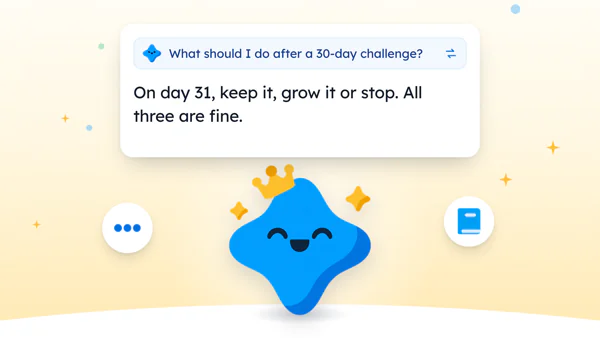
- On day 31, keep it, grow it or stop. All three are fine.
A month is a box of 30 days. You promise one month, and the calendar keeps count.
The trouble is packing the box too full on the 1st. By the 6th, it’s half unpacked in the hallway.
So these 60 ideas start small. We built an iPhone app around small steps, so we’re biased. A pen works just as well.

Reading XP0 XP
How to choose a 30-day challenge
Choose one challenge that fits into a day you’ve already got. Then shrink day 1 until it’s almost silly.
Three questions help you pick:
- What do you keep saying you’ll do? Maybe it’s the guitar in the corner.
- When would it happen? Tie it to something daily, like plugging in your phone.
- What’s the busy-day version? If it won’t fit your worst Tuesday, it’s too big.
That last question decides the size.
The point of a challenge is showing up on day 2, and on day 17, and on all the forgettable days between them that nobody photographs or posts about.
If day 1 takes more than five minutes, shrink it.
It’s the same idea behind small goals in general. A tiny start is easy to repeat, and repeating is the whole point.
Stacking challenges is the classic mistake. Each one looks small on the 1st, when the month is fresh and the calendar has nothing written on it yet.
But on a hard evening, small things add up to one big thing you skip.
For what keeps you going in week two, read how to stay consistent.
10 challenges with a day-1 and day-30 size
Here are ten good 30-day challenges, each with a start and a finish size.
The last column names the matching ready goal in our app, for anyone who’d rather skip drawing a grid by hand.
| Challenge | Day 1 | Day 30 | Ready goal |
|---|---|---|---|
| Read every day | 2 pages | 10 pages | Read |
| Walk after lunch | 5 minutes | 20 minutes | Walk |
| No-spend days | 1 a week | 3 a week | No-spend days |
| Water with every meal | 4 glasses | 8 glasses | Drink water |
| Practise an instrument | 5 minutes | 15 minutes | Practise an instrument |
| Stretch before bed | 2 minutes | 10 minutes | Stretch or yoga |
| Tidy one spot | 2 minutes | 10 minutes | Tidy up |
| Write something | 5 minutes | 15 minutes | Write |
| Call someone you love | A short hello | 2 calls a week | Call family or friends |
| Phone in another room | 10 minutes | 30 minutes | Less phone time |
Look at the day-1 column. Day 1 is a rehearsal, and nobody hands out medals at rehearsals.
And the day-30 size is a ceiling you can stop below. If week three feels right at 6 pages, then 6 pages is the challenge.
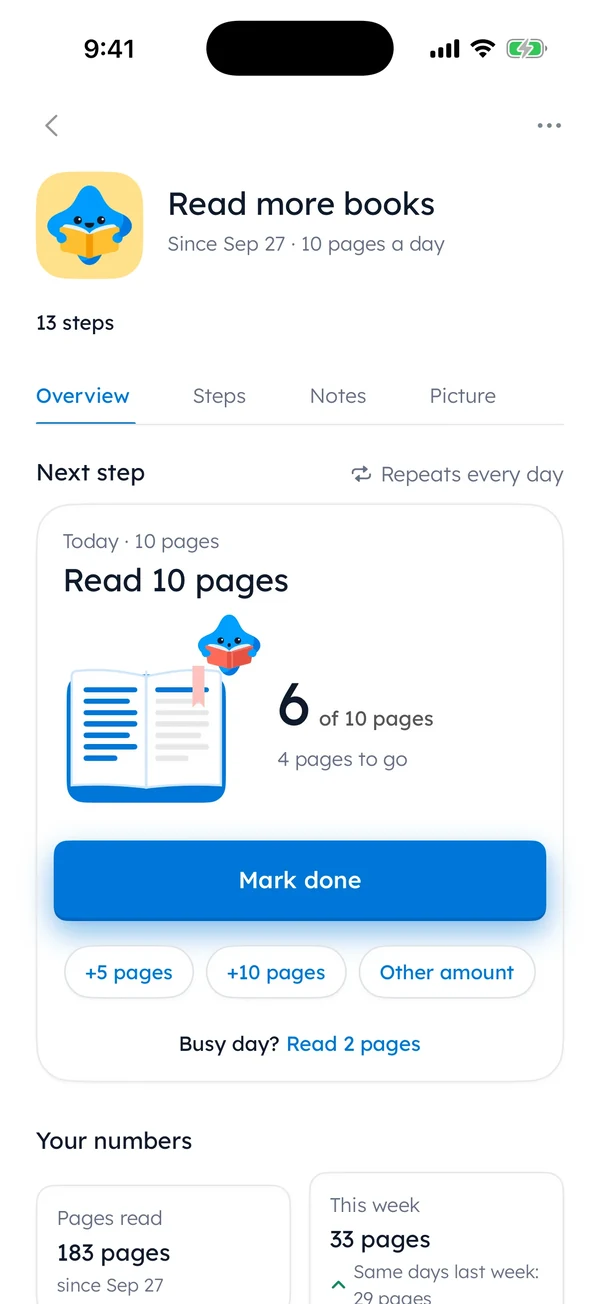
Every ready goal in Yumemira has a smaller busy-day step that counts in full.
On paper, write your busy-day size in the corner of the calendar before day 1.
60 30-day challenge ideas, sorted by area of life
Below is a 30-day challenge list in five groups of 12 ideas. Each idea gives the day-1 size first, then where it could be by day 30.
Skim until one makes you think “I could do that tonight”. That’s usually the right one.
Body: 12 challenges for moving and eating
- Walk after lunch. Day 1: 5 minutes. Day 30: 20 minutes.
- Stretch before bed. Day 1: 2 minutes on the floor. Day 30: 10 minutes.
- Take the stairs once a day. Day 1: one flight. Day 30: every flight at work.
- Wall push-ups. Day 1: 5. Day 30: 20, or move to the kitchen counter.
- A glass of water with every meal. Day 1: breakfast only. Day 30: all three meals.
- One piece of fruit a day. Day 1: put it on the counter. Day 30: eat it every day.
- Cook at home. Day 1: a simple snack. Day 30: dinner 4 times a week.
- Bring lunch from home. Day 1: pack it once. Day 30: 3 days a week.
- Step outside. Day 1: 5 minutes on the doorstep. Day 30: 20 minutes out.
- Dance in the kitchen. Day 1: one song. Day 30: a three-song playlist.
- Bike to one regular place. Day 1: pump up the tires. Day 30: twice a week.
- Swap one sweet drink. Day 1: one swap. Day 30: one swap every day.
But the body list is about actions you can count. What they do for your body is a question for your doctor, who knows it better than any list.
Calm mind: 12 challenges for slower minutes
- Three slow breaths. Day 1: once. Day 30: three times a day.
- Sit still with a timer. Day 1: 2 minutes. Day 30: 10 minutes.
- Three good things. Day 1: write one. Day 30: write three.
- Phone in another room. Day 1: 10 minutes. Day 30: 30 minutes.
- No phone at breakfast. Day 1: one breakfast. Day 30: every breakfast.
- One album, start to finish. Day 1: one song with no screen. Day 30: one album a week.
- A walk with no headphones. Day 1: to the corner. Day 30: 15 minutes.
- Look out the window on purpose. Day 1: 1 minute. Day 30: 5 minutes with tea.
- Up when the alarm rings. Day 1: once, no snooze. Day 30: every weekday.
- A screen-free hour before bed. Day 1: 10 minutes. Day 30: the full hour.
- One line about today. Day 1: three words. Day 30: one full sentence.
- Plan tomorrow on a sticky note. Day 1: one task. Day 30: the top three.
That’s the first 24. If nothing has grabbed you yet, the next groups lean toward learning and money, then home.
Learning and making: 12 challenges
- Read every day. Day 1: 2 pages. Day 30: 10 pages.
- New words in a language. Day 1: 3 words. Day 30: 10 minutes of practice.
- Practise an instrument. Day 1: one scale. Day 30: 15 minutes.
- Draw something. Day 1: one quick doodle. Day 30: 15 minutes.
- Write for yourself. Day 1: 5 minutes. Day 30: 15 minutes.
- Take one photo a day. Day 1: one photo. Day 30: one photo, picked with care.
- Learn one recipe by heart. Day 1: read it twice. Day 30: cook it without looking.
- Type faster. Day 1: one 2-minute typing test. Day 30: 10 minutes of drills.
- One short lesson a day. Day 1: 5 minutes of a free course. Day 30: 20 minutes.
- Memorize a poem. Day 1: the first line. Day 30: the whole thing.
- Study or focus. Day 1: one 10-minute timer. Day 30: two 25-minute blocks.
- Fix one small broken thing. Day 1: find the screwdriver. Day 30: the drawer finally closes.
Number 30 comes from a real 30-day challenge, told further down, and it may be the easiest one here to start tonight, since the camera is already in your pocket.
One tap a day.
Money: 12 challenges that start with small amounts
- No-spend days. Day 1: 1 a week. Day 30: 3 a week.
- Skip one small buy. Day 1: one coffee or snack. Day 30: one a day.
- Put aside a little. Day 1: $1. Day 30: $10 a week.
- Read your bank app. Day 1: last week’s spending. Day 30: a 5-minute check each Sunday.
- Cancel one thing you don’t use. Day 1: list your subscriptions. Day 30: one cancelled.
- Cook instead of ordering in. Day 1: one night. Day 30: 4 nights a week.
- Wait a day before buying. Day 1: one item in a cart. Day 30: every non-essential buy.
- Write down what you spend. Day 1: today only. Day 30: every day for a month.
- Use what’s in the pantry. Day 1: one meal from it. Day 30: one pantry meal a week.
- Sell one thing you don’t use. Day 1: take a photo of it. Day 30: three things sold.
- Carry a water bottle. Day 1: fill it once. Day 30: every time you leave home.
- Unsubscribe from shop emails. Day 1: one. Day 30: an inbox with no sales in it.
So the money group is about habits with money. A $1 day is as real as a $10 day.
People and home: 12 fun 30-day challenge ideas
- Call someone you love. Day 1: a short hello. Day 30: 2 calls a week.
- One kind message a day. Day 1: one text. Day 30: one to a different person each day.
- A compliment a day for someone at home. Day 1: one sentence. Day 30: one every day.
- Tidy one spot. Day 1: put five things away. Day 30: 10 minutes a day.
- Make the bed. Day 1: pull up the covers. Day 30: made before you leave the room.
- Clear the sink before bed. Day 1: one dish. Day 30: an empty sink every night.
- Water the plants. Day 1: check them. Day 30: a weekly round with a calendar mark.
- Eat one meal together. Day 1: one dinner at the table. Day 30: three a week.
- A board game night. Day 1: find the box. Day 30: once a week.
- Learn a neighbour’s name. Day 1: say hello. Day 30: three names you know.
- A family photo a week. Day 1: one photo. Day 30: four, printed.
- Write one thank-you note. Day 1: one line. Day 30: one note a week, posted.
The last group works well as a household challenge. Stick it on the fridge and let everyone cross off their own day.
Want more starting points beyond 30 days? There are a hundred examples of goals, each with a first step for today.
How to grow a challenge from day 1 to day 30
Grow the size once a week, never every day. Four small bumps are easier to remember than thirty.
Here’s what that looks like for a reading challenge, with the kind of line you might write at the end of each week.
| Days | Daily size | A line it might get |
|---|---|---|
| 1 to 7 | 2 pages | “Two pages. The book has a map at the front.” |
| 8 to 14 | 4 pages | “Four pages on the bus. Missed my stop, nearly.” |
| 15 to 21 | 6 pages | “Six pages. Someone in the book finally lied.” |
| 22 to 30 | 10 pages | “Ten pages, and I wanted an eleventh.” |
If a week felt hard, don’t grow it. Repeat the same size for another week.
The calendar won’t mind.
In the app, a goal can do the growing for you. Turn on Start small and grow in goal setup, and the first days start easier, with a little more as you go.
You can also set a 30-day challenge on a ready goal.
On paper, the plan fits in the margin of a wall calendar. Pencil 2, 4, 6 and 10 next to the first day of each week.
A real 30-day story, one photo at a time
The idea got a big push from a short talk. In 2011, Matt Cutts, then an engineer at Google, gave a TED talk called Try something new for 30 days (opens in a new tab).
In a 2017 interview on NPR’s TED Radio Hour (opens in a new tab), he listed some of his past challenges. They included a compliment for his wife each day and 10 minutes of ukulele.
His suggestion for a first try was small: take one picture a day for 30 days. He said it made each day easier to remember.
Two parts of that interview are worth keeping, especially if you’ve ever planned a whole year of self-improvement on January 1 and abandoned it by the second weekend.
- He’d pick the next challenge near the end of the month, with about a week left, instead of planning the whole year.
- He said a month of meditation didn’t suit him at all. Not every challenge sticks, and he said so.
“You also have to be OK with failure.”
But that’s one person’s story, in his own words. Yours will go its own way.
A challenge that didn’t stick still taught you something.
Can you build a habit in 30 days?
There’s no fixed number. Thirty days is a calendar length, and it’s handy because every month has a 1st.
One study, led by Phillippa Lally at University College London, followed 96 people as they each tried a new daily behavior.
As James Clear sums it up (opens in a new tab), the time it took to feel automatic ranged from 18 to 254 days. It depended on the person and the habit.
So day 30 is a good checkpoint.
The same summary has a kinder detail. In that study, missing one day didn’t really change the outcome.
After one missed day, do the next day’s step.
What happens on day 31?
On day 31, you get to choose: keep it, grow it, or stop. Each one is a fair ending to a month.
- Keep it if it fits into your day without a fight.
- Grow it if the day-30 size feels easy by now.
- Stop if it never fit. You learned that in 30 days, not 300.
Read back your month before you decide.
And trust the page over your memory, because thirty short lines will tell you more than the one bad Tuesday in week two that your brain keeps replaying.
But some challenges become part of the week. Others end up in a drawer next to the spare guitar strings.
Both are normal.
If you want the app to keep count while you decide,  try it in Yumemira. A goal can also run with no end date at all.
Pick next month’s challenge with a week to spare.
Tonight, before the light goes off, write tomorrow’s date and one day-1 size. The box for next month is already on the calendar, and it only needs one small thing in it.
Questions people ask
What are some ideas for monthly challenges?
Pick one small action you can repeat daily: read 2 pages, walk 5 minutes, take one photo, call someone, tidy one spot or have one no-spend day a week. Start tiny on day 1 and grow it once a week.
Do 30-day challenges actually work?
They work as a container. A month gives you a clear start and end, which makes it easier to try something. Results vary by person and by challenge, and some won’t stick. A small daily size makes it more likely you’ll reach day 30.
What are good 30-day challenges for beginners?
Start with one that takes under five minutes on day 1: two pages of a book, a short walk after lunch, a glass of water with breakfast or one photo a day. One challenge at a time is plenty.
Can you build a habit in 30 days?
There’s no fixed number of days. In one well-known study, the time for a habit to feel automatic ranged from 18 to 254 days. Use day 30 as a checkpoint for deciding what comes next.
What should I do after a 30-day challenge?
Read back what you did, then choose: keep it at the same size, grow it a little, or stop. Any of the three is fine. If you stop, pick the next challenge about a week before the new month starts.
Sources
TopicChallenges

You earned the Month Starter badge
You read all 60. Now write tomorrow’s date and your day-1 size.
0 XP

Yumemira is an iPhone app (iOS 18 or later).
How Yumemira worksYumemira is free to start. iPhone, iOS 18 or later.