
Goal ideas
Dreams and goals examples: how to turn a dream into a first step

The short answer
Dreams and goals examples work best side by side: “live by the sea” is a dream; “one Saturday a month on the coast” is a goal. To turn one into the other, pick one piece, give it a size and a day, then do a first step at a time you already stop. Keep it that small for a week.
In 30 seconds
- A dream says what you want. A goal says how much and when.
- Shrink any dream to one piece you could start this week.
- All 20 examples below end in a step small enough for tomorrow.
- Keep the dream written down, and spend your time on the step.
Picture a postcard of the sea on your fridge. One corner curls where the magnet doesn’t reach, and it’s been there long enough to fade.
That postcard is a dream. A goal is the Saturday you actually go.

Reading XP0 XP
Dreams vs goals, side by side
A dream is what you want. A goal is one part of it with a size and a day, so you can start it and tell when it’s done.
Both are useful. The dream picks the direction.
And the goal decides what you do on an ordinary Wednesday evening, when the sea is a long way off and the fridge is right there.
So how do you tell which one you’re holding? Run it through four quick tests.
| Test | Dream | Goal |
|---|---|---|
| It has a day or a date | “Live by the sea one day” | “One coast Saturday a month” |
| It has a size | “Read more” | “10 pages a day” |
| You can start it today | “Be a writer” | “Write for 15 minutes tonight” |
| You can tell when it’s done | “Get fit” | “Run 5K without stopping” |
If it passes all four, it’s a goal. No calendar slot means it’s still a dream.
For goals that already have a size, our list of examples of goals has 100 more, each with a first step.
How to turn a dream into a goal
It takes about five minutes and one sticky note. You can do it on the bus.
Name it.
Write the dream the way you’d say it to a friend: “I want to speak Spanish.” No polishing needed.
Pick one piece.
Spanish has many parts, from new words to ordering coffee in Madrid. Choose one part you could practise at home.
Give it a size.
A size and a day turn the piece into a goal: 10 minutes of Spanish a day, after dinner.
Shrink it for this week.
Cut the goal down until it fits a tired evening, like 2 minutes of practice. That’s the step you do first.
Step 4 can look a little silly. Two minutes of Spanish won’t get you through a menu by Friday.
But it gets you to day two.
And by day two, the goal starts to feel like something you do, instead of a line you once wrote on a sticky note and stuck to the side of the fridge.
20 dreams and goals examples
Each row starts with a dream and ends with a first step for this week. Copy any row onto a sticky note, and find 12 more by area under it.
| Dream | Goal | First step this week |
|---|---|---|
| Live by the sea | One coast Saturday a month | Pick the date |
| Write a book | Write 15 minutes a day | Write for 5 minutes |
| Run a marathon one day | Run 20 minutes, 3 times a week | Run for 10 minutes |
| Travel to Japan | Save for the trip, $10 a week | Put $1 in a trip fund |
| Speak Spanish | Practise 10 minutes a day | Practise for 2 minutes |
| Play the guitar | Practise 15 minutes a day | Practise for 5 minutes |
| Read 100 books | Read 10 pages a day | Read 2 pages |
| Be closer to family | Call home twice a week | Send a short hello |
Seven of these rows use real numbers from Yumemira, the small-steps goal journal for iPhone. The goal is where a ready goal starts, and the first step is its busy-day step.
We make the app, so we’re not neutral here. A sticky note on the fridge works just as well.
In the app, the dream can be the goal’s name. Call it “Run my first 5K”, and the Today screen shows Run for 10 minutes, with a Mark done button under it.
Tap it when the run is over. Mira cheers, and you can write one line about how it went. On paper, that’s two columns: the step, and one line about it.
Home
- “A calm home” becomes 10 minutes of tidying a day. First step: clear the chair with the laundry on it.
- “Grow my own food” becomes one pot of basil on the windowsill, watered daily. First step: buy the pot.
Work
- “Start my own business” becomes one hour on the idea every Sunday morning. First step: write the idea in one sentence.
- “Get a better job” becomes one application a week. First step: rewrite the top line of your résumé.
People
- “Have real friends in a new city” becomes one invitation a week. First step: ask one person from work to lunch.
- “Cook for the people I love” becomes 4 home-cooked meals a week. First step: make a simple snack at home.
Learning
- “Learn to draw” becomes 15 minutes of drawing a day. First step: draw the mug on your desk for 5 minutes.
- “Cook my grandmother’s dishes” becomes one family recipe a month. First step: call and ask for the first one.
Money
- “Have a money cushion” becomes $10 saved a week. First step: put aside $1.
- “Spend less on things I don’t need” becomes 3 no-spend days a week. First step: skip one small buy.
Travel
- “Visit every national park in my country” becomes one park a year. First step: pick this year’s park.
- “Live abroad for a year” becomes a one-month stay first. First step: write down two cities and one reason for each.
When the dream is too big for a week
What about a dream like “write a novel”? Even at 15 minutes a day, it can feel like eating a wedding cake with a teaspoon.
That’s fine. The dream doesn’t have to get smaller. Only this week’s piece does.
So keep the dream at the top of the sticky note and the small step underneath. Shrink the step, and keep the dream’s name.
In Yumemira, Make your own lets you name a goal after any dream and count it your way, in minutes, pages or a number in your own word.
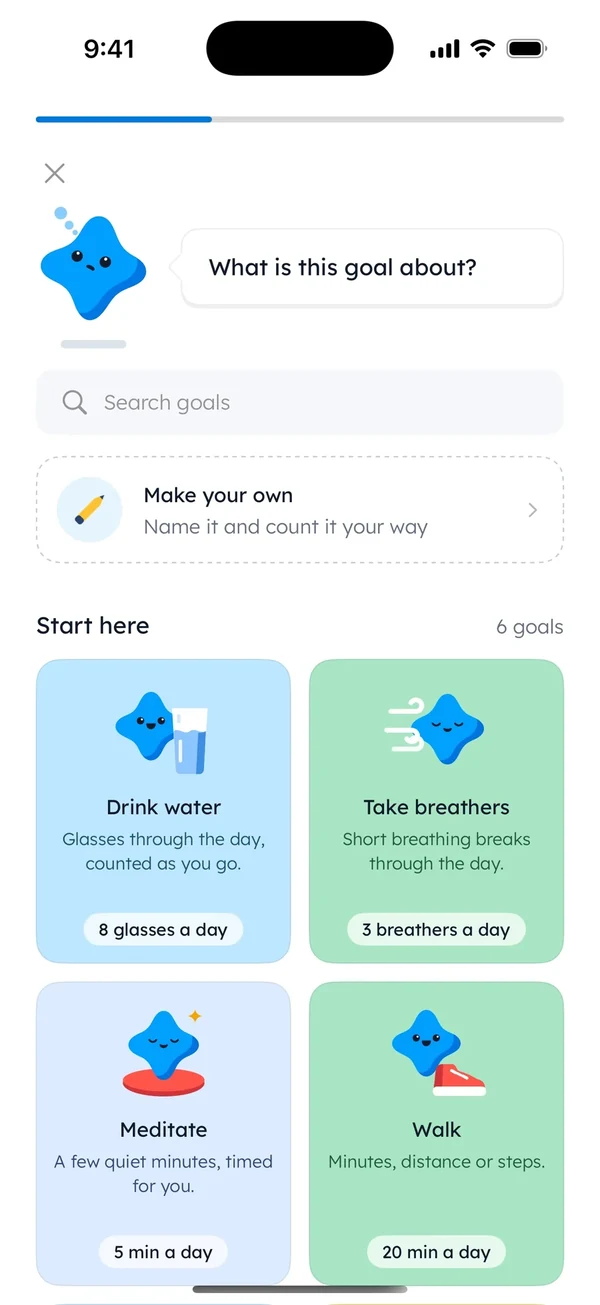
Or start from one of the 26 goals, or make your own.
The step can grow later, little by little, once it feels too easy. Our guide to small goals shows how to size one.
For dreams that take years, these life goals examples work the same way.
Small goals, big dreams, and the slow weeks
Some weeks the step doesn’t happen at all. Work runs late, and the guitar sits in its case looking slightly offended.
It helps to have a busy-day step ready before you need it: 2 pages instead of 10, a short hello instead of a long call.
Decide the busy-day step on a good day.
Then on a hard day, you only have to do it.
Write one dream down tonight
You don’t need a planner or a free weekend to begin. One dream and one step will do for now.
Then look at the postcard and write a Saturday under the magnet.
Questions people ask
What is the difference between a dream and a goal?
A dream is something you want with no size attached, like “live by the sea”. A goal is one piece of it you can measure and schedule, like one Saturday a month on the coast. You can start a goal this week.
What are some examples of dreams and goals?
“Write a book” is a dream, and writing 15 minutes a day is a goal. “Speak Spanish” is a dream, and 10 minutes of practice a day is a goal. “Travel to Japan” is a dream, and saving $10 a week for the trip is a goal.
How do you turn a dream into a goal?
Name the dream and pick one piece you could work on at home. Give that piece a size and a day. Then cut it down to a first step small enough for a tired evening, and do it this week.
Can a dream be a goal?
Yes, once it has a size and a when. “Run a marathon one day” stays a dream until it becomes something like three 20-minute runs a week. Keep the dream as the name, and let the goal do the weekly work.
TopicGoal ideas

You earned the Dream Sized badge
You read all 20. Now write one dream and its first step.
0 XP

Yumemira is an iPhone app (iOS 18 or later).
How Yumemira worksYumemira is free to start. iPhone, iOS 18 or later.